Budget Self-Cleaning Litter Boxes: A Data Shortlist
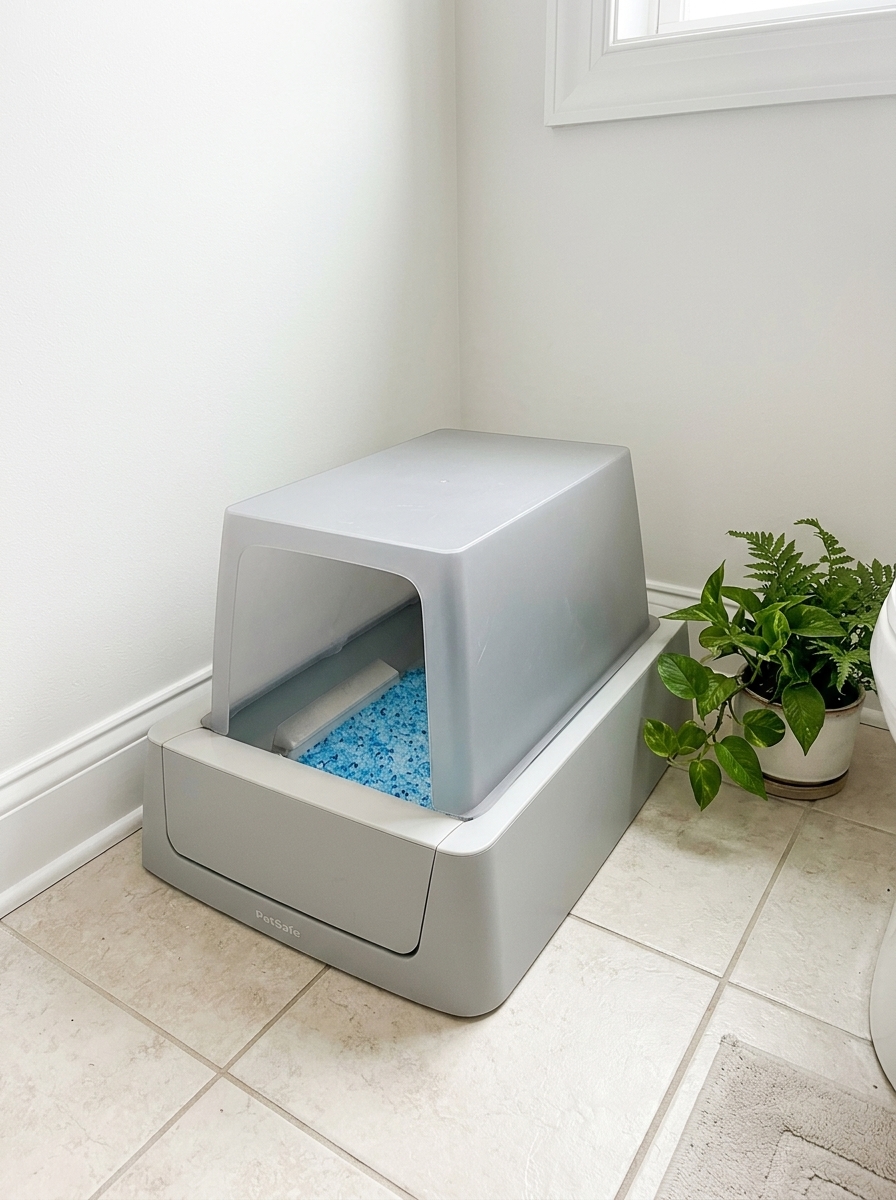
The six lowest tracked purchase prices in the category, $219.99–$359.99. Best score under $300: PetSafe ScoopFree Crystal Smart at 8.4/10.
Lab 01: Pet Tech · Automatic Litter Boxes
Email me when Litter-Robot 4 drops to my target price. The confirmation includes a manage link — use it any time to list or remove your alerts at Your price alerts. Lowest price tracked so far: USD 699.00 — a target below that is below the historical low and less likely to be reached.
Affiliate disclosure: AIBuyLab may earn a commission from qualifying purchases made through links on this page, at no extra cost to you. Prices and specifications below are drawn from manufacturer documentation and retailer listings checked on November 26, 2026, and may change.
Our pick: Litter-Robot 4 — check the current price at the retailer.
An automatic (self-cleaning) litter box is a motorized appliance that separates waste from clean litter after each visit, using a rotating globe, a rotating drum, a raking mechanism, or a sifting basket, so the owner empties a sealed waste drawer every few days instead of scooping daily. A fail-safe design is one whose failure state is the safe state: if the electronics, sensors, or power supply stop working, the machine should default to a condition in which a cat can always get out and the moving parts cannot close on an animal. That distinction — safety that depends on software working correctly versus safety built into the hardware geometry — runs through the current debate about enclosed rotating boxes, and is the right lens for comparing any two models.
The safety conversation around enclosed rotating litter boxes is not new, and nothing in the last two weeks changed it: a scan of recall and safety news for November 12–26, 2026 found no new recalls for pet tech or cleaning appliances. What keeps the topic current is design news. On November 12, 2026, PETKIT announced the Purobot Max 3 in Japan (Ueni Trading / PR TIMES release; the model went on sale there November 13), leading with a fail-safe claim: the entry remains open even if sensors fail or power is lost. Short-form videos from pet accounts have been circulating the same "what happens if every sensor dies?" test since early November. Meanwhile, older reporting about generic, no-name fully enclosed rotating boxes — still widely cited in 2026 roundups — is why buyers keep asking whether an enclosed chamber can trap a cat. Those reports concern unbranded units, not the named models below, but the question is legitimate for any enclosed design: what happens on the worst day, not the average day?
The PETKIT Purobot Max 3 is the clearest current example of hardware-first safety. According to PETKIT's product FAQ, the drum uses an incomplete gear — the cylinder never completes a full rotation — so, in PETKIT's words, "there is a permanent opening no matter what" and a cat "will never be trapped," even with no power and no functioning sensors. That claim is backed by 12 sensors for normal operation (per PETKIT's product documentation), but the important point is that the exit does not depend on any of them. The Max 3 identifies cats by weight rather than camera — PETKIT's own comparison notes the Max 3 has no camera, and differentiates cats by weight and usage frequency — and it carries a 7 L sealed side waste bin. It launched at a list price of $499.99 and was listed at $375.99 on petkit.com when checked on November 26, 2026. PETKIT rates it for cats from 1.5 kg to 10 kg and at least 6 months old, which matters for checklist point 3 below.
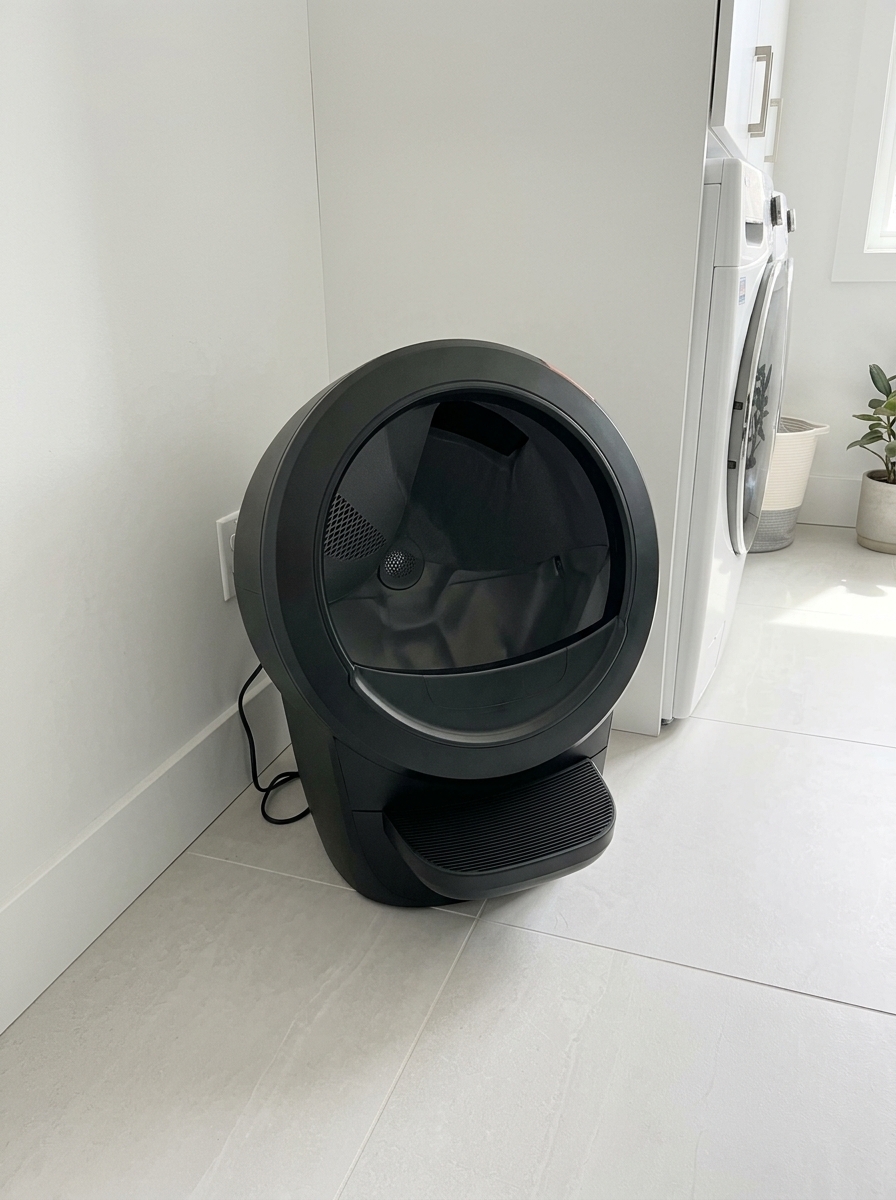
Contrast that with the more common architecture in enclosed boxes: a fully rotating globe or drum whose safety rests on sensors detecting the cat and halting the cycle. The Litter-Robot 4, which scores 6.9 in our catalog, is representative of the established end of this class: a rotating globe with anti-pinch sensing and weight-based cat detection, from a manufacturer with a long track record in the category. Sensor-based systems from reputable brands are engineered and certified with those failure modes in mind — but the safety case you are asked to accept is "the sensors will work," whereas the Max 3's case is "the geometry cannot close." Both are arguments; they are not the same argument, and buyers should know which one a given model is making.
The other way to dissolve the trapping question is to remove the enclosure. The Petlibro Luma uses an open-top design — a rotating sifting basket with no enclosed drum a cat can be sealed inside. Per Petlibro's documentation, the Luma runs four pre-cleaning safety checks (camera, infrared, and weight sensing confirm the cat has left) before a cycle starts, and pauses if a cat approaches mid-cycle.
Here is where source discipline matters. A 2026 safety-ranking video from the YouTube channel The Cat Butler placed the Luma last in that channel's own testing, reporting that in its contact test the rotating basket did not stop as the tester expected. That is a single creator's test, conducted under that channel's own protocol; it is not a regulatory finding, not a recall, and not something we can treat as established fact about every Luma unit. It is, however, exactly the kind of signal a buyer should weigh alongside manufacturer documentation — and it underlines why checklist point 2 (redundant, independent sensing) and point 4 (a way to stop the machine) matter even for open-top designs. Manufacturer claims tell you how a system is supposed to behave; independent tests, even imperfect ones, are the only public check on how it does behave.
1. Can the cat always get out — with the power off? Ask what the entry looks like at the worst moment. A permanent opening (Max 3, per PETKIT's FAQ) or an open top (Luma, per Petlibro) answers this structurally. For a fully enclosed globe, look for the manufacturer's explicit statement of what happens on power loss mid-cycle, not just during normal operation.
2. Is the sensing redundant, or is one sensor doing everything? Count the independent inputs: weight, infrared presence, motor-current/pinch detection, camera. The Max 3 documents 12 sensors; the Luma documents a four-part pre-cycle check across three sensor types. A single weight sensor between your cat and a moving drum is a thin margin.
3. What is the minimum weight and age — and is it enforced? Kittens are the highest-risk users: too light to trigger weight sensors reliably. PETKIT specifies 6+ months and 1.5–10 kg for the Max 3; Petlibro specifies cats from 2.2 lb (1 kg) for the Luma and directs owners of kittens under 6 months to manual mode. If the manual gives a minimum, treat it as a hard limit, and prefer models with a kitten/manual mode that disables automatic cycling entirely.
4. Is there a physical stop? An app pause button is software. Look for a physical power switch or button on the unit, and check whether the cycle can be interrupted by pressing on the unit itself. If the documentation only describes app control, note that as a gap.
5. Open-top or enclosed — which trade-off fits your cat? Enclosed globes contain odor and suit cats that want privacy, but they are the designs at the center of the trapping debate and depend most on their sensor stack. Open-top designs remove the enclosure question and are easier to inspect at a glance, but offer less odor containment and may not suit shy cats. Neither is automatically safer; the question is whether the specific model's failure behavior is documented.
6. What does the machine tell you when something is wrong? Look for fault alerts (jam, sensor error, drawer full) pushed to the app in real time, and check whether a fault stops the cycle or merely logs it. A box that silently retries a jammed cycle is worse than one that stops and complains.
7. What does the manual actually promise? Before buying, download the manual and search it for "power failure," "pinch," "sensor," and the minimum weight. Marketing pages summarize; manuals commit. If the manual is silent on power-loss behavior, that silence is information — factor it into the decision or ask the manufacturer directly.
The Max 3 is the strongest documented performer on point 1, with mid-pack marks elsewhere: no camera means its cat differentiation is weight-based only, and PETKIT does not publish a maximum cat count. The PETKIT PuraMax 2, which scores 6.7 in our catalog, shares the family's drum format with a 7 L waste bin and a notably quiet 35 dB cycle, and is worth comparing if the Max 3's price or availability does not suit — run the same seven questions against its manual rather than assuming the newer model's answers carry over. The Litter-Robot 4 remains the benchmark enclosed globe: its safety case rests on its sensor suite and the manufacturer's category track record rather than on a permanent opening, so points 2, 4, and 7 are where a buyer should focus. The Luma answers point 1 by design and documents a thorough pre-cycle check, with one creator's contrary test result on the record — a reason to read owner reports carefully, not a reason to dismiss or to condemn the model outright.
Where to buy: Litter-Robot 4 · PETKIT PuraMax 2 — retailer links run through our /go/ tracker; the product pages track prices daily.
Are automatic litter boxes safe for kittens? Only within the manufacturer's stated limits. Manufacturers of the models above specify minimum ages (6 months for the PETKIT Max 3, per PETKIT) and minimum weights, because a kitten below the weight threshold may not register on the sensors that gate the cycle. Below the limit, use manual mode or a conventional box.
What happens to an enclosed litter box in a power outage? It depends on the design, which is precisely the point of the checklist. PETKIT documents that the Max 3's incomplete-gear drum leaves a permanent opening with no power at all. For other enclosed models, the answer is whatever the manual says about power-loss behavior — check point 7 before buying rather than assuming.
Has any automatic litter box been recalled recently? No new recalls for pet tech or cleaning appliances appeared in the November 12–26, 2026 window we scanned, and the long-running safety discussion concerns older reports about generic unbranded enclosed units. Absence of a recall is not proof of safety, but there is no new recall event behind the current round of safety content.
Should I trust safety-ranking videos? As one input, with the source labeled. The Cat Butler's ranking of the Luma is a single channel's test under its own protocol — useful as a prompt to check the manual and owner reports, not a substitute for either. Weigh manufacturer documentation, independent testing, and owner reports together, and notice when a claim traces back to only one of the three.
Is open-top automatically safer than enclosed? No. Open-top designs remove the trapping scenario, but they still have moving parts, sensors, and failure modes. Enclosed designs from established manufacturers carry extensive sensor stacks. The checklist — exit, redundancy, thresholds, stop, alerts, documentation — predicts more than the silhouette.
Does the PETKIT Max 3 have a camera? No. Per PETKIT's own comparison material, the Max 3 differentiates cats by weight and usage patterns; the camera-equipped model in the line is the Purobot Max Pro 2.
Last updated: November 27, 2026
November 27, 2026 — Added retailer buying links (Our pick and Where to buy) for the products covered in this article.
The six lowest tracked purchase prices in the category, $219.99–$359.99. Best score under $300: PetSafe ScoopFree Crystal Smart at 8.4/10.
The six lightest tracked boxes by published unit weight (5–10.35 kg) — a stated proxy, because makers do not publish footprints consistently. Lightest: ChillX AutoEgg.
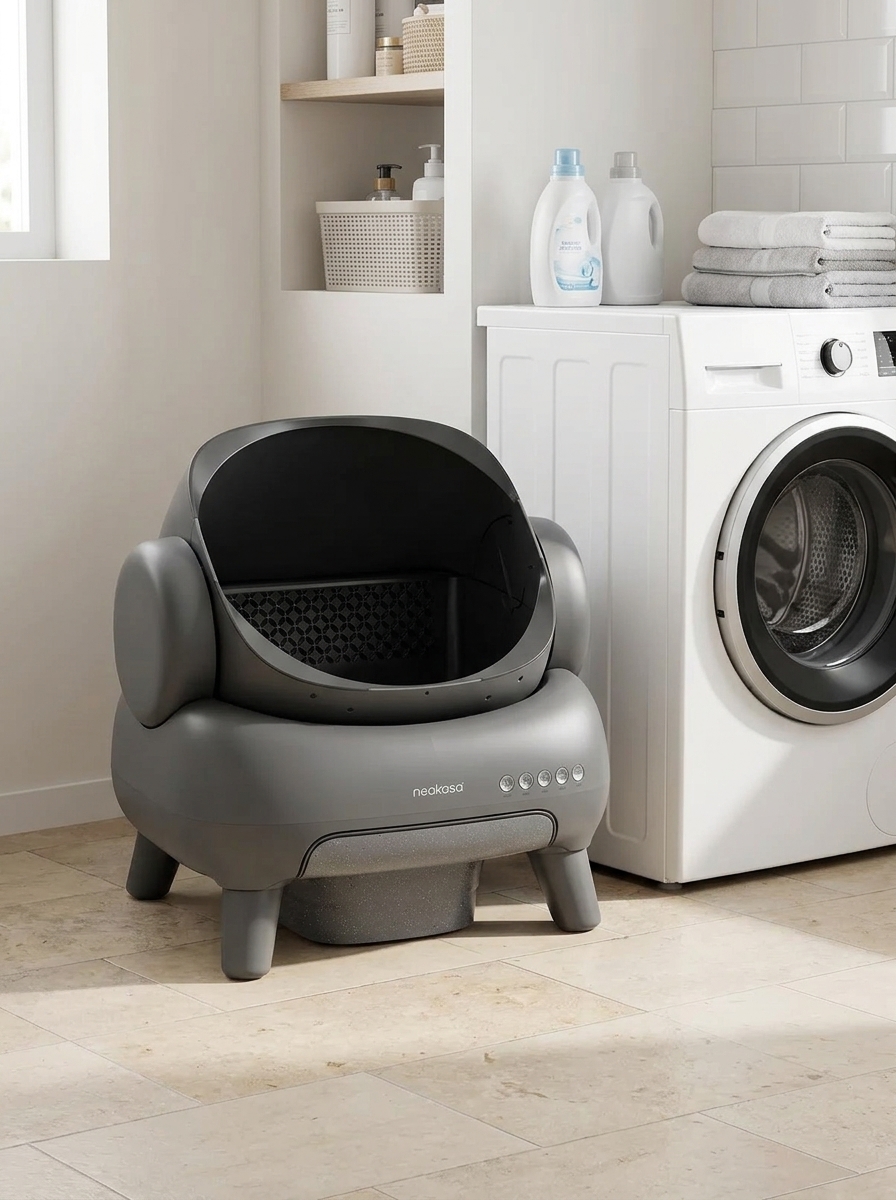
8 boxes meet the multi-cat rule (maker-rated for 2+ cats, or a waste drawer of 10 L+ where no rating is published), ranked by Score v1.0. Top: Neakasa M1 at 8.5/10.
PETKIT PuraMax 2 by the numbers: Score v1.0 6.7/10 (#9 of 16 in its category), owner rating 4.20/5 from 2,729 reviews, tracked from $380.99.
Discussion
No comments yet