

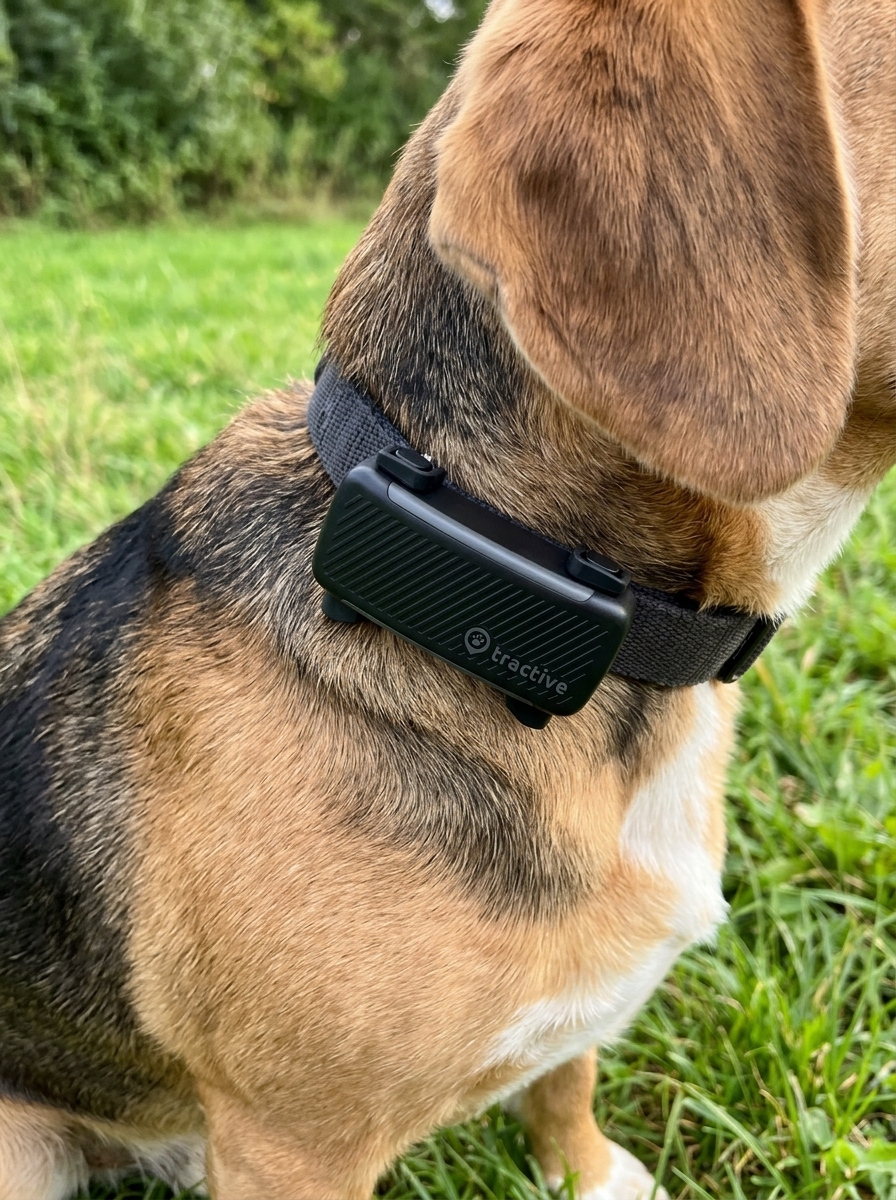
Tractive GPS Tracker for Dogs (DOG 6) by the Numbers: A Data Profile
Tractive GPS Tracker for Dogs (DOG 6) by the numbers: Score v1.0 7.3/10 (#3 of 15 in its category), owner rating 4.10/5 from 116 reviews, tracked from $48.30.
Lab 01: Pet Tech · GPS Trackers for Dogs
Email me when Fi Series 3+ drops to my target price. The confirmation includes a manage link — use it any time to list or remove your alerts at Your price alerts. Lowest price tracked so far: USD 129.00 — a target below that is below the historical low and less likely to be reached.
Affiliate disclosure: AIBuyLab may earn a commission when you buy through links on this page, at no extra cost to you. This comparison is desk research based on our product catalog and published manufacturer specifications — we did not hands-on test either collar, and every figure below comes from the catalog data cited in the tables.
Our pick: Fi Series 3+ vs Halo Collar 5 — check current prices at the retailers.
A GPS pet collar is a collar-mounted unit that combines satellite positioning (GPS) with a cellular connection, so the collar can report the dog's location to a phone app from anywhere with cell coverage — not just within Bluetooth or Wi-Fi range. Because the cellular link is a paid network service, this class of device almost always requires an ongoing subscription; without one, the collar cannot phone home.
Within that class, though, there are two different jobs:
The Fi Series 3+ is the tracker in this pairing. The Halo Collar 5 is the containment collar. Both list virtual fence features and activity tracking in our catalog, which is exactly why they get cross-shopped — but the spec sheet shows how differently each one spends its design budget.
Spec | Fi Series 3+ | Halo Collar 5 |
|---|---|---|
AIBuyLab Score (v1.0) | 3.3 | 1.7 |
Primary job | GPS tracking | GPS containment / fence training |
Positioning | GPS + cellular | GPS + cellular |
Battery life | 90 days | 2 days |
Device weight | 77 g | 130 g |
Virtual fence | Yes | Yes |
Activity tracking | Yes | Yes |
App control | Yes | Yes |
Waterproof rating | Not specified in our catalog | IP67 |
Warranty | 1 year | Not specified in our catalog |
Subscription | Required | Required |
Ninety days versus two days is not a marginal difference — it is a 45× gap, and it dictates how each collar fits into your life.
The Fi Series 3+, at a rated 90 days per charge, needs charging roughly four times a year. That is what makes it viable as an always-on tracker: the chance that it is dead on the one day your dog gets out is low, provided you keep even a loose charging routine.
The Halo Collar 5, at a rated 2 days per charge, demands near-daily charging discipline. Miss a charge and the fence goes down with the battery. That is a manageable routine if the collar is part of a structured containment setup — the dog wears it during yard time and it charges on a schedule — but it is a poor fit for anyone expecting a fit-and-forget device.
Weight tells the same story. At 77 g, the Fi is the lighter all-day wear. At 130 g, the Halo is a substantially heavier unit, consistent with a collar built to do fence work rather than disappear on the dog's neck.
Both collars require a subscription, and in our catalog both carry a tracked monthly figure. The arithmetic over a three-year ownership window:
Cost | Fi Series 3+ | Halo Collar 5 |
|---|---|---|
Tracked subscription | $14.13/month | $9.99/month |
Per year | $169.56 | $119.88 |
Over 3 years | $508.68 | $359.64 |
The Halo's subscription is cheaper — $4.14/month less, which adds up to $149.04 less over three years. That is a real saving, but weigh it against what the money buys in each case: with the Fi, the higher monthly fee rides on a collar that stays charged for a season at a time; with the Halo, the lower fee buys into a system you must charge almost daily to keep the fence alive. Neither subscription is optional on either device, so this is a fixed cost of ownership for both, not an upsell to dodge.
Both of these collars score low in our system — 3.3 for the Fi Series 3+ and 1.7 for the Halo Collar 5 under Score v1.0. Stated plainly: the rating component behind those scores is thin for this product class, so treat the 3.3 vs 1.7 gap as weak evidence. The spec gap — 90 days of battery versus 2, 77 g versus 130 g, and two genuinely different jobs — is the strong evidence in this comparison, and it is what the verdict below is built on.
Choose the Fi Series 3+ if your fear is the escape: a dog that digs under fences, slips leads, or travels with you to unfamiliar places. Tracking is its job, the 90-day battery means it will almost certainly be alive when you need it, and at 77 g it is the easier all-day wear. Accept the higher subscription — $14.13/month, $508.68 over three years — as the price of that readiness.
Choose the Halo Collar 5 if your problem is a boundary: a yard without a physical fence and a dog you intend to train to GPS-defined lines. Containment is its job, and its virtual fence system is the point of the purchase. Accept the discipline it demands — charging roughly every day or two, without exception — and the heavier 130 g build. Its subscription is the cheaper of the two at $9.99/month, $359.64 over three years.
Skip both if you are hoping one collar quietly does both jobs with no routine on your part. The tracker cannot train a boundary, and the containment collar's 2-day battery makes it an unreliable escape locator. Decide which failure you are actually trying to prevent — a dog you cannot find, or a dog that will not stay — and buy for that job first.
Where to buy: Fi Series 3+ · Halo Collar 5 — retailer links run through our /go/ tracker; the product pages track prices daily.
Is the Halo Collar 5 just a tracker with a fence feature? No. Both collars list a virtual fence in our catalog, but the Halo is built as a containment and fence-training system — that is its primary job. The Fi Series 3+ is built as a tracker. The spec sheet backs this up: the Halo's 2-day battery suits a collar that comes off and charges on a routine, while the Fi's 90-day battery suits a collar that stays on.
How often will I actually charge each collar? At the rated figures: the Fi Series 3+ roughly four times a year (90 days per charge), and the Halo Collar 5 close to daily (2 days per charge). Real-world battery life varies with use, but the order-of-magnitude difference — weeks versus days — is the planning number that matters.
Can I use either collar without the subscription? No. Both require a subscription in our catalog — $14.13/month tracked for the Fi Series 3+ and $9.99/month tracked for the Halo Collar 5. The cellular connection that lets the collar report location from anywhere is what the subscription pays for, so budget it as a fixed ownership cost: $508.68 versus $359.64 over three years.
Which collar suits a small dog better? On the figures we track, the Fi Series 3+ is the lighter unit at 77 g versus the Halo's 130 g, and its 90-day battery also means less handling. Our catalog does not track a minimum dog weight for either model, so check the manufacturer's sizing guidance for your dog before buying either.
Why are both scores so low — are these bad products? Not necessarily. Under Score v1.0 both collars land low (3.3 and 1.7), and the rating component for this class is thin, which makes the scores a weak signal. Judge this pairing on the specs that are solid: battery life, weight, the subscription arithmetic, and — above all — which of the two jobs you need done.
Does the Halo's IP67 rating make it the better choice for a dog that swims? The Halo Collar 5 carries an IP67 waterproof rating in our catalog; our catalog does not specify a waterproof rating for the Fi Series 3+. If water exposure is a deciding factor for you, that is a point in the Halo's column — but it does not change the battery math, which still favors the Fi for tracking duty.
Last updated: November 27, 2026
November 27, 2026 — Added retailer buying links (Our pick and Where to buy) for the products covered in this article.
Tractive GPS Tracker for Dogs (DOG 6) by the numbers: Score v1.0 7.3/10 (#3 of 15 in its category), owner rating 4.10/5 from 116 reviews, tracked from $48.30.
Of 15 tracked GPS trackers, 10 require a subscription ($5.00–$16.50/mo). Cheapest first year for true cellular GPS: Tractive GPS Tracker for Dogs (DOG 6) at $108.30. 3 models skip the subscription at a higher upfront price; 2 are Bluetooth tags, not GPS.
As of 2026-11-27, this ranking covers pet-worn GPS trackers only: 12 models from 9 brands, scored with Score v1.0 from owner ratings, spec strength and three-year ownership cost. Bluetooth item finders (Tile Mate, Apple AirTag) and the Cube GPS tracker are not pet trackers — they live in their own Item Trackers category and never rank here.
Both trackers score an identical 6.3 in our catalog (Score v1.0), and that tie is almost meaningless — they are built for different animals, different terrain, and different owners. - The [Tractiv
Discussion
No comments yet