
Tractive GPS Tracker for Dogs (DOG 6) by the Numbers: A Data Profile
Tractive GPS Tracker for Dogs (DOG 6) by the numbers: Score v1.0 7.3/10 (#3 of 15 in its category), owner rating 4.10/5 from 116 reviews, tracked from $48.30.
Lab 01: Pet Tech · GPS Trackers for Dogs
Email me when Invoxia Pet GPS Tracker (Biotracker) drops to my target price. The confirmation includes a manage link — use it any time to list or remove your alerts at Your price alerts. Lowest price tracked so far: USD 99.99 — a target below that is below the historical low and less likely to be reached.
Affiliate disclosure: AIBuyLab may earn a commission when you buy through links on this page, at no extra cost to you. This article is desk research: we compared the two trackers using manufacturer specifications and our own catalog data. We did not hands-on test either device, and nothing below is based on personal use.
Our pick: Invoxia Pet GPS Tracker (Biotracker) vs Fi Series 3+ — check current prices at the retailers.
A GPS-cellular pet tracker is a small collar-mounted device that combines a GPS receiver with a cellular radio. The GPS half works out where your dog is; the cellular half sends that position to an app on your phone, so you can see the location from anywhere with mobile coverage rather than only when you are within Bluetooth range. Because the tracker is continuously reporting position, both devices in this comparison also layer on software features built from that data stream: activity tracking (a daily record of movement), app control (settings and alerts managed from your phone), and a virtual fence — a boundary you draw on a map that triggers an alert if the tracker crosses it. The trade-off for all of that connectivity is a subscription: the cellular connection is a recurring service, so neither of these trackers works on a buy-once basis.
Spec | Invoxia Pet GPS Tracker (Biotracker) | Fi Series 3+ |
|---|---|---|
AIBuyLab catalog Score | 4.1 | 3.3 |
Positioning | GPS-cellular | GPS-cellular |
Battery life | ~15 days | ~90 days |
Device weight | 37 g | 77 g |
Water resistance | IP67 | Not tracked in our catalog |
Activity tracking | Yes | Yes |
App control | Yes | Yes |
Virtual fence | Yes | Yes |
Subscription required | Yes | Yes |
Subscription (our catalog) | $10.83/month | $14.13/month |
Subscription, 3-year total | $389.88 | $508.68 |
The 3-year totals are simple arithmetic on the monthly figures tracked in our catalog ($10.83 × 36 and $14.13 × 36); they assume the monthly price stays flat, which no provider guarantees.
The single largest gap between these two trackers is battery life, and it is not close. The Fi Series 3+ runs about 90 days between charges. The Invoxia Biotracker runs about 15. In practical terms, the Fi asks you to think about charging roughly four times a year; the Invoxia asks about twice a month — around 24 charging cycles a year, every year you own it.
That difference changes who each tracker suits. A 90-day battery forgives forgetfulness: if charging the collar slips your mind for a week, or three, the tracker keeps reporting. A 15-day battery does not forgive much. Miss the low-battery window by a few days and the device can go dark — and a tracker that is off is just collar weight. Owners who know they are bad at charging routines should weight this spec heavily, because it is the one most likely to decide whether the tracker is working on the day it actually matters.
The Invoxia's defense is that its shorter battery is the price of its size, which brings us to the other side of the trade.
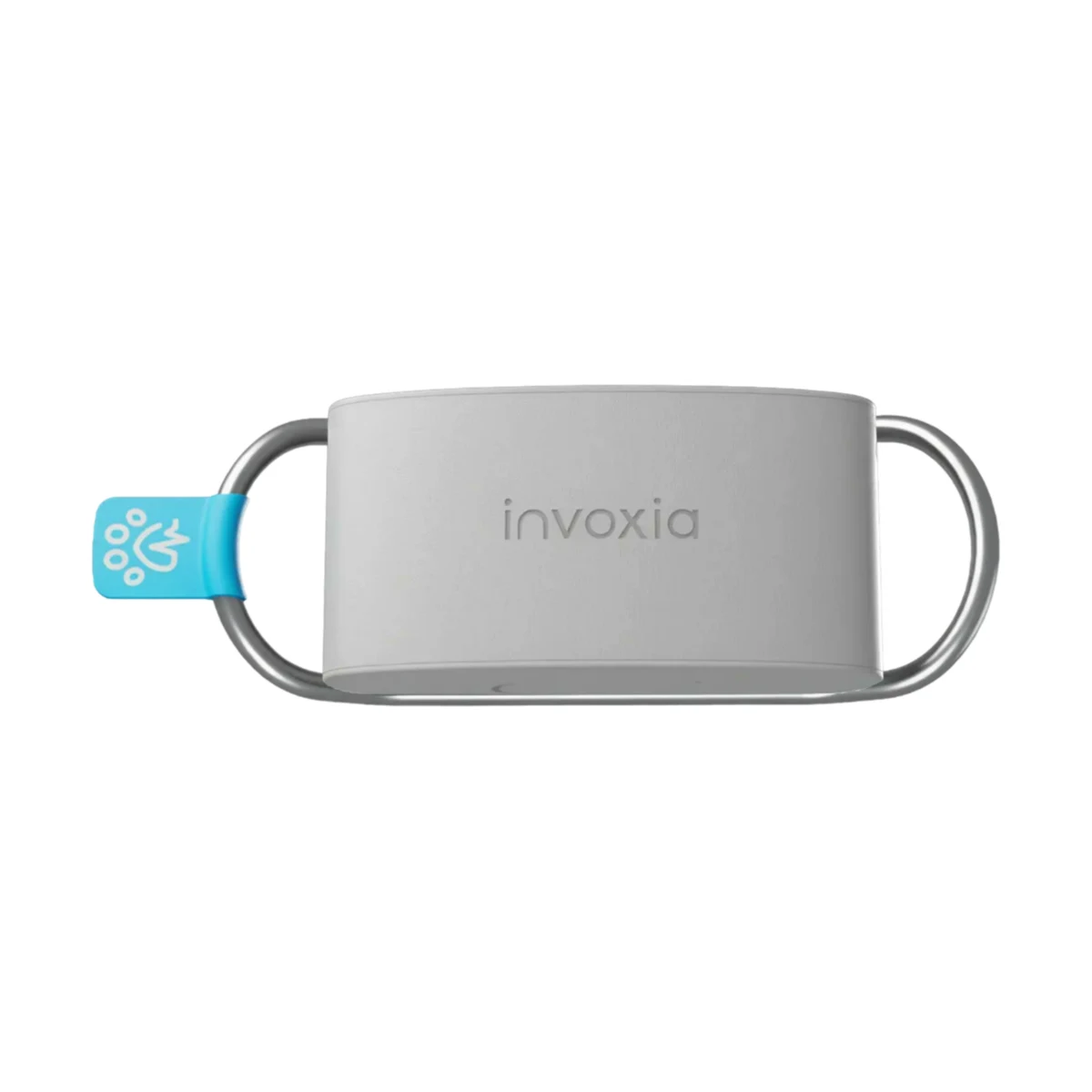
The Invoxia weighs 37 g. The Fi weighs 77 g — a little over twice as much, a difference of 40 g hanging from the collar.
On a large dog, 40 g is background noise; a big, broad-necked dog will not notice either device. On a small dog, the calculus flips. Tracker weight is usually judged relative to the dog wearing it, and a device that is trivial on a 30 kg dog can be a genuine burden on a 5 kg one. If your dog is small, the Invoxia's 37 g build is a real, physical advantage that no software feature cancels out — and it pairs with an IP67 water-resistance rating in our catalog data, so it is built to shrug off rain and splashes.
So the headline trade is clean: the Fi gives you six times the battery at twice the weight; the Invoxia gives you half the weight at a sixth of the battery.
Both trackers require a subscription, so the monthly fee is not an optional extra — it is part of the real cost of ownership, and over a typical multi-year ownership span it adds up to more than pocket change.
Per the figures tracked in our catalog, the Invoxia's subscription is $10.83/month and the Fi's is $14.13/month. That is a $3.30 monthly gap. Stretched over three years, it becomes $389.88 for the Invoxia against $508.68 for the Fi — the Invoxia saves you $118.80.
Neither subscription buys you a different feature set on paper: both devices offer activity tracking, app control, and virtual-fence alerts. So the Fi's higher fee is not paying for extra headline features in our catalog data; it is bundled with the hardware proposition of the 90-day battery. Whether that battery is worth $118.80 extra over three years depends entirely on how much you trust yourself to charge the Invoxia twice a month, every month.
It is fair to ask why the Fi Series 3+ carries a lower catalog Score (3.3) than the Invoxia (4.1) when it wins the battery comparison so decisively.
The honest answer is that our Score is a weighted view across the whole spec sheet, not a battery contest. Weight class is one of the things it weighs: at 77 g, the Fi is a heavy device in a category where grams sit on a dog's neck all day, and that drags its score down even though the same physical bulk is presumably what makes the 90-day battery possible. The Invoxia, at 37 g with an IP67 rating, presents a lighter, more universally wearable package, and the scoring reflects that.
Treat the Score as a summary of trade-offs, not a verdict. If battery life is your dominant concern — and for escape-prone dogs owned by forgetful chargers, it reasonably could be — the lower-scored device here may still be the right one for you. The sections above exist precisely so you can re-weight the specs by your own priorities.
Choose the Fi Series 3+ if you are a forgetful charger, your dog is big enough that 77 g is irrelevant, and you want the tracker to simply keep working for a season at a time. The 90-day battery is the strongest single spec in this comparison, and for a large dog with any escape history, reliability of coverage beats a modest subscription saving. You will pay $508.68 in subscription over three years for that peace of mind.
Choose the Invoxia Biotracker if your dog is small, the 37 g build matters, and you are disciplined about charging every couple of weeks. You give up the long battery, but you get the same core feature set — GPS-cellular positioning, activity tracking, app control, virtual fence — in a lighter, IP67-rated package, and you keep $118.80 over three years.
The one-line summary: the Fi sells endurance, the Invoxia sells lightness and lower running costs. Match the tracker to your dog's neck and your own charging habits, in that order.
Where to buy: Invoxia Pet GPS Tracker (Biotracker) · Fi Series 3+ — retailer links run through our /go/ tracker; the product pages track prices daily.
Do both trackers require a subscription? Yes. Both the Invoxia Biotracker and the Fi Series 3+ require a subscription to function, per our catalog data. Budget for it as a running cost: $10.83/month for the Invoxia and $14.13/month for the Fi, based on the figures we track.
How much do the subscriptions cost over three years? Multiplying the catalog figures by 36 months gives $389.88 for the Invoxia and $508.68 for the Fi — a difference of $118.80 in the Invoxia's favor. This is arithmetic on current tracked pricing and assumes no price changes.
Which tracker is better for a small dog? On the specs we track, the Invoxia: at 37 g it weighs less than half as much as the 77 g Fi, which matters more the smaller the dog. Its trade-off is the 15-day battery, so small-dog owners need a reliable charging routine.
How often does each tracker need charging? About every 90 days for the Fi Series 3+ and about every 15 days for the Invoxia Biotracker, based on the battery-life figures in our catalog. Real-world intervals will vary with how actively the tracker is reporting.
Does the higher Score mean the Invoxia is the better tracker? Not automatically. Our Score (Invoxia 4.1, Fi 3.3) weighs the full spec sheet, including weight class, where the Fi's 77 g build counts against it. If the Fi's 90-day battery solves your biggest problem, it can be the right choice despite the lower Score.
Is the Invoxia waterproof? Our catalog lists the Invoxia Biotracker with an IP67 water-resistance rating. We do not have a comparable rating tracked for the Fi Series 3+, so we cannot make a like-for-like claim there.
---
Last updated: November 27, 2026
November 27, 2026 — Added retailer buying links (Our pick and Where to buy) for the products covered in this article.
Tractive GPS Tracker for Dogs (DOG 6) by the numbers: Score v1.0 7.3/10 (#3 of 15 in its category), owner rating 4.10/5 from 116 reviews, tracked from $48.30.
Of 15 tracked GPS trackers, 10 require a subscription ($5.00–$16.50/mo). Cheapest first year for true cellular GPS: Tractive GPS Tracker for Dogs (DOG 6) at $108.30. 3 models skip the subscription at a higher upfront price; 2 are Bluetooth tags, not GPS.
As of 2026-11-27, this ranking covers pet-worn GPS trackers only: 12 models from 9 brands, scored with Score v1.0 from owner ratings, spec strength and three-year ownership cost. Bluetooth item finders (Tile Mate, Apple AirTag) and the Cube GPS tracker are not pet trackers — they live in their own Item Trackers category and never rank here.
Both trackers score an identical 6.3 in our catalog (Score v1.0), and that tie is almost meaningless — they are built for different animals, different terrain, and different owners. - The [Tractiv
Discussion
No comments yet