Budget Self-Cleaning Litter Boxes: A Data Shortlist
The six lowest tracked purchase prices in the category, $219.99–$359.99. Best score under $300: PetSafe ScoopFree Crystal Smart at 8.4/10.
Lab 01: Pet Tech · Automatic Litter Boxes
Email me when Neakasa M1 drops to my target price. The confirmation includes a manage link — use it any time to list or remove your alerts at Your price alerts. Lowest price tracked so far: USD 359.99 — a target below that is below the historical low and less likely to be reached.
Affiliate disclosure: AIBuyLab may earn a commission if you buy through links on this page, at no extra cost to you. This comparison is desk research based on the manufacturer specifications and catalog data tracked on our product pages — we have not hands-on tested either unit, and no prices are quoted because the real cost difference between these two boxes is structural, not a sticker number.
Our pick: Neakasa M1 vs PetSafe ScoopFree Crystal Smart — check current prices at the retailers.
An automatic litter box is a self-cleaning cat toilet that separates waste from clean litter after each use, so the owner empties a waste compartment on a schedule of days or weeks instead of scooping daily. The category splits into two mechanism families, and this comparison is really a comparison of those families. Rotating-globe boxes, like the M1, tumble the entire litter bed through a sifting screen and drop clumps into a sealed drawer below; they use standard clumping litter and their consumables are generic. Raking tray systems, like the ScoopFree Crystal Smart, drag a rake across a shallow bed of crystal litter after each visit and push solids into a covered section of a disposable tray; when the tray is spent, the whole tray — litter and all — is thrown away and replaced. Everything else in this article follows from that single design fork.
Specification | Neakasa M1 | PetSafe ScoopFree Crystal Smart |
|---|---|---|
AIBuyLab Score (v1.0) | 8.5/10 | 8.4/10 |
Cleaning mechanism | Rotating globe | Raking |
Litter type | Standard clumping litter | Proprietary crystal litter trays |
Waste capacity | 11.23 L drawer | Tray-based (see note below) |
Maximum cat weight | 15 kg | Not specified in our catalog data |
Entry height | 35.2 cm | Not specified in our catalog data |
Noise | 50 dB | Not specified in our catalog data |
Unit weight | 10.35 kg | 7.12 kg |
Camera | No | No |
App control | Yes | Yes |
Subscription required | No | No |
Warranty | — | 1 year |
A note on the gaps in this table: we only publish figures we can source from manufacturer specifications, and we would rather leave a cell empty than fill it with a guess. The waste-capacity row deserves a special explanation. The M1's capacity is a drawer volume — 11.23 L of clumps accumulate before you empty it. The ScoopFree does not work that way: waste stays inside the disposable tray itself, so its "capacity" is measured in weeks of tray life rather than litres, and the two numbers are not directly comparable. Treat any site that converts one into the other with suspicion.
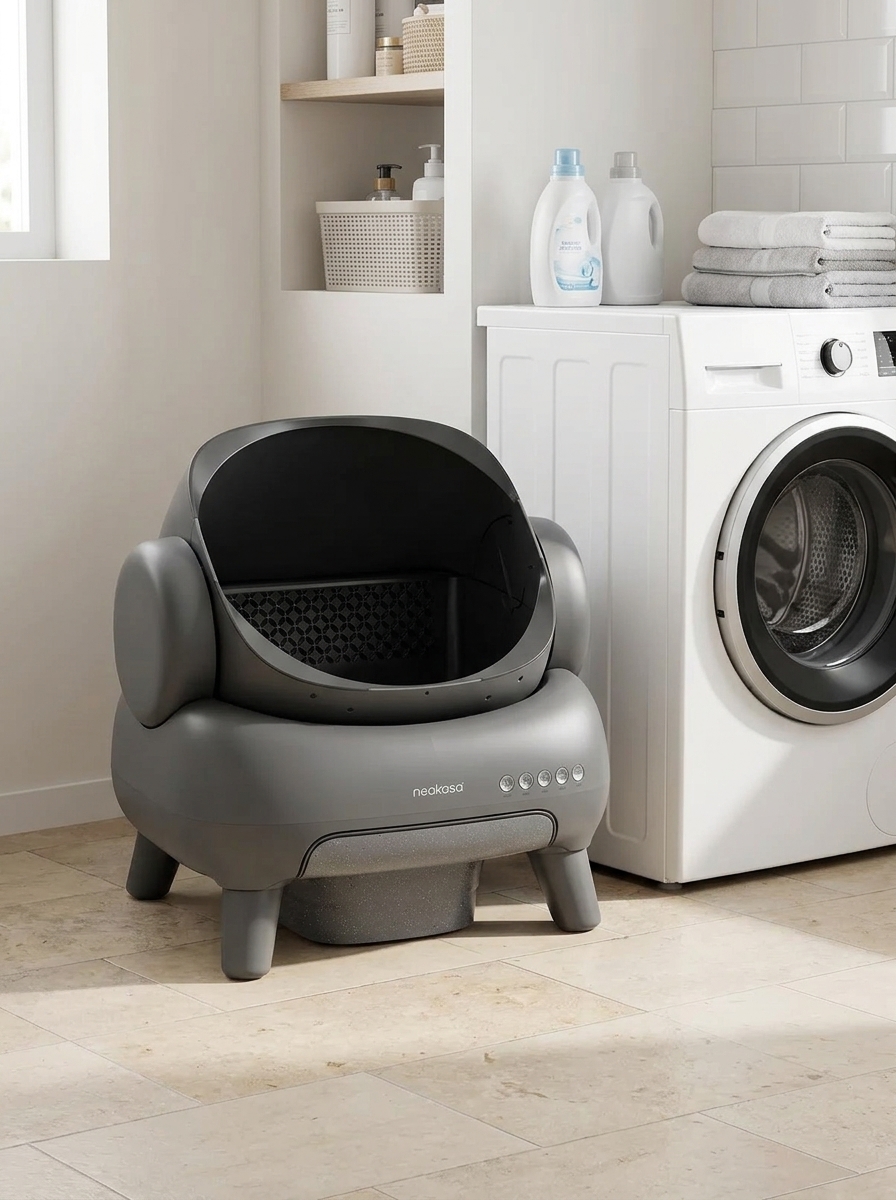
The M1's globe rotates the full litter bed after a visit. Clean litter passes through a sifting screen and returns to the bed; clumps and solids roll into the waste drawer beneath. Because the whole bed turns over, the litter your cat steps on stays comparatively fresh, and because the waste sits in a separate sealed drawer, odor is contained away from the bed. The trade-offs are mechanical: a globe is a large moving assembly, which is part of why the unit weighs 10.35 kg, and the entry sits 35.2 cm up — a real consideration we return to below.
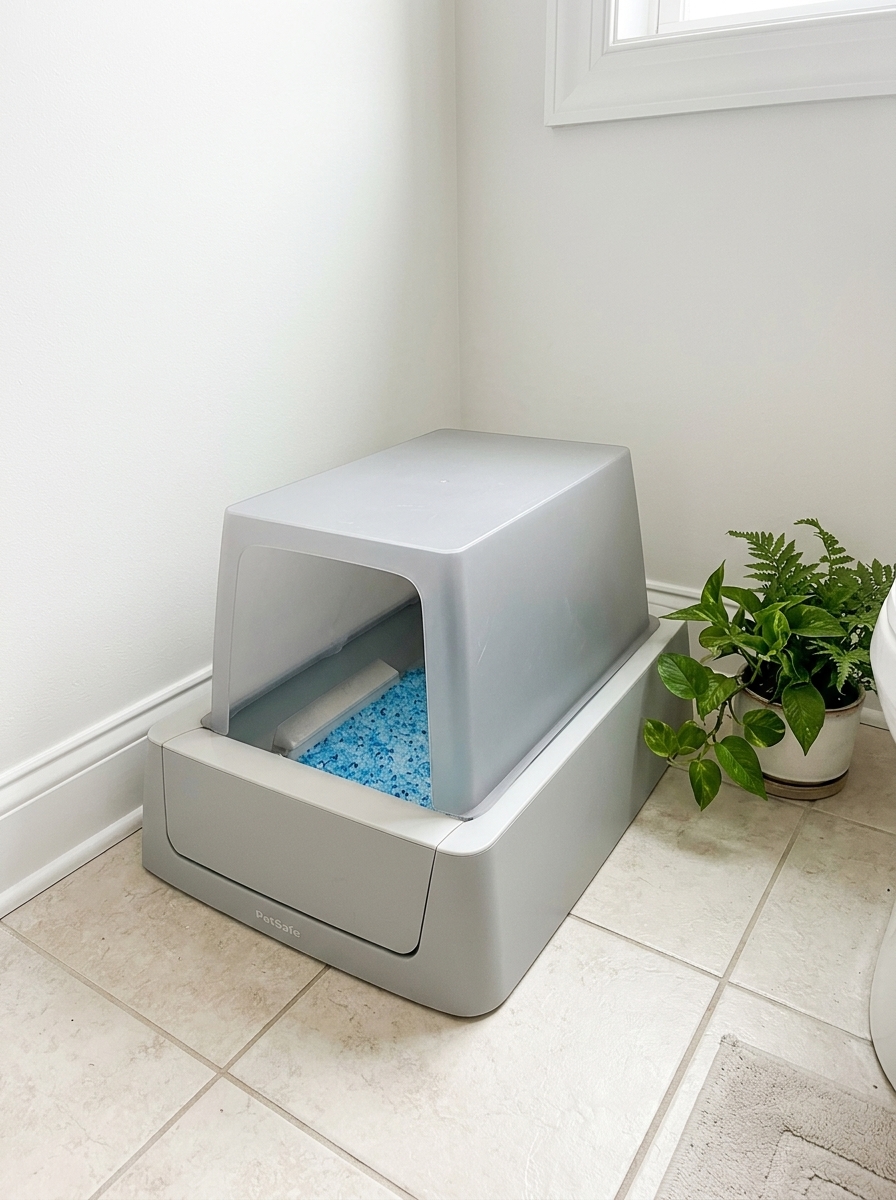
The ScoopFree Crystal Smart takes the opposite approach. After a visit, a rake combs through the crystal bed and pushes solids into a covered waste compartment at one end of the tray. The crystals themselves do the liquid work: they absorb urine and dehydrate waste rather than clumping it, which is why the system can go a long stretch without attention. There is no drawer to empty and nothing to wash — when the tray is done, you lift it out, throw it away, and slide in a fresh one. That simplicity is the entire appeal, and it is genuine.
Neither box has a camera, and both offer app control without requiring a subscription, so connectivity is a wash in this pairing.
Strip away the hardware and these two boxes are two different purchasing relationships.
With the M1, you buy the machine once and then buy commodity consumables forever: any clumping litter you like, from any brand, at any store, plus drawer liners or bags. If your cat rejects a litter, you switch brands next week. If a litter goes on sale, you stock up. If you prefer a low-dust, lightweight, or plant-based litter, the globe does not care. Your ongoing spend is real — litter is a permanent line item — but it is competitive, substitutable, and under your control.
With the ScoopFree Crystal Smart, the consumable is the product. The crystal litter comes pre-loaded in proprietary disposable trays made for this system, and there is no generic substitute: when a tray is spent, you buy another tray from the same ecosystem. In exchange, you get a service experience no globe can match — no litter to pour, no drawer to scrub, no loose litter stored in a cupboard, and a swap that takes under a minute. The costs of that convenience are structural rather than numerical: permanent dependence on one supplier's tray pricing and availability, and a steady stream of disposable trays going to landfill, litter and plastic together.
We are deliberately not attaching prices to either side of this comparison. Tray and litter prices move, multipacks change the arithmetic, and a figure quoted here would be stale on arrival. What does not change is the shape of the commitment: commodity consumables you control versus a closed consumable you rent, effectively, for as long as you own the box. Decide which shape fits your household and the hardware choice makes itself.
The M1 is built for bigger cats and busier litter rooms. Its 15 kg maximum cat weight is the highest class of rating in this category, and the 11.23 L drawer means multi-cat households empty waste less often. The cost of that capacity is access: a 35.2 cm entry height is a climb, and it is a legitimate reason to hesitate for kittens, senior cats, or any cat with mobility issues. A step can mitigate it, but it should be a conscious part of the purchase decision, not an afterthought. At 50 dB, the globe's cleaning cycle is audible — roughly conversation-adjacent mechanical noise — though cycles are brief and typically run when the cat is elsewhere.
The ScoopFree is the smaller commitment in physical terms too: 7.12 kg, no globe to maneuver, and a footprint and service routine that suit a single-cat household or a smaller space. Its 1-year warranty is the figure in our catalog data; the M1's warranty term is not one we publish, so check the product page before treating warranty as a differentiator either way.
Choose the Neakasa M1 if you have a large cat, more than one cat, or a firm preference for choosing your own litter. Its higher score (8.5 vs 8.4) rests on capacity and flexibility, and its running costs stay in a competitive market you control. Accept the entry-height caveat and arrange a step for smaller or older cats.
Choose the PetSafe ScoopFree Crystal Smart if the chore you are really buying your way out of is litter handling itself. The tray swap is the simplest maintenance routine in the category, the unit is lighter and easier to place, and the score gap is small enough that convenience can honestly win. Just go in clear-eyed: the trays are a permanent, single-supplier commitment, in both cost and waste.
Full specifications, tracked data, and the score breakdown for each box are on the Neakasa M1 product page and the PetSafe ScoopFree Crystal Smart product page.
Where to buy: Neakasa M1 · PetSafe ScoopFree Crystal Smart — retailer links run through our /go/ tracker; the product pages track prices daily.
Can the ScoopFree Crystal Smart use regular clumping litter instead of crystal trays? No. The system is designed around its proprietary disposable crystal trays — the rake geometry, the covered waste compartment, and the absorbency model all assume crystal litter in that tray format. Using ordinary litter in it is not a supported configuration.
Can the Neakasa M1 use crystal litter? It is specified for standard clumping litter. The globe's sifting screen is designed to separate clumps from loose litter, and non-clumping crystal litter does not form the clumps that mechanism depends on. Stick with clumping litter.
Which box is better for a very large cat? The M1, on the data we track: it is rated for cats up to 15 kg and pairs that with an 11.23 L waste drawer. The ScoopFree's catalog data does not publish a maximum cat weight in our records, so if your cat is at the large end, the M1 is the verifiable choice.
Which one produces less household waste? The M1. Its consumables are litter and drawer bags, while the ScoopFree sends an entire disposable tray — plastic tray plus spent crystals — to landfill at every change. If waste volume matters to you, that difference compounds over years of ownership.
Is the M1's 35.2 cm entry height a problem for kittens or senior cats? It can be. It is a high step relative to low-entry boxes, and for kittens, arthritic seniors, or post-surgery cats we would treat a stable pet step as part of the setup rather than an optional extra.
Do either of these require a subscription? No. Both offer app control with no subscription required, according to the catalog data tracked on our product pages.
Last updated: November 27, 2026
November 27, 2026 — Added retailer buying links (Our pick and Where to buy) for the products covered in this article.
The six lowest tracked purchase prices in the category, $219.99–$359.99. Best score under $300: PetSafe ScoopFree Crystal Smart at 8.4/10.
The six lightest tracked boxes by published unit weight (5–10.35 kg) — a stated proxy, because makers do not publish footprints consistently. Lightest: ChillX AutoEgg.
8 boxes meet the multi-cat rule (maker-rated for 2+ cats, or a waste drawer of 10 L+ where no rating is published), ranked by Score v1.0. Top: Neakasa M1 at 8.5/10.
PETKIT PuraMax 2 by the numbers: Score v1.0 6.7/10 (#9 of 16 in its category), owner rating 4.20/5 from 2,729 reviews, tracked from $380.99.
Discussion
No comments yet