Budget Self-Cleaning Litter Boxes: A Data Shortlist
The six lowest tracked purchase prices in the category, $219.99–$359.99. Best score under $300: PetSafe ScoopFree Crystal Smart at 8.4/10.
Lab 01: Pet Tech · Automatic Litter Boxes
Email me when PetSafe ScoopFree Crystal Smart drops to my target price. The confirmation includes a manage link — use it any time to list or remove your alerts at Your price alerts. Lowest price tracked so far: USD 299.95 — a target below that is below the historical low and less likely to be reached.
Disclosure: AIBuyLab is reader-supported. When you buy through links on this page, we may earn a commission at no extra cost to you. This guide is based on the manufacturer's published specifications and our catalog data — we do not claim hands-on testing, and all cost figures below are structural models, not quotes.
Our pick: PetSafe ScoopFree Crystal Smart — check the current price at the retailer.
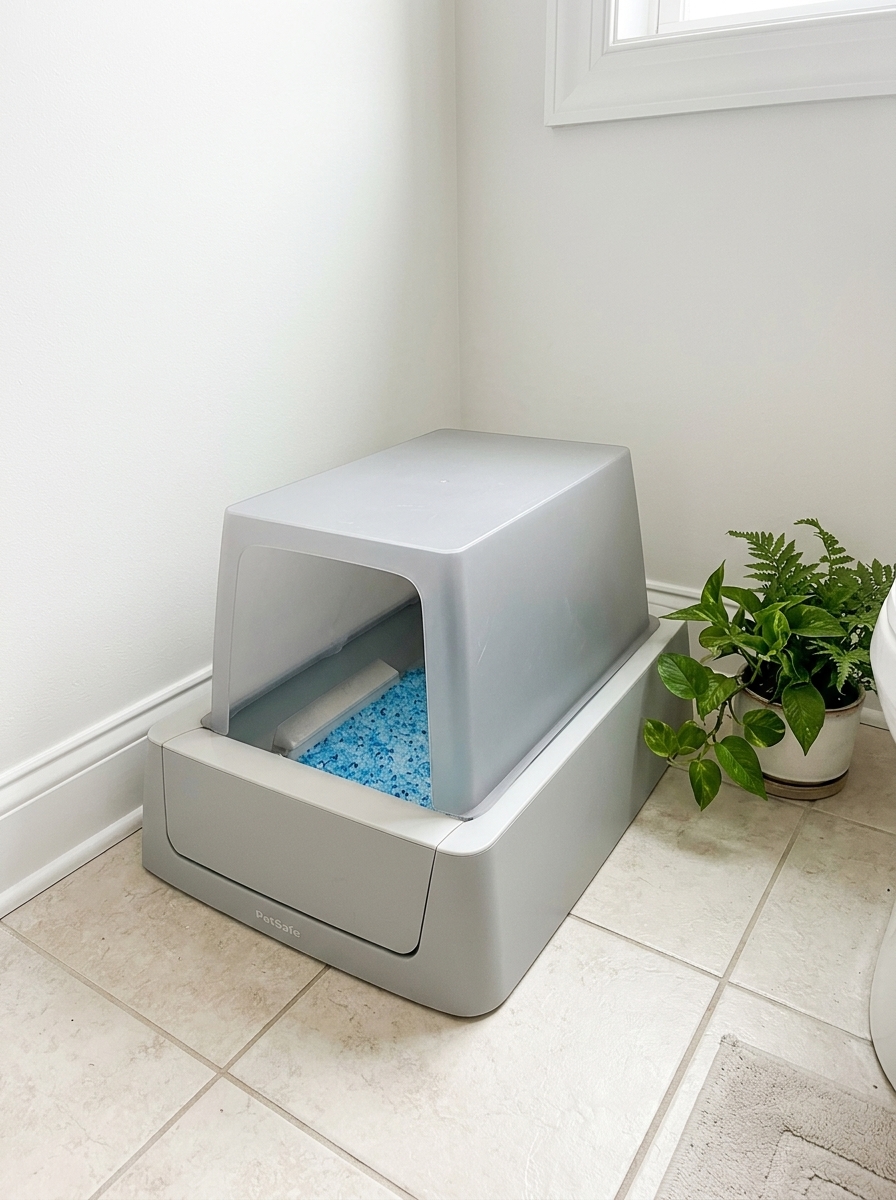
The PetSafe ScoopFree Crystal Smart is an automatic litter box built around a single idea: instead of a washable waste drawer and loose litter you manage yourself, it uses a disposable tray pre-filled with proprietary crystal litter. An automatic rake passes through the crystals after each use, pushing solid waste into a covered compartment at one end of the tray while the crystals absorb liquid and dehydrate waste. When the tray is spent, you lift the whole thing out, lid it, and throw it away. No scooping, no scrubbing, no litter dust poured from a bag.
In our catalog it carries an AIBuyLab Score of 8.4/10, weighs 7.12 kg, connects to an app with usage and health-counter style tracking (the ScoopFree concept counts rake cycles, which is a rough proxy for how often your cat uses the box), requires no subscription, and is covered by a 1-year warranty. The raking mechanism and the tray are not two separate features — the tray is the product. That is exactly why its cost model deserves a closer look than most.
Most litter box budgets have several moving parts. The ScoopFree has essentially one. Write the three-year cost as:
3-year cost = machine price + (trays per year × price per tray × 3)
Everything except the trays is either fixed or trivial. There is no separate litter purchase, no waste-drawer liners in the usual sense, and the electricity draw of a periodic rake motor is negligible — cents, not dollars, over a year. The machine price you can check in seconds on our product page, where we track current offers. What you cannot see at checkout is the multiplier hiding in "trays per year," so that is where an honest model has to spend its time.
PetSafe's own marketing puts one tray at roughly three to four weeks for a single cat — treat that as the maker's claim, not a guarantee. Real tray life depends on the cat's size, diet, water intake, and how much odor you personally tolerate before swapping. Running the arithmetic across a realistic range:
Scenario | Tray life | Trays per year | Trays over 3 years |
|---|---|---|---|
Maker's optimistic end | ~4 weeks | 12 | 36 |
Middle of the range | ~3 weeks | 18 | 54 |
Heavy use / low odor tolerance | ~2 weeks | 26 | 78 |
Notice what this table does to your budget: the difference between the optimistic and heavy scenarios is 42 trays. Whatever a tray costs at the retailer you buy from, multiply that figure by 42 and you have the real financial stakes of the "how long does a tray last" question — a number that will almost certainly exceed any sale discount you have ever seen on the machine itself. This is the classic razor-and-blades shape: a moderately priced device attached to a consumable you can only buy from one maker, in one format, at whatever price it sells for that month. It is not a scam — it is a trade, and it should be evaluated as one.
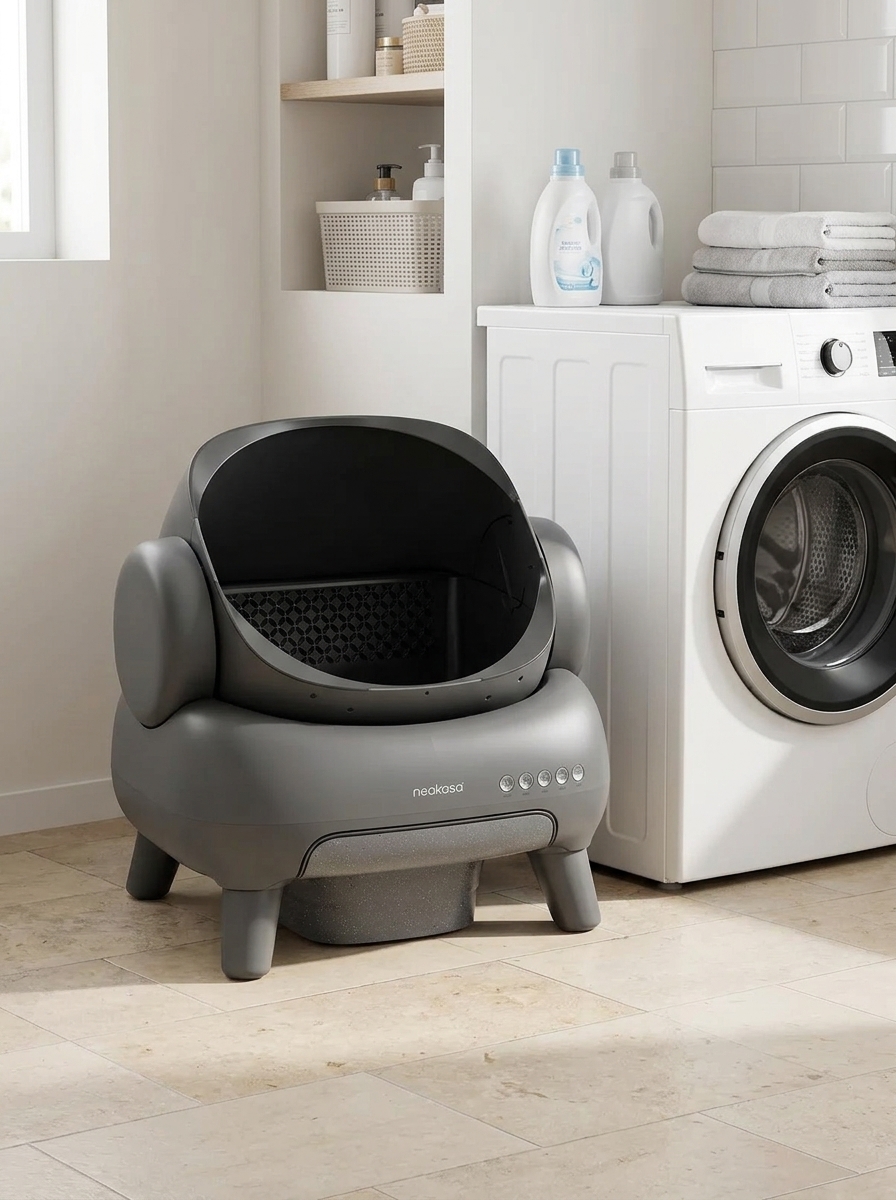
Compare that with a globe-style box such as the Neakasa M1 (AIBuyLab Score 8.5/10, with an 11.23 L waste capacity). Its three-year cost looks like:
3-year cost = machine price + litter + waste bags + negligible electricity
Every term on the right is a commodity. Clumping litter is sold by dozens of brands, in bulk, on sale, in whatever scent or formulation you prefer; if one brand raises its price, you switch. The per-year consumable total is typically far lower than a tray habit, but it is lumpy and effortful: you are topping up litter, emptying a waste bin, and deep-cleaning a drum on a schedule. The ScoopFree's curve is the mirror image — a smooth, predictable, higher spend that buys your time and attention back almost completely. Neither shape is "cheaper" in the abstract. One is cheaper in money; the other is cheaper in minutes and nose.
It is easy to frame the tray as a tax. It is more accurate to frame it as a service:
What the money does not buy: flexibility. The tray fits this machine and no other. If PetSafe changes the price, the format, or your cat simply produces more waste than the crystals can handle, there is no third-party workaround.
One cat, small home, odor-sensitive: the math works. At 12–18 trays a year, the three-year consumable bill is a known, budgetable premium for the cleanest-smelling version of cat ownership in this category. This is the household the product was designed for.
Travel-heavy owners: the math works even better. If the alternative is paying a sitter for daily scooping visits, a tray that stretches across a trip is competing against pet-care labor, not against litter. Against that benchmark, trays are cheap.
Multi-cat homes: the trays scale badly. Tray life divides by the number of cats while the price per tray does not. Two cats push you toward the 26-tray column and beyond; three cats make the consumable line the dominant cost of the entire setup, while a globe box's litter bill rises far more gently. Past two cats, run the scenario table with your own tray price before you commit.
Budget-first owners: buy the globe. If minimizing three-year spend is the priority and you do not mind the chores, the commodity-consumable model wins on arithmetic alone — the M1's higher catalog score at the same no-subscription terms makes it the natural comparison point.
Where to buy: PetSafe ScoopFree Crystal Smart · Neakasa M1 — retailer links run through our /go/ tracker; the product pages track prices daily.
How long does one ScoopFree tray really last? PetSafe's marketing says roughly three to four weeks for one cat. Your mileage depends on the cat and your odor threshold; our cost scenarios deliberately span two to four weeks so you can locate yourself in the range rather than trusting the optimistic end.
Can I refill a tray with cheaper crystal litter instead? The system is designed around the sealed disposable tray, and the rake and waste compartment assume that format. Refilling defeats the odor-sealing and no-contact disposal that justify the product's premium in the first place. If you want bulk crystal litter economics, a conventional box is the honest route.
Does the Crystal Smart need a subscription? No. Our catalog lists it as subscription-free; the app and usage counting work without a paid plan. Your ongoing spend is trays, not software.
How does the 3-year cost compare with the Neakasa M1 in one sentence? The M1 (Score 8.5) spends less on commodities and more of your time; the ScoopFree (Score 8.4) spends more on trays and almost none of your time — see both models above and price the tray column with your retailer's current figure.
What happens if tray prices rise after I buy the machine? That risk is structural to any proprietary consumable: you cannot switch suppliers. It is the strongest argument for checking the current tray price — and ideally the multi-pack price — before buying the machine, not after.
Is the usage counter a health feature? It is a usage trend, nothing more. A visible change in how often your cat uses the box can be a useful prompt to pay attention or call a vet, but the counter does not diagnose anything.
The ScoopFree Crystal Smart is honestly priced at the register and quietly priced forever after. Model it as machine + 36 to 78 trays over three years, decide which scenario column your cat belongs in, and the decision usually makes itself: one cat and a premium on your time — buy it; several cats and a premium on your wallet — buy the globe.
Last updated: November 27, 2026
November 27, 2026 — Added retailer buying links (Our pick and Where to buy) for the products covered in this article.
The six lowest tracked purchase prices in the category, $219.99–$359.99. Best score under $300: PetSafe ScoopFree Crystal Smart at 8.4/10.
The six lightest tracked boxes by published unit weight (5–10.35 kg) — a stated proxy, because makers do not publish footprints consistently. Lightest: ChillX AutoEgg.
8 boxes meet the multi-cat rule (maker-rated for 2+ cats, or a waste drawer of 10 L+ where no rating is published), ranked by Score v1.0. Top: Neakasa M1 at 8.5/10.
PETKIT PuraMax 2 by the numbers: Score v1.0 6.7/10 (#9 of 16 in its category), owner rating 4.20/5 from 2,729 reviews, tracked from $380.99.
Discussion
No comments yet