
Furbo 360° Dog Camera by the Numbers: A Data Profile
Furbo 360° Dog Camera by the numbers: Score v1.0 6.6/10 (#5 of 6 in its category), owner rating 4.61/5 from 734 reviews, tracked from $30.00.
Lab 01: Pet Tech · Pet Cameras
Email me when Ring Indoor Cam (2nd Gen) drops to my target price. The confirmation includes a manage link — use it any time to list or remove your alerts at Your price alerts. Lowest price tracked so far: USD 49.99 — a target below that is below the historical low and less likely to be reached.
Affiliate disclosure: AIBuyLab may earn a commission when you buy through links on this page, at no extra cost to you. This comparison is desk research based on our product catalog and published manufacturer specifications — we did not hands-on test either camera, and every claim below traces back to the catalog data cited in the spec table.
Both cameras score 6.0 / 10 in our catalog (Score v1.0), and both record in 1080p with two-way audio and app control. Everything else about them is opposite. The Ring Indoor Cam (2nd Gen) is a fixed camera with a wide 143° field of view: it sits in one spot and watches one room, corner to corner, with nothing that moves. The SKYMEE Owl Robot is a roaming robot with pan/tilt movement, local storage, and a treat tosser — it drives to your pet instead of waiting for your pet to walk into frame. Pick the Ring if you want simple, set-and-forget coverage of a single room. Pick the Owl if your pet roams the whole home and you want interaction — treats and a moving camera — not just observation. One more difference matters: the Owl records to local storage, while our catalog lists no local storage for the Ring, so Ring footage lives in the cloud side of the equation.
Our pick: Ring Indoor Cam (2nd Gen) vs SKYMEE Owl Robot — check current prices at the retailers.
A pet camera is an indoor camera aimed at animals rather than security intruders: it streams live video to an app, usually offers two-way audio so you can talk to your pet, and increasingly adds pet-specific features such as bark alerts and treat tossing. Two specification terms decide most of the difference in this comparison.
Pan/tilt means the camera head (or, in the Owl's case, the whole robot) can move to change where it looks. A fixed camera like the Ring sees only what its lens covers from where you placed it — its 143° field of view is the entire strategy. A pan/tilt device can follow a pet across a room or reposition entirely.
Local storage means footage is recorded on the device itself (typically a memory card) rather than only in a cloud service. It matters because it decides where your recordings live, whether reviewing old clips depends on a cloud plan, and whether the camera keeps recording if the internet drops. In our catalog, the SKYMEE Owl Robot has local storage; the Ring Indoor Cam (2nd Gen) does not.
Spec | Ring Indoor Cam (2nd Gen) | SKYMEE Owl Robot |
|---|---|---|
AIBuyLab Score (v1.0) | 6.0 / 10 | 6.0 / 10 |
Resolution | 1080p | 1080p |
Field of view | 143° | Not specified in our catalog |
Pan/tilt / movement | No — fixed position | Yes — pan/tilt, roams |
Local storage | No | Yes |
Treat tossing | No | Yes |
Two-way audio | Yes | Yes |
App control | Yes | Yes |
Bark alerts free | No | No |
Subscription required | No (per our catalog) | No |
The Ring's argument is coverage without complexity. A 143° field of view is wide enough that a single fixed camera, placed in a corner, can see essentially a whole typical room at once. There is no pan motor to fail, no wheels to get stuck on a rug edge, no treat hopper to refill or jam. You place it, open the app, and the room is watched — continuously, not just when the camera happens to be pointing the right way.
That fixedness is also the limit. The Ring sees one room. If your dog spends the morning in the kitchen and the afternoon in the bedroom, the Ring sees half a day. And because our catalog lists no local storage for this model, your recordings depend on cloud storage — worth confirming what the cloud plan covers before you rely on reviewing old footage.
The Ring fits homes where the pet's world is basically one room: apartment dogs gated to the living room, a cat whose bed, litter box, and window perch are all in one space, or anyone who wants a camera that behaves like a smoke detector — installed, ignored, and there when you check it.
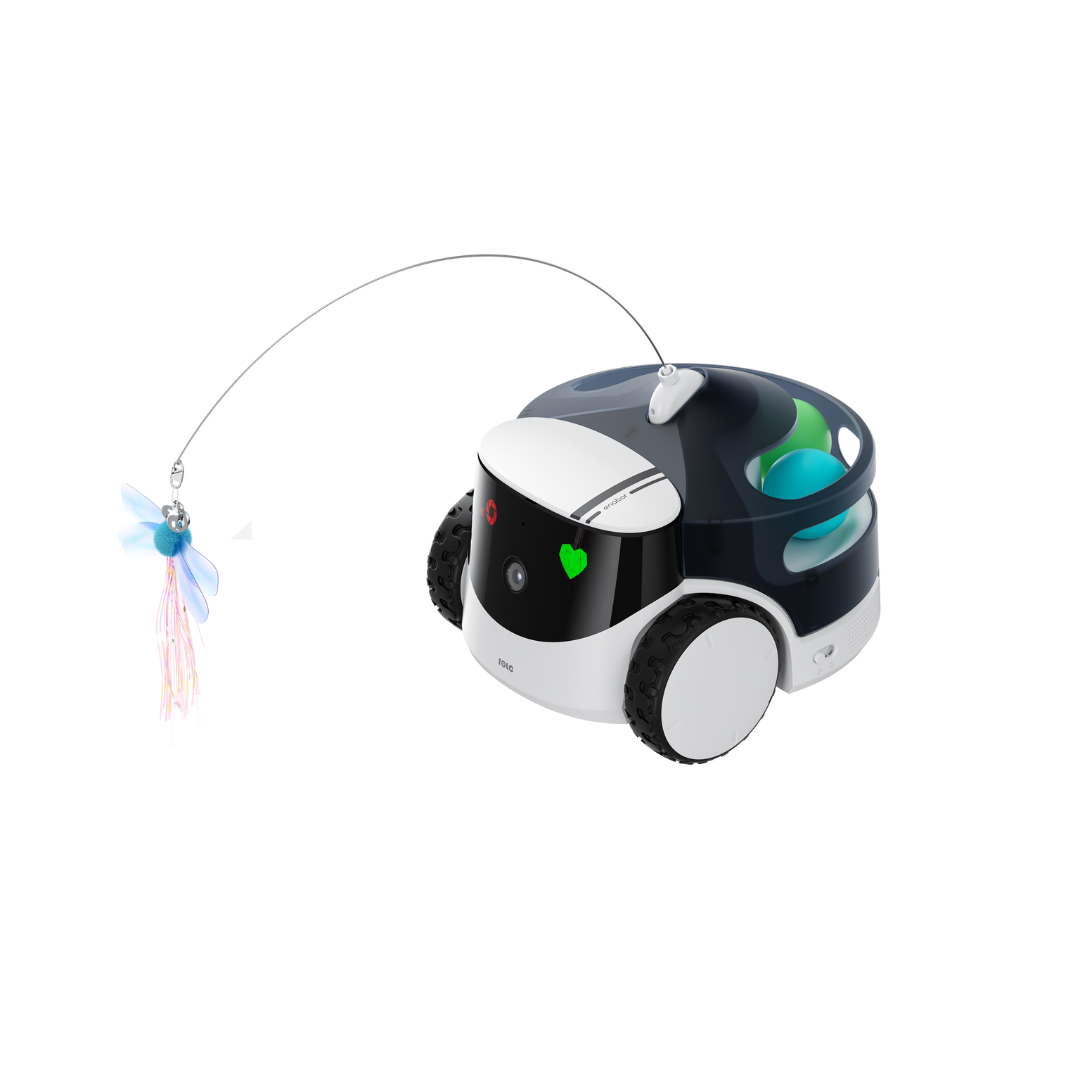
The SKYMEE Owl Robot inverts the Ring's philosophy. Instead of a wide lens watching a fixed frame, it moves: pan/tilt lets it look around, and as a robot it can reposition through the home, so one device covers rooms a fixed camera cannot. When it finds your pet, it can do more than watch — it tosses treats, which turns a check-in into a small interaction and gives anxious pets something positive to associate with the robot's arrival.
The Owl also answers the storage question the Ring leaves open. Local storage means recordings stay on the device; reviewing footage does not hinge on a cloud subscription, and per our catalog no subscription is required for either camera.
The trade-offs are the moving parts themselves. A roaming robot has wheels, motors, and a treat mechanism — more to charge, more to clean, more that can stop working, and a device on the floor that a large or curious dog may treat as a toy. The Owl fits multi-room homes, pets that free-roam, and owners who actively want to play with their pet from work rather than just verify the house is quiet.
Two rows of the spec table deserve a second look because they shape daily use more than resolution does. On storage, the Owl's local recording is the simpler long-term story: clips are on the device, full stop. The Ring, with no local storage in our catalog, routes everything through the cloud — convenient for remote access, but it means your footage history is a service, not a thing you own.
On alerts, the two are tied in an unhelpful way: bark alerts are not free on either model per our catalog, so budget for the possibility that the smart-alert features you see advertised sit behind a paid tier on both. Neither camera requires a subscription in our catalog record, but "not required" and "every feature free" are different claims — check which alerts are included before choosing on that basis.
Choose the Ring Indoor Cam (2nd Gen) if your pet lives in one main room, you want the widest fixed view (143°) with zero moving parts, and you are comfortable with cloud-based recording. It is the lower-maintenance way to keep an eye on a defined space.
Choose the SKYMEE Owl Robot if your pet roams multiple rooms, you want treat tossing and two-way interaction rather than passive watching, and you prefer local storage over cloud dependence. You are accepting moving parts and floor-level vulnerability in exchange for reach and play.
The identical 6.0 scores are honest: these are not a better and a worse camera, they are two different answers to "how do I watch my pet?" — one watches a place, the other follows an animal. Decide which problem you actually have, and the choice makes itself.
Where to buy: Ring Indoor Cam (2nd Gen) · SKYMEE Owl Robot — retailer links run through our /go/ tracker; the product pages track prices daily.
Which camera is better for a large, multi-room house? The SKYMEE Owl Robot. Its pan/tilt movement and roaming design let one device cover more than a single room, while the fixed Ring can only see the room it is installed in.
Does the Ring Indoor Cam (2nd Gen) record without a cloud plan? Our catalog lists no local storage for the Ring, so its recordings are cloud-based. The Owl, by contrast, records to local storage. Verify the current cloud terms for the Ring before relying on footage history.
Can either camera toss treats? Only the SKYMEE Owl Robot — treat tossing is one of its defining features. The Ring has no treat function; it is a pure observation camera with two-way audio.
Are bark alerts free on either camera? No. Per our catalog, bark alerts are not free on either model, even though neither camera requires a subscription. Check the current alert pricing for both before buying on that feature.
Which one is better for a small apartment? Usually the Ring. A 143° fixed view covers a small living space completely, and there are no moving parts to manage. The Owl earns its keep when one fixed viewpoint is not enough.
Do both cameras have two-way audio and app control? Yes. Both models offer two-way audio and app control at 1080p, so talking to your pet from the app is available either way.
Last updated: November 27, 2026
November 27, 2026 — Added retailer buying links (Our pick and Where to buy) for the products covered in this article.
Furbo 360° Dog Camera by the numbers: Score v1.0 6.6/10 (#5 of 6 in its category), owner rating 4.61/5 from 734 reviews, tracked from $30.00.
As of 2026-11-21, we track 16 pet cameras from 11 brands, scored with Score v1.0 from owner ratings, spec strength and ownership cost. Petcube Cam leads the list at 8.3/10. Tracked prices run from $24 to $200; the full table below is sortable by score and price.
The SKYMEE Owl Robot scores 6.0 in our catalog; the Enabot ROLA PetPal scores 1.0 — the lo
On paper, these two indoor cameras are nearly twins: both shoot 1080p video, both see a 143° field of view, both offer two-way audio and app control, and neither pans, tilts, or tosses treats. - The o
Discussion
No comments yet