
Budget Self-Cleaning Litter Boxes: A Data Shortlist
The six lowest tracked purchase prices in the category, $219.99–$359.99. Best score under $300: PetSafe ScoopFree Crystal Smart at 8.4/10.
Lab 01: Pet Tech · Automatic Litter Boxes
Email me when PetSafe ScoopFree Crystal Pro drops to my target price. The confirmation includes a manage link — use it any time to list or remove your alerts at Your price alerts. Lowest price tracked so far: USD 229.99 — a target below that is below the historical low and less likely to be reached.
Affiliate disclosure: AIBuyLab may earn a commission if you buy through links on this page, at no extra cost to you. This is a desk-research cost model built from the manufacturer's published specifications tracked on our product pages — we did not hands-on test this litter box, and we quote no prices anywhere in this article. The point is the structure and cadence of the costs: the tray count is fixed by your household, and you supply the one variable — the tray price you actually pay.
Our pick: PetSafe ScoopFree Crystal Pro — check the current price at the retailer.
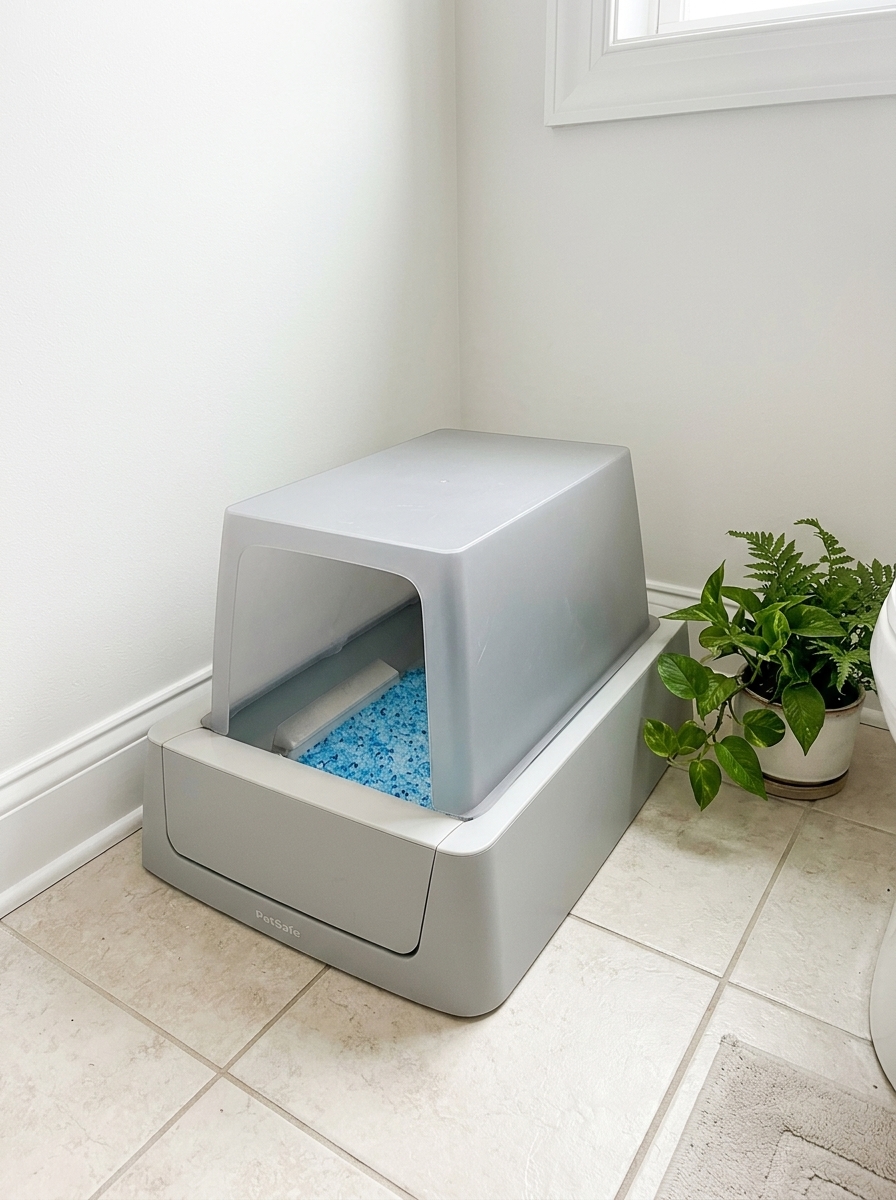
The ScoopFree Crystal Pro is a self-cleaning litter box built around a raking mechanism: after a cat leaves, a rake sweeps waste into a covered compartment at one end of the box. The floor of the box is not a permanent litter bed you maintain — it is a disposable tray pre-filled with crystal litter, and when the crystals are saturated and the waste compartment is full, you lift the whole tray out and replace it with a fresh one.
That design choice defines everything about ownership. The catalog records the model at 8.2 kg, with no app control and no camera — there is nothing to configure, monitor, or update. It also records the limit that matters most before any cost discussion: a maximum cat weight of 6.8 kg (about 15 lb). This is a small-cat box. A large Maine Coon, a chunky British Shorthair, or any cat over that line is outside the design envelope, and a cat that does not fit comfortably will simply stop using the box — the most expensive outcome of all.
On our product page for the PetSafe ScoopFree Crystal Pro, those specifications combine into an AIBuyLab Score v1.0 of 6.0/10 — a mid-pack score for a deliberately simple machine. The question this article answers is not whether the box works, but what its simplicity costs per year once the purchase is behind you.
Because we do not quote prices in this model, every figure below is a count. Your total 3-year consumables cost is one multiplication:
3-year tray cost = (trays per year × 3) × the price you pay per tray
Tray prices vary by retailer, pack size, and region, and they drift over time — which is precisely why the count is the durable part of the model. Work out your count from the table, then price it with current figures from the product page or your usual retailer.
A crystal tray's life is set by how fast the crystals saturate and the waste compartment fills, and both scale with the number of cats. The cadences below are planning estimates derived from how this class of disposable-tray box is used — they are not manufacturer figures, and a cat that drinks heavily or a tray placed in a humid room will shorten them.
Household | Tray life (planning estimate) | Trays per year | Trays over 3 years |
|---|---|---|---|
1 cat, average use | ~3–4 weeks | ~13–18 | ~39–54 |
2 cats sharing one box | ~10–14 days | ~26–36 | ~78–108 |
1 cat, heavy use / humid home | ~2–3 weeks | ~18–26 | ~54–78 |
Two structural facts fall out of the table. First, a second cat roughly doubles the consumables bill — there is no economy of scale in a disposable tray, because saturation is saturation. Second, the spread between the cheapest and most expensive row is nearly 3×, driven entirely by cadence. Two owners of the identical box can have radically different 3-year costs, and neither of them is using it wrong.
Electricity is negligible in structure: a rake motor that runs briefly after each visit. It is not a line item worth modelling.
The machine itself is the second cost, and it is a replacement risk rather than a consumable. A rake mechanism cycling several times a day for three years is a wear item in a way a passive tray is not; if the unit fails outside warranty, the replacement decision arrives with your tray inventory as sunk cost — trays you have already bought fit nothing else.
Your time runs the other direction: a tray swap is a lift-out, drop-in task with no scooping, no bin emptying, and no litter top-ups between swaps. That labour saving is what the tray premium buys, and for owners who travel or who cannot scoop daily, it may be the entire point.
The tray is the wear part. Unlike a bagged robot vacuum or a filter-based fountain, there is no stack of small consumables — the crystal tray absorbs the roles of litter, liner, and waste container in a single disposable unit. Nothing else on the box is user-replaceable in the normal course of ownership.
The rake and its track accumulate litter dust and debris with every cycle. Crystal litter is abrasive by design, and grit in the rake path is the mechanism's natural enemy over a multi-year horizon. Keeping the area around the box swept and the tray seated correctly is the only maintenance the design really asks of you.
The crystals set the clock, not the calendar. A tray that looks fine can be functionally done: once the crystals are saturated, odour control — the main reason to choose crystal litter — falls off quickly. Owners who stretch trays past saturation to save money are not beating the model; they are converting a self-cleaning box into a smelly manual one, and cats vote on that with their feet.
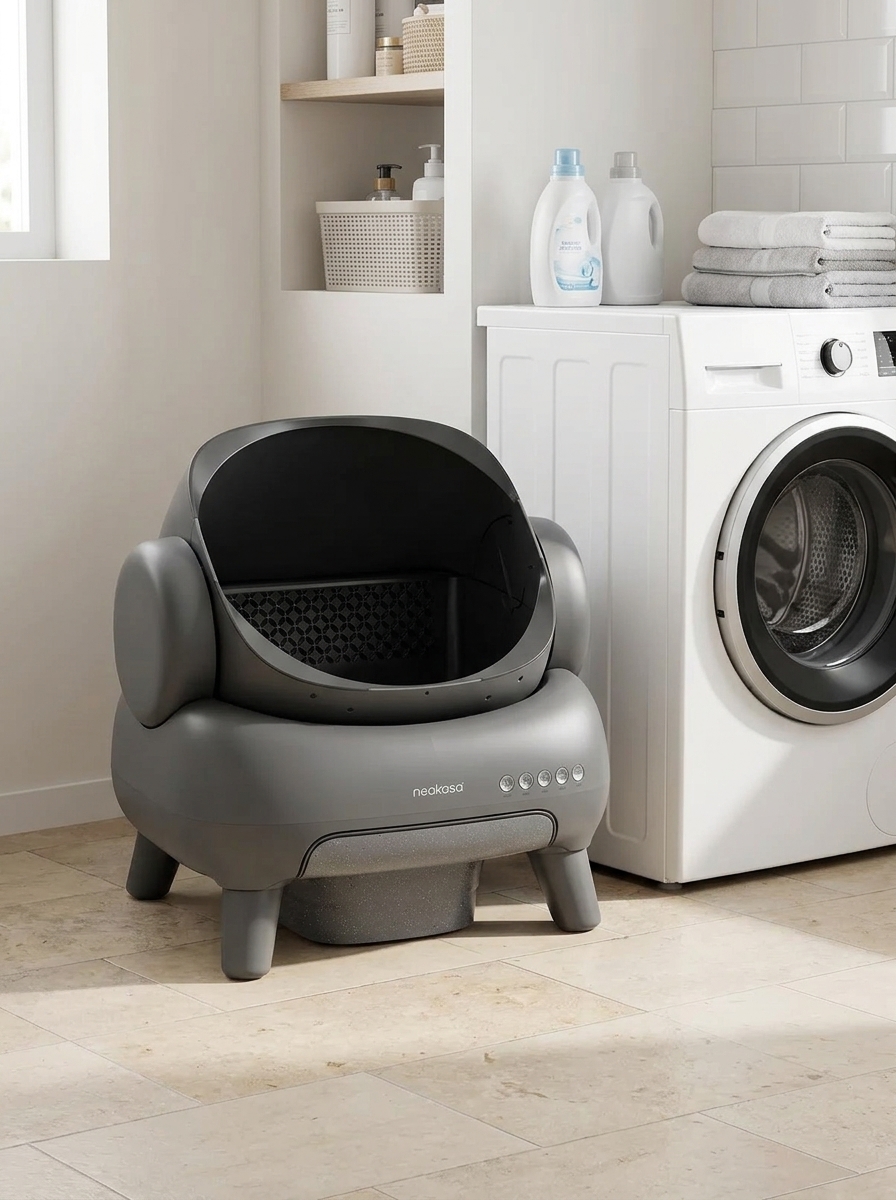
Compare the shape — not the price — with the Neakasa M1, which scores 8.6/10 in our catalog. The M1 is a sifting box with an 11.23 L waste bin that runs on ordinary clumping litter: the consumable is a commodity sold by every pet retailer under dozens of brands, in whatever quantity and at whatever price point you choose.
The ownership structures are mirror images. The Crystal Pro concentrates all consumable spend into one proprietary item whose price you do not control and whose supply you depend on; in exchange, maintenance is a single swap. The M1 spreads consumable spend across a competitive commodity market and asks more of you — litter to buy, carry, and top up, and a waste bin to empty. Neither structure is universally cheaper. The tray model wins on effort per week; the commodity model wins on price control per year, and the gap widens the more cats you add, because commodity litter scales gently while tray cadence scales linearly.
Buy the ScoopFree Crystal Pro with your eyes open and it is a fair trade: you are renting convenience with trays. The model makes sense for a one-cat household with a cat under 6.8 kg, an owner who values a two-minute swap over price control, and anyone whose schedule makes daily scooping unrealistic.
Skip it if your cat is over the weight cap — that gate is absolute — or if a second cat is in your near future, because the tray count doubles and never comes back down. And if the idea of a consumable you can only buy from one ecosystem bothers you, it will bother you more in year two than in week two: look at the sifter class instead, starting with the Neakasa M1.
Where to buy: PetSafe ScoopFree Crystal Pro · Neakasa M1 — retailer links run through our /go/ tracker; the product pages track prices daily.
How many trays does a ScoopFree Crystal Pro use in a year? As a planning estimate, roughly 13–18 trays a year for one cat and 26–36 for two cats sharing the box. Your real cadence depends on the cat, the room, and how long you let the crystals run past saturation — which we do not recommend.
Can I use regular litter in the Crystal Pro instead of the trays? No. Our catalog lists the litter type as proprietary: the disposable crystal tray is integral to the design — it is the litter bed and the waste container in one. There is no generic-tray or loose-litter mode to fall back on.
Is there a subscription or app fee on top of the trays? No. The catalog records no subscription for this model, and there is no app control or camera. The tray spend is the whole running-cost story — a physical subscription rather than a digital one.
What is the largest cat the Crystal Pro suits? The catalog tracks a maximum cat weight of 6.8 kg (about 15 lb). Treat that as a hard eligibility gate: a cat above it needs a different class of box, such as a large-capacity sifter.
Does the Crystal Pro work for multi-cat homes? It functions, but the economics turn against you: a second cat roughly halves tray life, doubling the 3-year tray count to an estimated 78–108. Multi-cat homes are where commodity-litter machines pull away on running cost.
What wears out over three years besides the trays? Nothing user-replaceable in normal use. The rake mechanism is the long-horizon wear item, and tray grit is its main enemy. If the unit itself fails, remember that any trays you have stockpiled fit no other box.
Last updated: November 27, 2026
November 27, 2026 — Added retailer buying links (Our pick and Where to buy) for the products covered in this article.
The six lowest tracked purchase prices in the category, $219.99–$359.99. Best score under $300: PetSafe ScoopFree Crystal Smart at 8.4/10.
The six lightest tracked boxes by published unit weight (5–10.35 kg) — a stated proxy, because makers do not publish footprints consistently. Lightest: ChillX AutoEgg.
8 boxes meet the multi-cat rule (maker-rated for 2+ cats, or a waste drawer of 10 L+ where no rating is published), ranked by Score v1.0. Top: Neakasa M1 at 8.5/10.
PETKIT PuraMax 2 by the numbers: Score v1.0 6.7/10 (#9 of 16 in its category), owner rating 4.20/5 from 2,729 reviews, tracked from $380.99.
Discussion
No comments yet