Email me when Catit Flower Fountain drops to my target price. The confirmation includes a manage link — use it any time to list or remove your alerts at Your price alerts. Lowest price tracked so far: USD 19.60 — a target below that is below the historical low and less likely to be reached.
Affiliate disclosure: AIBuyLab may earn a commission if you buy through links on this page, at no extra cost to you. This guide is desk research based on the manufacturer's published specifications and the product data tracked on our product pages — we did not hands-on test this fountain, and the maintenance intervals below are AIBuyLab guidance ranges derived from the fountain's design, not the manufacturer's instructions.
TL;DR
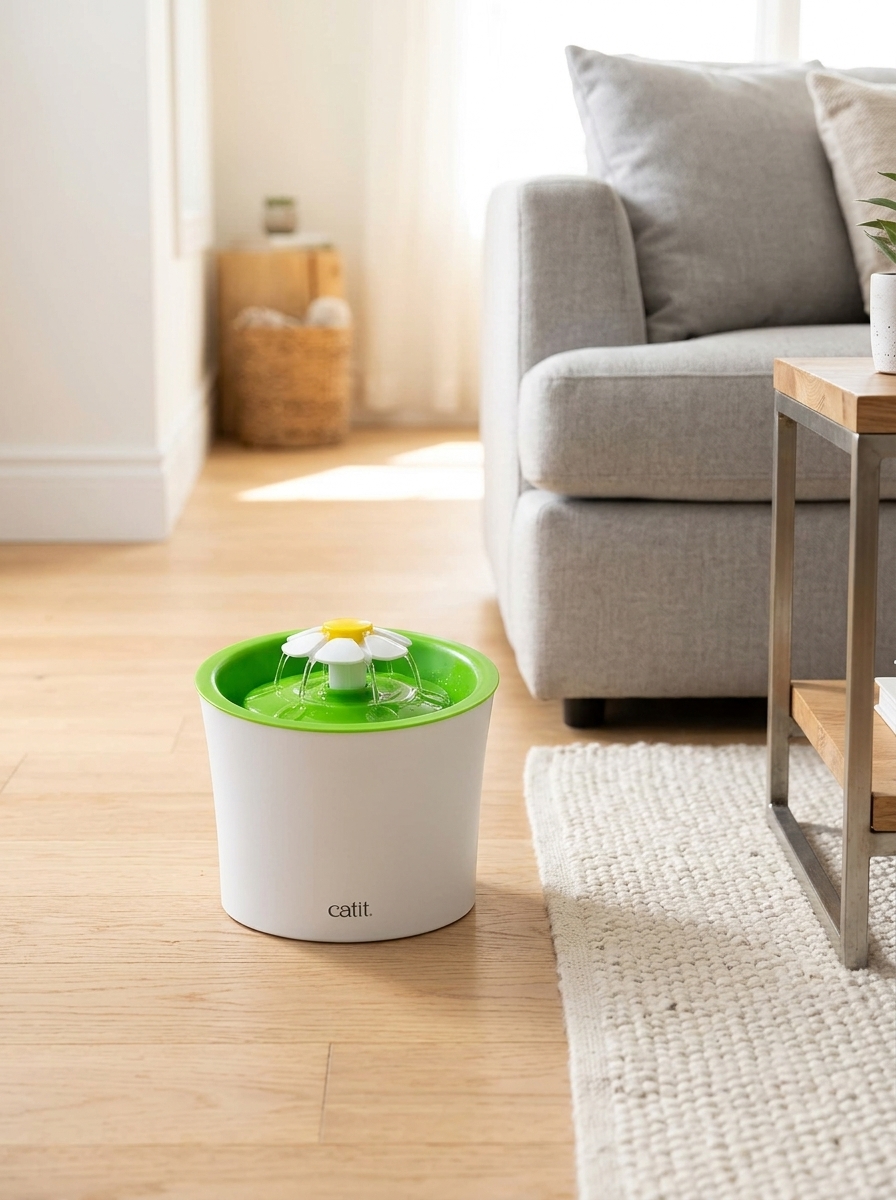
The Catit Flower Fountain is the highest-scoring pet water fountain in our catalog (AIBuyLab Score 8.2/10), with a 3 L reservoir, multi-stage filtration, and a plastic body — but it has no app control, so no filter reminders, no low-water alerts, nothing. The schedule is entirely on you.
The working cadence: top up every 2–4 days, rinse and scrub weekly, swap the filter roughly every 3–4 weeks, deep-clean and descale the pump quarterly.
Filters are the only recurring spend. There is no subscription and no other consumable tracked for this model.
Every interval in this guide is a guidance range built from how a 3 L recirculating plastic reservoir actually behaves — biofilm growth, evaporation, and pump physics — not a quote from the manual.
The Catit Flower Fountain is a corded, free-standing pet water fountain that continuously recirculates 3 litres of water through a multi-stage filter cartridge, presenting it through a flower-shaped top with multiple flow settings. Its body is plastic, it runs on mains power via a small submersible pump, and — the fact that drives this entire guide — it has no app control and no smart features of any kind. No sensor notices the water is low, no timer counts filter days, no notification arrives when the pump starts to struggle. In our Score v1.0 model it earns 8.2/10, the strongest fountain score we track, on capacity, filtration design, and owner-rating data. None of that changes the maintenance reality: a well-designed dumb fountain still becomes a slimy fountain on a predictable schedule, and the only reminder system available is the one you build yourself.
Why the schedule looks like this: the physics of 3 litres of recirculating water
Three forces set every interval below.
Biofilm. Any surface in constant contact with nutrient-bearing water grows a biofilm — the slippery slime layer you feel on the reservoir walls. In a warm room, a noticeable film forms on plastic within about a week, and plastic is more prone to it than steel or ceramic because microscopic scratches from washing give the film anchor points. Once biofilm establishes in the pump housing, a rinse no longer removes it; you need friction — a brush or cloth — and a full water change.
Evaporation and concentration. A 3 L fountain with an exposed flower top loses water to evaporation and drinking around the clock. As the level drops, whatever minerals and organic load are in the water concentrate, and the pump — which must stay submerged to cool and prime — gets closer to running dry. A dry-running pump is the single fastest way to kill a fountain like this.
Scale. Unless you use filtered or distilled water, dissolved minerals plate onto the pump impeller and housing. Scale buildup is slow — a quarterly problem, not a weekly one — but it is cumulative and largely irreversible once the impeller starts to rattle.
The schedule below is simply those three curves turned into a calendar.
The schedule at a glance
Weekly tasks
Task
Why
Time it takes
Full water change (dump, don't just top up)
Resets the biofilm clock and mineral concentration
5 minutes
Scrub reservoir walls, flower top, and stem with a soft cloth or bottle brush
Biofilm needs friction to remove; rinsing alone won't do it
Included above
Rinse the filter cartridge under the tap
Clears trapped hair and surface debris so flow stays even
1 minute
Check pump intake for hair mats
A starved pump cavitates, gets loud, and wears fast
30 seconds
Monthly tasks
Task
Why
Time it takes
Replace the multi-stage filter cartridge (every 3–4 weeks is our guidance range)
The carbon stage exhausts and the mesh loads up; an overdue filter recirculates dirty water
2 minutes
Disassemble and wash all parts with mild dish soap, rinse thoroughly
Soap reaches the biofilm in seams and under the flower stem that a weekly scrub misses
10 minutes
Inspect the cord and pump housing for cracks or swelling
A corded fountain lives next to water permanently; catch damage early
1 minute
Quarterly tasks
Task
Why
Time it takes
Descale the pump: soak pump parts in a 1:1 white vinegar and water solution for 30–60 minutes, then rinse
Dissolves mineral scale on the impeller before it starts rattling or seizing
15 minutes active
Deep-clean the reservoir with a vinegar soak, then rinse until no vinegar smell remains
Strips the mineral film and mature biofilm a normal wash leaves behind
10 minutes active
Check impeller spin by hand (unplugged)
A gritty or stiff impeller is your early warning that the pump is near end of life
1 minute
Top-up rhythm: how often 3 litres actually runs low
Drinking is the other drain on the reservoir, and it scales with cat count. A commonly used veterinary estimate puts a cat's water intake at roughly 40–60 ml per kilogram of body weight per day — for a typical 4–5 kg indoor cat, call it an estimated 200–250 ml per day, more in summer or on a dry-food diet. Treat these figures as estimates, not measurements from your cat.
Against a 3 L reservoir, that arithmetic gives you:
One cat: drinking alone removes roughly 1.5 L a week. Add evaporation and you should expect to top up every 3–4 days to keep the level comfortably above the pump.
Two cats: intake roughly doubles. Expect to top up every 2 days, and treat the weekly full change as non-negotiable — the organic load doubles too.
Three or more cats: you are refilling close to daily. The fountain still works, but be honest with yourself: at this point the 3 L capacity, not the cats, is setting your workload.
The practical rule: never let the level fall to the pump line. Mark your personal "add water" level with a piece of tape on the reservoir the first week, based on where the level sits after two days — your home's evaporation rate is the variable no guide can know.
Per-part care notes
The reservoir. Plastic scratches; scratches harbour biofilm. Use soft cloths and bottle brushes, never abrasive scouring pads, and expect the scrub to matter more over the fountain's life, not less.
The flower top and stem. The narrow stem channel is the part owners most often skip, and it is where flow weakens first. A thin bottle brush or pipe cleaner through the stem at the monthly wash keeps the streams even.
The filter cartridge. Multi-stage cartridges combine a debris mesh with activated carbon. The mesh you can rinse; the carbon you cannot recharge — once it has adsorbed its capacity of taste and odour compounds, it is done, which is why the swap interval exists. Our guidance range is every 3–4 weeks for a one- or two-cat home; heavy use, hard water, or a noticeable return of tap-water taste argues for the shorter end. This is a guidance range derived from how these cartridges behave generally, not a manufacturer specification.
The pump. The pump is the only moving part and the only part that can truly fail. Hair at the intake, scale on the impeller, and dry-running are its three enemies — the weekly intake check, the quarterly descale, and the top-up discipline address one each. A pump that gets louder over a few days is telling you something; check the intake and water level before assuming the worst.
The cost line: filters, and only filters
The Flower Fountain's running-cost structure is as simple as the category gets: electricity for a small pump (negligible at household scale) and replacement filter cartridges. There is no subscription, no app tier, and no other consumable tracked for this model in our catalog. We don't quote a cartridge price here because prices move; the current figure is on the Catit Flower Fountain product page, and the honest way to budget is cartridges-per-year — at a 3–4 week cadence, roughly 13–17 a year.
Contrast that shape with a cordless design like the Petlibro Dockstream Cordless Fountain (Score 7.5/10, 2.5 L): our catalog tracks its consumables at $6.75/month, a steadier, higher baseline that buys you placement freedom and app-connected convenience. The Catit asks for your attention instead of your money — no reminders, but also no ongoing meter running. Which trade suits you depends on whether you are better at remembering a calendar or paying a small bill.
Signs you waited too long
Slimy feel on the reservoir walls — biofilm is established. Do the monthly soap wash now, not at the weekend.
Visible particles circulating — the filter is loaded or bypassing. Rinse it; if the water doesn't clear, swap it early.
Weak or uneven flower streams — usually a clogged stem or a hair mat at the pump intake, occasionally a spent filter raising resistance.
Pump noticeably louder than last month — check level first, intake second, then descale ahead of schedule.
Your cat goes back to the tap or a bowl — cats vote on water freshness with their feet. Treat it as a water-quality alarm, not fussiness.
Sour or swampy smell at a full reservoir — the water is being recirculated, not cleaned. Full change, soap wash, new filter.
Is this schedule from the Catit manual? No. The intervals here are AIBuyLab guidance ranges derived from the fountain's design — a 3 L recirculating plastic reservoir with a multi-stage cartridge — and from how biofilm, evaporation, and scale behave in any fountain of this type. Where our ranges and the manufacturer's instructions differ, following the manufacturer is never wrong; our aim is a schedule owners will actually keep.
Can I stretch the filter to six weeks to save money? You can, and the fountain will still run — but the carbon stage will be exhausted, so you will be recirculating water that is filtered in name only. If cost is the pressure, the weekly scrub and full water change matter more than the cartridge; a clean reservoir with an older filter beats a slimy reservoir with a new one.
Does the lack of an app really matter? For the fountain's core job, no — it circulates and filters water the same regardless. What you lose is every reminder and alert: no low-water warning, no filter countdown, no record of whether the pump stopped while you were away. This schedule exists precisely because the fountain will never nudge you.
How is this different from maintaining a cordless fountain? The hygiene tasks are identical — water, biofilm, and scale don't care about the power source. A cordless model like the Dockstream adds battery care and, per our catalog data, a higher tracked consumable cost ($6.75/month), while removing the cord-routing constraint. The Catit's cord means placement near an outlet, but also that it can never die quietly on a flat battery.
What water should I fill it with? Tap water is fine for most homes and is what the maintenance cadence above assumes. If your water is very hard, expect the quarterly descale to become a monthly one, or use filtered water and watch the scale problem mostly disappear. Avoid distilled water as a default — most cats drink it happily, but it changes mineral intake; if you're considering it, that's a question for your vet, not a fountain guide.
My pump stopped. Is the fountain dead? Not necessarily. Unplug it, check that the water level covers the pump, clear the intake, and spin the impeller by hand after a vinegar soak. Pumps on fountains of this class most often stop from hair, scale, or dry-running — all three are addressed in the schedule above, and all three are cheaper to prevent than to fix.
Last updated: November 27, 2026
Changelog
November 27, 2026 — Added retailer buying links (Our pick and Where to buy) for the products covered in this article.
Related in this category
Pet Tech · Pet Water Fountains · Updated Nov 22, 2026
Across 17 tracked fountains: plastic dominates (12 of 17), capacities run 1.5–9.5 L, and only 1 maker publishes a filter cost — the hygiene field that decides what a fountain really costs to keep clean.
Pet Tech · Pet Water Fountains · Updated Nov 21, 2026
As of 2026-11-21, we track 17 pet water fountains from 11 brands, scored with Score v1.0 from owner ratings, spec strength and ownership cost. Catit Flower Fountain leads the list at 8.2/10. Tracked prices run from $17 to $100; the full table below is sortable by score and price.

Discussion
No comments yet