Email me when Whisker Feeder-Robot drops to my target price. The confirmation includes a manage link — use it any time to list or remove your alerts at Your price alerts. Lowest price tracked so far: USD 299.00 — a target below that is below the historical low and less likely to be reached.
Disclosure: AIBuyLab may earn a commission from qualifying purchases made through links on this page. This comparison is based on manufacturer specifications and our product catalog data — we have not hands-on tested either feeder, and no score or claim below is based on in-person use.
TL;DR
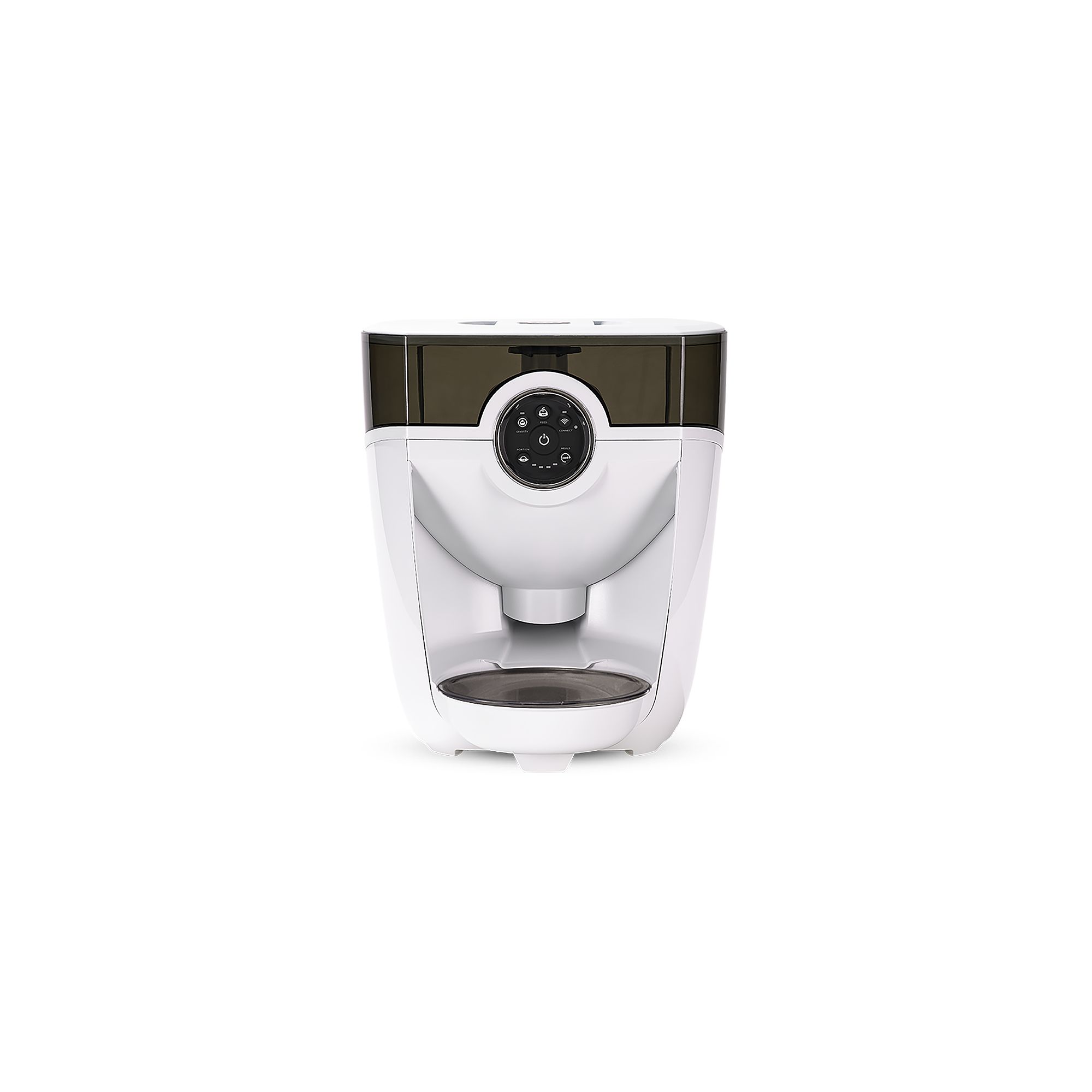
The Whisker Feeder-Robot and the Petlibro One RFID Smart Feeder are both app-controlled automatic dry-food feeders with battery backup, but they solve different problems. The Feeder-Robot is a volume machine: a 7.68 L hopper and up to 8 scheduled meals a day make it the pick for multi-cat households and travel. The Petlibro One RFID is a gatekeeper: its 3 L hopper is much smaller, but its RFID tag recognition restricts bowl access to one specific pet, which is the feature that matters for prescription diets and food thieves. Both score low-to-mid in our catalog (4.1 vs 3.8), and Score v1.0 leans on thin aggregated ratings for this class — so judge this one on use case, not on the 0.3-point gap.
What an automatic feeder with pet recognition actually is
An automatic feeder is a hopper-fed dispenser that releases measured portions of dry food on a schedule you set, usually through an app. Most feeders are indiscriminate: whatever food lands in the bowl is available to any animal that walks up to it. That is fine for a single-pet home, but it breaks down in two common situations — when one pet eats everyone's food, or when one pet is on a prescription diet the others must not touch.
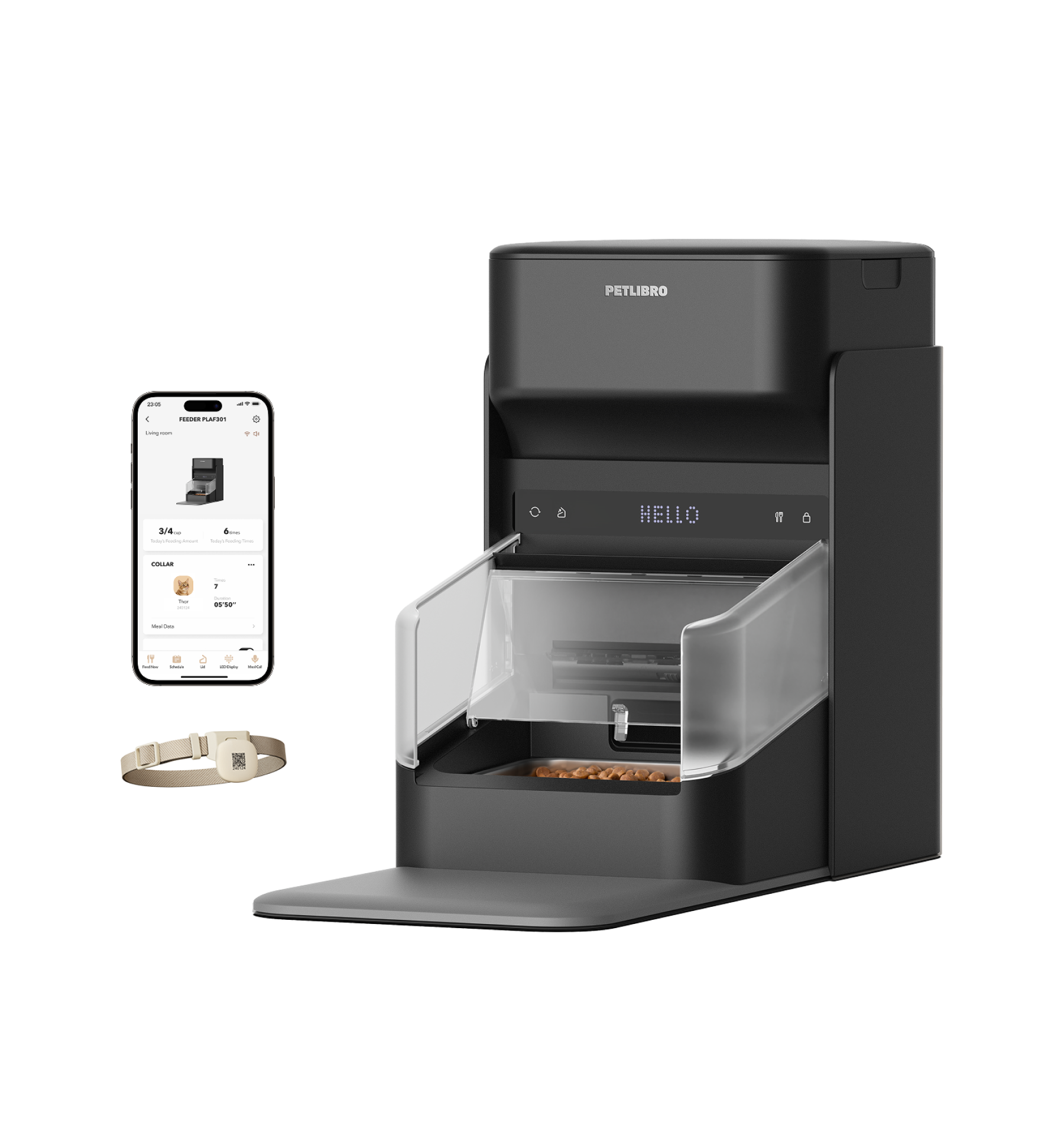
Pet recognition is the fix for the second problem. In the RFID-tag design used here, the pet wears a small tag on its collar, and a reader in the feeder detects that tag when the pet approaches. Only the tagged pet triggers the feeder to open access to the food; an untagged pet standing at the same bowl gets nothing. It is an access-control system for a food bowl — the feeder stops being a shared buffet and becomes a single-pet station. Of the two feeders in this comparison, only the Petlibro One RFID has it. The Feeder-Robot has no pet recognition at all, which is not a flaw so much as a statement of purpose: it is built to feed, in quantity, on schedule.
The spec sheet
Whisker Feeder-Robot
Petlibro One RFID Smart Feeder
AIBuyLab Score (v1.0)
4.1
3.8
Hopper capacity
7.68 L
3 L
Meals per day
Up to 8
Up to 10
Pet recognition
None
RFID tag
Camera
No
No
App control
Yes
Yes
Battery backup
Yes
Yes
Food type
Dry only
Dry only
Subscription required
No
No
Warranty
1 year
Not tracked in our catalog
Read the table and the real story is capacity versus access control. The Feeder-Robot's hopper holds roughly two and a half times what the Petlibro's does. Nearly everything else — app control, battery backup, dry-only dispensing, no subscription, no camera on either unit — is shared.
Volume feeding: where the Feeder-Robot wins
The Feeder-Robot's 7.68 L hopper is the headline. In a multi-cat household, hopper size translates directly into refill interval: a bigger reservoir means the feeder keeps working through a long weekend or a work trip without anyone topping it up. For households feeding several cats on the same food, this is the single most practical spec on the page.
Its schedule is also generous — up to 8 meals per day gives you fine-grained portion control across the day, which suits cats that do better on many small meals than two large ones. Battery backup means a power outage does not silently cancel dinner, and app control lets you adjust the schedule or trigger an extra portion remotely.
The limitation is structural: with no pet recognition and no camera, the Feeder-Robot cannot tell you who ate, or stop anyone from eating. Every cat in the house has equal access to every portion it dispenses. If your household's problem is simply "feed several cats reliably while we're away," that limitation never bites. If your problem is one specific cat, it is the whole story — and this is the wrong tool.
Food-theft control: where the Petlibro One RFID wins
The Petlibro One RFID exists for the household where open access is the problem. The classic cases: one cat on a prescription or weight-management diet that the others must not eat, a grazer whose food is stolen by a faster housemate, or a dog that treats the cat's feeder as a snack station. RFID tag recognition addresses all three by tying bowl access to the tagged pet's collar. The right pet approaches, the feeder recognizes the tag, and access opens. Everyone else is locked out by default.
That gatekeeping comes with trade-offs you should accept with open eyes. The hopper is 3 L — less than half the Feeder-Robot's — so refill frequency roughly doubles, and this is fundamentally a one-pet station rather than a household feeder; a second pet on a different diet would need its own unit and its own tag. Interestingly, its scheduling ceiling is higher: up to 10 meals per day, the finer-grained option of the two, which pairs well with slow, portioned feeding plans for a single cat.
Like its rival, it has app control and battery backup, and neither feeder has a camera — if visual confirmation of who ate matters to you, neither model in this pairing provides it.
About those scores
The Feeder-Robot scores 4.1 and the Petlibro One RFID scores 3.8 in our catalog. Both are low-to-mid for the automatic feeder class, and we want to be plain about what that means: Score v1.0 leans on thin aggregated ratings for feeders in this segment, so these numbers carry more uncertainty than our scores in data-rich categories. Treat the 0.3-point gap as noise. The decision here should be made on the use-case split above — capacity versus access control — not on the score line.
Verdict
Choose the Whisker Feeder-Robot if you feed multiple cats the same dry food, travel regularly, or simply want the longest possible interval between refills. Its 7.68 L hopper, 8-meal scheduling, battery backup, and app control make it the stronger household workhorse — see the full specs on the Feeder-Robot product page.
Choose the Petlibro One RFID Smart Feeder if one pet's food must be protected from the others — a prescription diet, a food thief, or a slow eater who loses every meal to a faster cat. RFID tag recognition is the deciding feature, and it is the only one of the two that has it. Accept the smaller 3 L hopper and one-pet scope as the price of that control — details are on the Petlibro One RFID product page.
If your household has neither a volume problem nor a theft problem, honestly, either feeder's shared core — app scheduling plus battery backup on dry food — covers the basics. But most buyers shopping this pair have one of those two problems, and the right answer is whichever machine was built for yours.
Can the Petlibro One RFID feed two cats on different diets? Not from one unit. RFID recognition gates access to a single tagged pet per feeder, so two pets on different diets would each need their own feeder and their own tag. The Feeder-Robot, by contrast, feeds multiple cats — but only the same food, with no way to separate diets.
What happens to each feeder during a power outage? Both models have battery backup, so scheduled dispensing continues when the mains power drops. That is one of the shared strengths of this pairing.
Does either feeder have a camera? No. Neither the Feeder-Robot nor the Petlibro One RFID includes a camera, so neither offers visual confirmation of a pet eating. If camera monitoring is a requirement, you will need to look at a different model class.
How much more food does the Feeder-Robot hold? Its hopper is 7.68 L versus the Petlibro's 3 L — roughly two and a half times the capacity, which translates into proportionally longer intervals between refills.
Which feeder allows more meals per day? The Petlibro One RFID, at up to 10 scheduled meals per day, versus up to 8 for the Feeder-Robot. Both allow multiple small portions rather than one or two large ones.
Is a subscription required for either feeder? No. Our catalog lists both models as requiring no subscription for their core feeding functions.
---
Last updated: November 27, 2026
Changelog
November 27, 2026 — Added retailer buying links (Our pick and Where to buy) for the products covered in this article.
Related in this category
Pet Tech · Automatic Cat Feeders · Updated Nov 21, 2026
As of 2026-11-21, we track 16 automatic cat feeders from 9 brands, scored with Score v1.0 from owner ratings, spec strength and ownership cost. PETKIT Fresh Element Solo leads the list at 8.0/10. Tracked prices run from $47 to $299; the full table below is sortable by score and price.
The VOLUAS Automatic Cat Feeder 4L (Score 7.8 in our catalog) has no app, no camera, and no account — so its entire ownership contract is physical: desiccant, dust, seals, and batteries.
- The working
Discussion
No comments yet