Price alerts — WOPET Heritage View Pet Feeder with Camera (Dual Bowls)
Price-drop alert
Email me when WOPET Heritage View Pet Feeder with Camera (Dual Bowls) drops to my target price. The confirmation includes a manage link — use it any time to list or remove your alerts at Your price alerts. Lowest price tracked so far: USD 119.99 — a target below that is below the historical low and less likely to be reached.
Affiliate disclosure: This article is desk research. We compiled it from the manufacturer's published specifications and our own catalog data; we did not hands-on test this feeder, and no maintenance interval below is a measured result. Every cadence in this guide is a planning estimate — a sensible starting rhythm you can adjust to your home, your cat, and your kibble. If AIBuyLab earns a commission through a link on this page, it does not change the schedule we recommend.
TL;DR
The VOLUAS Automatic Cat Feeder 4L (Score 7.8 in our catalog) has no app, no camera, and no account — so its entire ownership contract is physical: desiccant, dust, seals, and batteries.
The working rhythm (all planning estimates): swap desiccant every 4–6 weeks, clear portion-mechanism dust monthly, deep-clean the hopper every 2–3 months, inspect the lid seal quarterly, and replace the battery set on a fixed 4–6 month cycle whether it looks tired or not.
Battery discipline is the one non-negotiable. On a battery-powered feeder, a dead battery set is not an inconvenience — it is a missed meal with no notification, because there is no app to warn you.
Budget roughly 2–3 battery sets and 8–12 desiccant packs per year as planning-estimate consumable counts. That, plus about ten minutes a month, is the whole upkeep bill.
What the VOLUAS Automatic Cat Feeder 4L Is
The VOLUAS Automatic Cat Feeder 4L is an offline automatic cat feeder: a 4 L hopper that dispenses dry food only, on a timer, up to 4 meals per day. It carries a Score of 7.8 in our catalog. What defines it is what it leaves out. There is no app control, so nothing is configured or changed from a phone. There is no camera, so it never shows you the bowl. There is no pet recognition, so it cannot tell one cat from another — or from a determined raccoon, for that matter. Power comes from batteries, with the battery set serving as the backup and the primary strategy at once: there is no cloud service keeping this feeder honest, only the hardware in your kitchen.
That simplicity is the product's appeal, and it cuts both ways. A connected feeder can ping you when its hopper runs low or its motor jams. The VOLUAS cannot. Every failure mode it has — stale kibble, a dust-choked dispensing mechanism, a swollen lid seal, a dying battery — arrives silently. The maintenance schedule below is therefore not a nice-to-have accessory to ownership. It is the mechanism by which an offline feeder stays reliable, and it is the whole contract you sign when you choose a feeder with no firmware and no account attached.
The Schedule at a Glance
All intervals are planning estimates, extrapolated from the feeder's tracked design — a 4 L dry-food hopper, up to 4 dispensing events per day, and battery power — rather than from manufacturer-stated service intervals.
Task
Cadence (planning estimate)
Why it matters
Desiccant pack swap
Every 4–6 weeks
A 4 L hopper holds weeks of kibble; moisture is its enemy
Portion-mechanism dust clear
Monthly
Kibble dust migrates into the dispensing path and skews portions
Hopper and bowl deep clean
Every 2–3 months
Fat residue from kibble coats surfaces and turns rancid
Lid seal inspection
Quarterly
A warped or dirty seal defeats the desiccant entirely
Battery set replacement
Every 4–6 months, on schedule
No app warning exists; a fixed cycle is the only safeguard
Full schedule review
Twice a year
Re-check meal count and portion size against your cat's condition
Desiccant: The 4–6 Week Swap
A 4 L hopper is generous, and that generosity is a freshness liability. Filled to the top, it can hold several weeks of dry food, and every day that food sits in a kitchen it exchanges moisture with the room air each time the lid opens or the mechanism cycles. Desiccant is the countermeasure: a moisture-absorbing pack, typically seated in the lid, that keeps the hopper's internal air dry. Desiccant saturates. Once it has absorbed all the water it can hold, it stops protecting the food while looking exactly the same as a fresh pack — another silent failure.
Swap the pack every 4–6 weeks as a planning estimate, and lean toward the shorter end in humid climates, in summer, or if the feeder lives near a stove or dishwasher that vents steam. If your cat eats slowly and a fill lasts longer than six weeks, treat the desiccant swap as the trigger to check the kibble itself: food that has sat past the desiccant's protection window should be judged on smell and texture, not on the calendar. As a planning-estimate count, expect to use roughly 8–12 packs per year.
Portion-Mechanism Dust: The Monthly Clear
Dry kibble sheds. Every bag carries a residue of crumbs and fine dust, and a dispensing mechanism that turns up to 4 times a day works that dust steadily into its moving parts. The first symptom is rarely a jam; it is portion drift — meals that come out slightly light or slightly heavy because dust is occupying space in the measuring path or adding friction to it. On an app-connected feeder, a camera might let you spot the drift. On the VOLUAS, your only instrument is the schedule.
Once a month, as a planning estimate, empty the bowl, run the mechanism's path clear of loose kibble, and brush or wipe the dust out of the dispensing outlet and rotor area with a dry brush or cloth. Do not wash components that are not specified as washable, and let anything you do rinse dry completely before kibble goes back in — moisture introduced during cleaning undoes the desiccant's work. If portions still look uneven after a dust clear, that is a mechanical problem, not a cleaning problem, and it is time to contact the manufacturer rather than escalate the scrubbing.
Seals: The Quarterly Inspection
The lid seal is the desiccant's partner. Desiccant can only dry the air that is inside the hopper; if the seal leaks, humid kitchen air replaces that dried air continuously and the pack saturates in days instead of weeks. Once a quarter, as a planning estimate, run a fingertip around the seal: you are feeling for warping, cracks, embedded kibble crumbs, and the greasy film that kibble fat leaves behind. Wipe the seal and its mating surface clean, and confirm the lid closes with even pressure all the way around. A seal that no longer sits flat is a replacement item, not a cleaning item — no amount of fresh desiccant compensates for it. This two-minute check is the highest-value line on the whole schedule, because it protects every other line.
Batteries: The Fixed-Cycle Rule
On this feeder, battery backup is not a fallback layered over mains power; the battery-powered design means the battery set is the power strategy. That changes the discipline completely. A connected feeder on mains power can warn you through its app when something is wrong. A battery feeder whose cells fade simply dispenses weaker, then late, then not at all — and it tells no one. Your cat's first missed meal is the notification.
The countermeasure is a fixed replacement cycle that ignores how the batteries seem to be doing. Replace the full set every 4–6 months as a planning estimate, on a date you choose in advance, and write the date on a label stuck to the feeder. Replace the whole set at once rather than topping up individual cells, since mixing old and new cells lets the weakest one govern the set. As a planning-estimate count, that works out to roughly 2–3 sets per year. Keep the next set in the same drawer as the desiccant packs; the two consumables are this feeder's entire supply chain. If your household includes travel, align the battery change with your longest trip of the season, so the freshest set covers the days nobody is home to notice a problem.
How It Compares on Upkeep
The maintenance burden here is the mirror image of a connected feeder's. Something like the Petlibro Air WiFi Feeder spreads its upkeep across the physical and the digital: the same desiccant-and-dust routine, plus firmware, app permissions, and account credentials to keep current. The VOLUAS deletes the digital half entirely and concentrates everything into a short list of physical tasks that never change. Neither profile is objectively lighter; they are differently shaped. If you are the kind of owner who keeps a calendar reminder and a small stock of consumables, the VOLUAS's contract is simple and cheap. If you know you will forget, an app that nags you may be worth more than any schedule printed in a guide like this one.
Verdict
The VOLUAS Automatic Cat Feeder 4L asks for about ten minutes a month, a quarterly two-minute seal check, a battery set changed on faith twice a year or so, and a modest stock of desiccant packs. In exchange, it offers a feeder with no account to breach, no app to abandon it, and no subscription-shaped surprises. The schedule is the whole ownership contract — keep it, and a Score-7.8 offline feeder stays exactly as reliable as the day you filled it. Skip it, and the failures will not announce themselves; they will simply accumulate in the hopper. For a machine with no way to speak, the calendar has to speak for it.
FAQ
How often should I replace the desiccant pack? Every 4–6 weeks as a planning estimate — sooner in humid conditions. The pack gives no visible signal when it is saturated, so the calendar, not its appearance, is the guide. Expect roughly 8–12 packs per year.
What happens if the batteries die while I am away? The feeder stops dispensing and, having no app or camera, sends no warning. This is why the fixed 4–6 month replacement cycle matters more than any other item on the schedule: it makes an unobserved dead battery a near-impossibility rather than a matter of luck.
Can I skip the monthly dust clear if portions look fine? Portion drift is gradual, and by the time it is visible in the bowl it has usually been building for weeks. The monthly clear is a planning estimate precisely because it is cheap insurance — a dry brush and two minutes — against a problem that is otherwise hard to detect on a feeder with no feedback channel.
Does the feeder need any software maintenance? No. With no app control and no account, there is no firmware to update, no password to rotate, and no service that can be discontinued out from under the hardware. The physical schedule in this guide is the complete maintenance picture.
How many meals a day can the schedule support? The feeder dispenses up to 4 meals per day of dry food only, per its catalog specifications. More frequent dispensing cycles move more kibble dust through the mechanism, so homes running all 4 meals should hold to the monthly dust clear rather than stretching it.
Is wet food ever an option in this feeder? No. The VOLUAS 4L is a dry-food-only design, and it has no pet recognition or cooling. Wet food belongs in a feeder built for it; putting it in a dry hopper would defeat the desiccant system and the dispensing mechanism alike.
Last updated: November 27, 2026
Related in this category
Pet Tech · Automatic Cat Feeders · Updated Nov 21, 2026
As of 2026-11-21, we track 16 automatic cat feeders from 9 brands, scored with Score v1.0 from owner ratings, spec strength and ownership cost. PETKIT Fresh Element Solo leads the list at 8.0/10. Tracked prices run from $47 to $299; the full table below is sortable by score and price.
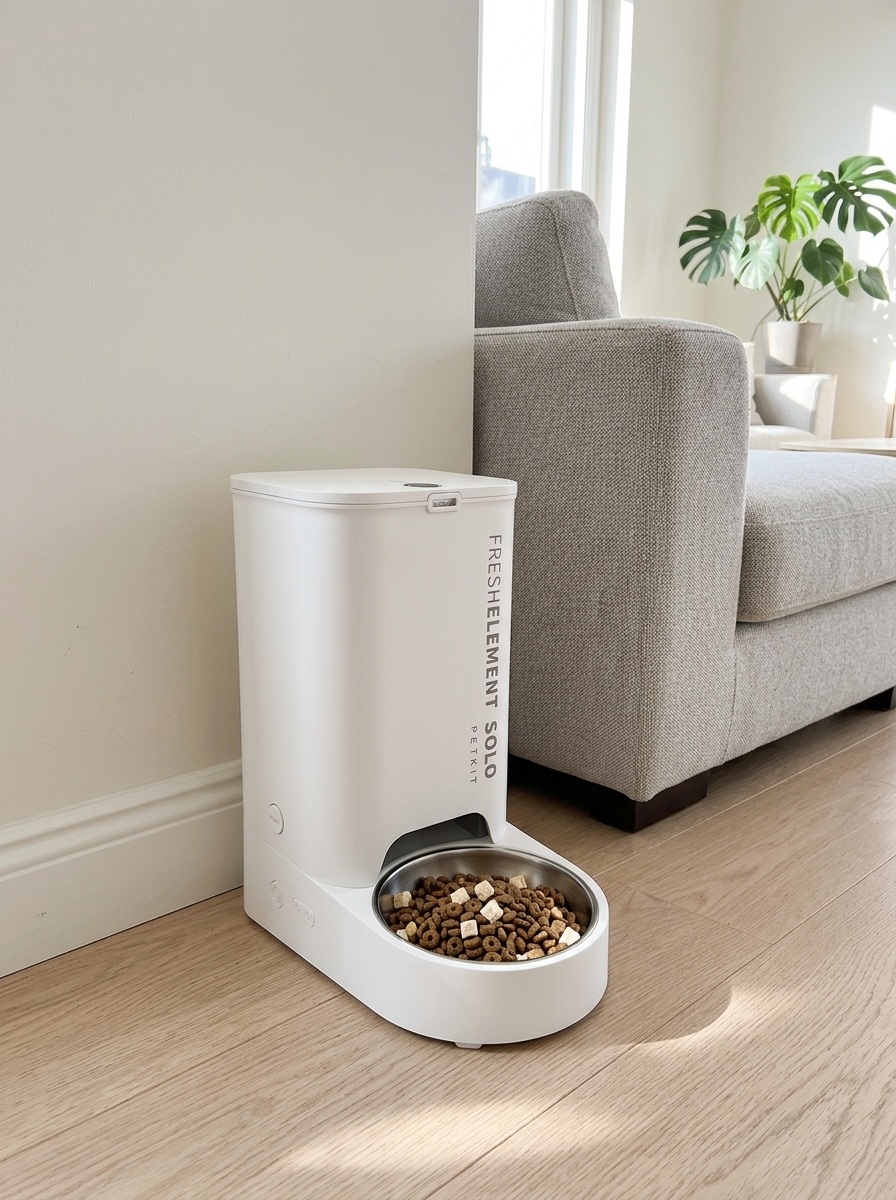
The PETKIT Fresh Element Solo carries a Score of 8.0 in our catalog — one of the strongest ratings we track in the compact feeder class.
- Our catalog tracks no consumable cost and no subscription for


Discussion
No comments yet