Price alerts — WOPET Heritage View Pet Feeder with Camera (Dual Bowls)
Price-drop alert
Email me when WOPET Heritage View Pet Feeder with Camera (Dual Bowls) drops to my target price. The confirmation includes a manage link — use it any time to list or remove your alerts at Your price alerts. Lowest price tracked so far: USD 119.99 — a target below that is below the historical low and less likely to be reached.
Affiliate disclosure: AIBuyLab may earn a commission from qualifying purchases made through links on this page. This article is desk research built from manufacturer specifications and our product catalog — we did not hands-on test either feeder, and no score or verdict here comes from in-person use.
TL;DR
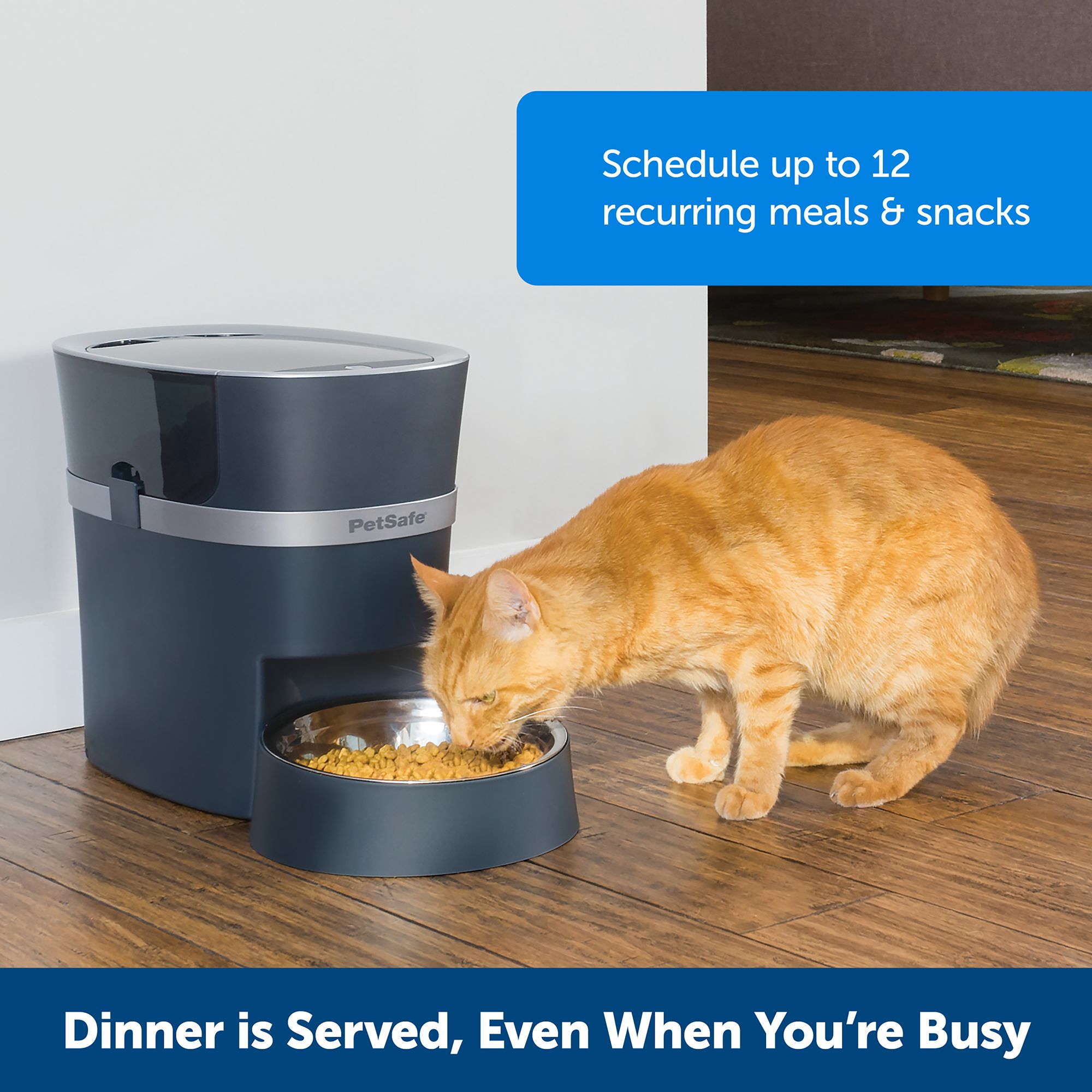
The PetSafe Smart Feed is the bigger, more flexible machine: a 5.76 L hopper and up to 12 meals a day, the deepest feeding schedule in this comparison.
The Petlibro One RFID Smart Feeder is smaller — a 3 L hopper and 10 meals a day — but it does one thing the PetSafe cannot: it recognizes an RFID collar tag and serves only the tagged pet.
Neither feeder has a camera, both run on app control with battery backup, and both are dry-food only.
One-pet home: buy the Smart Feed. Multi-pet home with a prescription diet or a food thief: the One RFID's gatekeeping is the entire point, and its lower Score does not change that.
What an Automatic Smart Feeder Is
An automatic smart feeder is a hopper-fed dispensing machine that stores dry food in bulk and releases measured portions on a schedule you set from a phone app. The category splits into two philosophies. Capacity feeders optimize for volume and scheduling freedom — bigger hoppers, more meals per day, longer stretches between refills. Access-control feeders optimize for who eats: they use a sensor — here, an RFID tag worn on a collar — to open or serve only for an authorized pet. The PetSafe Smart Feed is the archetype of the first philosophy. The Petlibro One RFID is the archetype of the second. Comparing them is less about which is "better" and more about which problem your household actually has.
Spec Comparison
Spec
PetSafe Smart Feed
Petlibro One RFID Smart Feeder
AIBuyLab Score (v1.0)
7.8
3.8
Hopper capacity
5.76 L
3 L
Max meals per day
12
10
Pet recognition
None
RFID tag
Camera
No
No
App control
Yes
Yes
Battery backup
Yes
Yes
Food type
Dry only
Dry only
Every figure above comes from our catalog's tracked specifications. Fields our catalog does not track for a model are simply not claimed here.
Capacity and Schedule: Where the Smart Feed Runs Away With It
The Smart Feed's 5.76 L hopper holds nearly twice the One RFID's 3 L. In practical terms, that is the difference between refilling roughly every couple of weeks and refilling most weeks for a typical single cat — the exact interval depends on portion size and meals per day, but the ratio is fixed by the hardware. If you travel for long weekends or simply hate the refill chore, capacity is not a minor convenience; it is the feature you will feel most often.
The schedule gap compounds it. Twelve meals a day versus ten sounds like a rounding difference, but it matters for the feeding patterns vets increasingly recommend: many small meals spread across the day rather than two large ones, dawn-and-dusk grazing splits for cats prone to scarf-and-barf, and slow weight-loss plans built on frequent micro-portions. The Smart Feed's deeper schedule gives you more shapes to work with. The One RFID's ten meals still covers most real feeding plans — but it is a ceiling you can hit, where the PetSafe's is one you probably won't.
Access Control: The One Feature That Decides Everything
The One RFID's defining spec is the one the Smart Feed lacks entirely: pet recognition. The Petlibro reads an RFID tag on your pet's collar and serves only when the tagged pet is at the bowl. The PetSafe has no recognition of any kind — any pet who walks up when food is dispensed, or who learns to linger near the bowl at mealtimes, eats.
That single difference flips the verdict for a specific and common household: multiple pets where one is on a prescription diet. Renal food, urinary food, weight-management food — these diets fail the moment the wrong cat eats from the bowl, and they fail expensively, in both the wasted medicated food and the untreated condition. The same logic applies to the classic two-cat problem: one grazer, one thief. An open feeder cannot solve either problem at any hopper size. The One RFID can, because gatekeeping is not a feature it added — it is the product.
There are honest limits to state. RFID gating controls access at this feeder; it does not stop a determined thief from eating out of a second, ungated bowl elsewhere in the house, and the system depends on the tagged pet actually wearing its collar tag. It also means the One RFID serves one recognized pet per unit — a household with two pets on two different special diets is looking at a more complicated setup than a single gated feeder.
Why the Score Gap Is So Wide — and Why It Misleads Here
A 7.8 against a 3.8 looks like a rout, so the gap deserves an honest explanation. Our Score (v1.0) rewards breadth across the tracked spec sheet: capacity, schedule depth, feature count, and the general flexibility a machine offers an average buyer. The Smart Feed wins nearly every one of those rows — bigger hopper, more meals, a spec sheet with no obvious thin spots. The One RFID's sheet is thinner almost everywhere, and its one exceptional capability sits in a single row (pet recognition) that the scoring weighs as one feature among many.
That is a fair way to score feeders for a typical one-pet household, and it is exactly the wrong way to read this particular pair. A composite score measures how much a machine does. It cannot measure whether the one thing a machine does is the thing your household cannot live without. If no pet in your home needs dietary separation, the One RFID's gatekeeping is worth close to zero to you, and the Score gap reflects your reality well. If one pet does, the gatekeeping is worth more than every other row in the table combined — and the Score gap is simply measuring a different question than the one you are asking.
Shared Ground: What Both Machines Give You
The two feeders agree on the fundamentals. Both are app-controlled, so schedules and portions are set from your phone rather than by crouching over a button panel. Both carry battery backup, which is the difference between a power outage being a non-event and a missed-meal problem. Both are dry-food only — neither belongs in a wet-food feeding plan. And neither has a camera: if watching your pet eat from work is part of the appeal, neither of these machines offers it, and you should be shopping a different shortlist entirely rather than treating it as a tiebreaker here.
Verdict
Buy the PetSafe Smart Feed if you have one pet, or several pets who all eat the same food. It is the more capable machine by almost every tracked measure — nearly double the hopper, the deepest meal schedule in this pair, and a Score that reflects that breadth. For the majority of households, this is the right answer and it is not close.
Buy the Petlibro One RFID if one of your pets eats a prescription or otherwise restricted diet, or one pet reliably steals another's food. In that household the Smart Feed is not the better machine that lacks a feature; it is the wrong machine, because it cannot do the one job the feeder exists to do. Accept the smaller hopper and the more frequent refills as the price of a bowl that only opens for the right cat.
FAQ
Can the PetSafe Smart Feed keep one cat out of another cat's food? No. The Smart Feed has no pet recognition in our catalog's tracked specs — any pet at the bowl when food is served can eat it. Dietary separation is the One RFID's job.
How does the Petlibro One RFID know which pet is at the bowl? It reads an RFID tag worn on the pet's collar and serves only for the tagged pet. That is the sole recognition method our catalog tracks for this model; it has no camera-based recognition.
Which feeder is better for a two-week vacation? On tracked specs, the Smart Feed: its 5.76 L hopper is nearly twice the One RFID's 3 L, so it stretches far longer between refills at the same portion settings. Both have battery backup for outages.
Does either feeder work with wet food? No. Both are tracked as dry-food only in our catalog.
Can I watch my pet eat with either feeder? No. Neither model has a camera. If video matters to you, look at camera feeders instead of treating it as a deciding factor between these two.
Why is the One RFID's Score so much lower if it has the unique feature? Because our Score (v1.0) aggregates breadth across the whole spec sheet — capacity, schedule, features — and the Smart Feed wins most rows. The score does not weight "the one feature your household needs" above the rest. For a prescription-diet household, that single row outweighs the aggregate.
Last updated: November 27, 2026
Related in this category
Pet Tech · Automatic Cat Feeders · Updated Nov 21, 2026
As of 2026-11-21, we track 16 automatic cat feeders from 9 brands, scored with Score v1.0 from owner ratings, spec strength and ownership cost. PETKIT Fresh Element Solo leads the list at 8.0/10. Tracked prices run from $47 to $299; the full table below is sortable by score and price.
The VOLUAS Automatic Cat Feeder 4L (Score 7.8 in our catalog) has no app, no camera, and no account — so its entire ownership contract is physical: desiccant, dust, seals, and batteries.
- The working
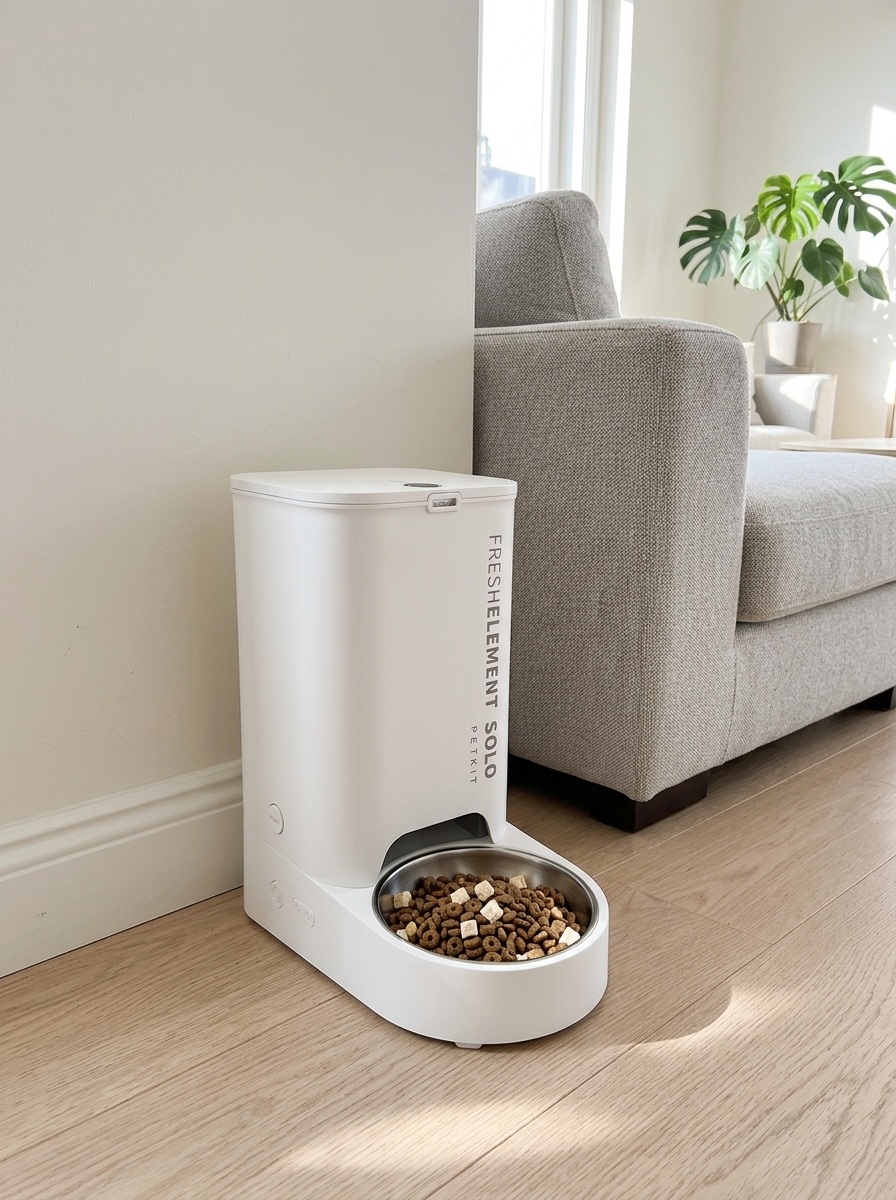
The PETKIT Fresh Element Solo carries a Score of 8.0 in our catalog — one of the strongest ratings we track in the compact feeder class.
- Our catalog tracks no consumable cost and no subscription for


Discussion
No comments yet