Price alerts — WOPET Heritage View Pet Feeder with Camera (Dual Bowls)
Price-drop alert
Email me when WOPET Heritage View Pet Feeder with Camera (Dual Bowls) drops to my target price. The confirmation includes a manage link — use it any time to list or remove your alerts at Your price alerts. Lowest price tracked so far: USD 119.99 — a target below that is below the historical low and less likely to be reached.
Affiliate disclosure: AIBuyLab may earn a commission from qualifying purchases made through links on this page. This comparison is desk research based on manufacturer specifications and our catalog data — we did not hands-on test either feeder, and no score or verdict here comes from in-person use.
That gap is not a mistake: Score v1.0 weighs the whole spec sheet, not raw capacity, and the Feeder-Robot gives back points on meal scheduling flexibility and its short 1-year warranty.
On vacation math alone, the Feeder-Robot wins clearly — 7.68 L stretches roughly twice as far between refills as 3.5 L.
For everyday feeding in a home where someone is around most days, the HoneyGuaridan is the better-matched pick. For long trips and multi-cat households, the Feeder-Robot's reservoir is the deciding factor.
What These Two Feeders Are
An automatic WiFi cat feeder is a dry-food dispenser with a sealed hopper, a portioning mechanism, and an app-connected schedule: you set meal times and portion sizes, and the feeder drops kibble into the bowl whether or not you are home. Both feeders in this comparison fit that definition. Both offer app control, battery backup so a power outage does not cancel dinner, dry-food-only operation, and no camera and no pet recognition — neither one can tell you which cat ate, or show you the bowl.
Where they diverge is scale. The HoneyGuaridan is a compact single-cat-class feeder built around a 3.5 L hopper and up to 6 scheduled meals per day. The Whisker Feeder-Robot is the large-format sibling in this pairing: a 7.68 L hopper — about 2.2× the HoneyGuaridan's capacity — with up to 8 scheduled meals per day, backed by a 1-year warranty.
Spec Table
Spec
HoneyGuaridan 5G WiFi Feeder
Whisker Feeder-Robot
AIBuyLab Score (v1.0)
5.7
4.1
Hopper capacity
3.5 L
7.68 L
Max scheduled meals/day
6
8
App control
Yes
Yes
Battery backup
Yes
Yes
Food type
Dry only
Dry only
Camera
No
No
Pet recognition
None
None
Warranty
Not tracked in our catalog
1 year
Every figure above comes from our catalog's manufacturer-spec data. Where a field is not tracked, we say so rather than guess.
Why the Smaller Feeder Scores Higher
It looks backwards at first glance: the Feeder-Robot holds 2.2× the food and offers two more meals per day, yet it trails by 1.6 points. The explanation is that Score v1.0 is a weighted read of the full catalog record, not a capacity contest. Capacity is one input; scheduling granularity, feature completeness against the category checklist, and ownership terms are others.
On those other inputs, the Feeder-Robot gives ground back. Its 1-year warranty is the shortest coverage term we track in this feeder class, and a feeder is a motor-and-auger appliance that runs multiple times a day, every day — warranty length is a real ownership variable, not fine print. The HoneyGuaridan, meanwhile, covers the category's core checklist — app scheduling, battery backup, portioned dry-food dispensing — in a smaller body without the gaps that pull the Feeder-Robot's composite down.
The honest takeaway: the Score says the HoneyGuaridan is the more complete everyday feeder per our weighting. It does not say the Feeder-Robot is the wrong purchase. If your binding constraint is days-between-refills, capacity outranks the composite — which is exactly what the next section quantifies.
The Vacation Math
Refill interval is the one number that decides whether an automatic feeder actually covers a trip. The arithmetic is simple: hopper capacity divided by daily ration. Using labeled planning estimates — dry kibble at roughly 0.5 L per 100 g, and a typical adult cat eating 60–80 g of dry food per day — one cat consumes about 0.30–0.40 L of hopper volume daily. These are estimates, not measurements; your cat's ration and your kibble's density will move them.
HoneyGuaridan (3.5 L): roughly 9–12 days for one cat; roughly 4–6 days for two cats.
Feeder-Robot (7.68 L): roughly 19–25 days for one cat; roughly 10–13 days for two cats.
Two cautions belong on top of those ranges. First, dry food stales in a hopper; a three-week fill is a storage compromise even when the math allows it, and shorter fills with fresher food are the better practice when someone is home. Second, no feeder replaces a human check-in on a long trip — battery backup covers outages, not every failure mode, and neither of these feeders has a camera to confirm a meal actually dropped. For trips beyond a few days, a sitter visit plus a feeder beats a bigger hopper alone.
What the math does settle: for a one-week trip with two cats, the HoneyGuaridan sits at the edge of its range while the Feeder-Robot covers it with half its hopper to spare. For a long weekend, both are comfortably sufficient, and capacity stops being a reason to choose.
Scheduling and Daily Life
Day to day, the differences narrow. Six scheduled meals a day (HoneyGuaridan) versus eight (Feeder-Robot) matters only to households splitting rations into many small portions — grazers on vet-directed micro-meals, for instance. Most cats eat two to four timed meals, a schedule both feeders handle identically through their apps.
Both units share the same blind spots, and they are worth stating plainly: no camera means no visual confirmation, and no pet recognition means a two-cat household cannot ration one cat's prescription kibble from the other's bowl. If either of those is your actual problem, neither feeder in this comparison solves it, and you should be looking at a recognition-equipped model instead.
Footprint is the quiet daily-life factor in the HoneyGuaridan's favor. A 3.5 L feeder fits a kitchen corner or apartment feeding station without dominating it; a 7.68 L reservoir is a piece of furniture. If you are home most days and refilling weekly is a non-event, you are paying for the Feeder-Robot's capacity in space without ever spending it in days.
Verdict
Choose the HoneyGuaridan 5G WiFi Feeder if yours is a daily-life home: one cat (or two with someone around), trips measured in long weekends, and a premium on a compact footprint. It is the higher-scored, more complete everyday feeder in our catalog, and its roughly 9–12 day single-cat range already covers the absences most households actually take.
Choose the Whisker Feeder-Robot if your constraint is genuinely days between refills: frequent week-plus travel, or a multi-cat household where a 3.5 L hopper would need topping up twice a week. Its 7.68 L reservoir is the single most decisive spec in this comparison — just go in knowing the trade-offs our Score is flagging, including that 1-year warranty.
Choose neither if you need to see the bowl or control which cat eats. Both are blind, recognition-free feeders; that is a category step up, not a setting.
FAQ
Does the bigger hopper make the Feeder-Robot the better feeder? Only if refill interval is your deciding factor. Capacity is one spec; our Score weighs the full record, and on that basis the HoneyGuaridan (5.7) rates above the Feeder-Robot (4.1). For a home that refills weekly anyway, the extra 4.18 L is unused headroom.
How long can each feeder really go between refills? By our labeled estimates — about 0.30–0.40 L of kibble per cat per day — the HoneyGuaridan's 3.5 L lasts roughly 9–12 days for one cat, and the Feeder-Robot's 7.68 L roughly 19–25 days. Two cats halve both figures. Treat these as planning ranges, not guarantees.
Can either feeder stop one cat from eating the other's food? No. Both have pet recognition listed as none in our catalog, and neither has a camera. In a multi-cat home, both cats get access to whatever drops into the bowl.
What happens during a power outage? Both feeders have battery backup per their catalog records, so scheduled meals continue through an outage. Neither feeder can notify you visually that a meal dispensed, since neither has a camera.
Is the Feeder-Robot's 1-year warranty a real concern? It is the shortest warranty we track in this pairing and worth weighing: a feeder cycles its motor and auger several times daily, so coverage length is a legitimate part of the ownership picture — and one of the factors behind the Score gap.
Which feeder suits an apartment? The HoneyGuaridan. Its 3.5 L body fits a small feeding station, and apartment households rarely need more than its roughly week-and-a-half single-cat range. The Feeder-Robot's reservoir earns its footprint only when refill interval is a real constraint.
Last updated: November 27, 2026
Related in this category
Pet Tech · Automatic Cat Feeders · Updated Nov 21, 2026
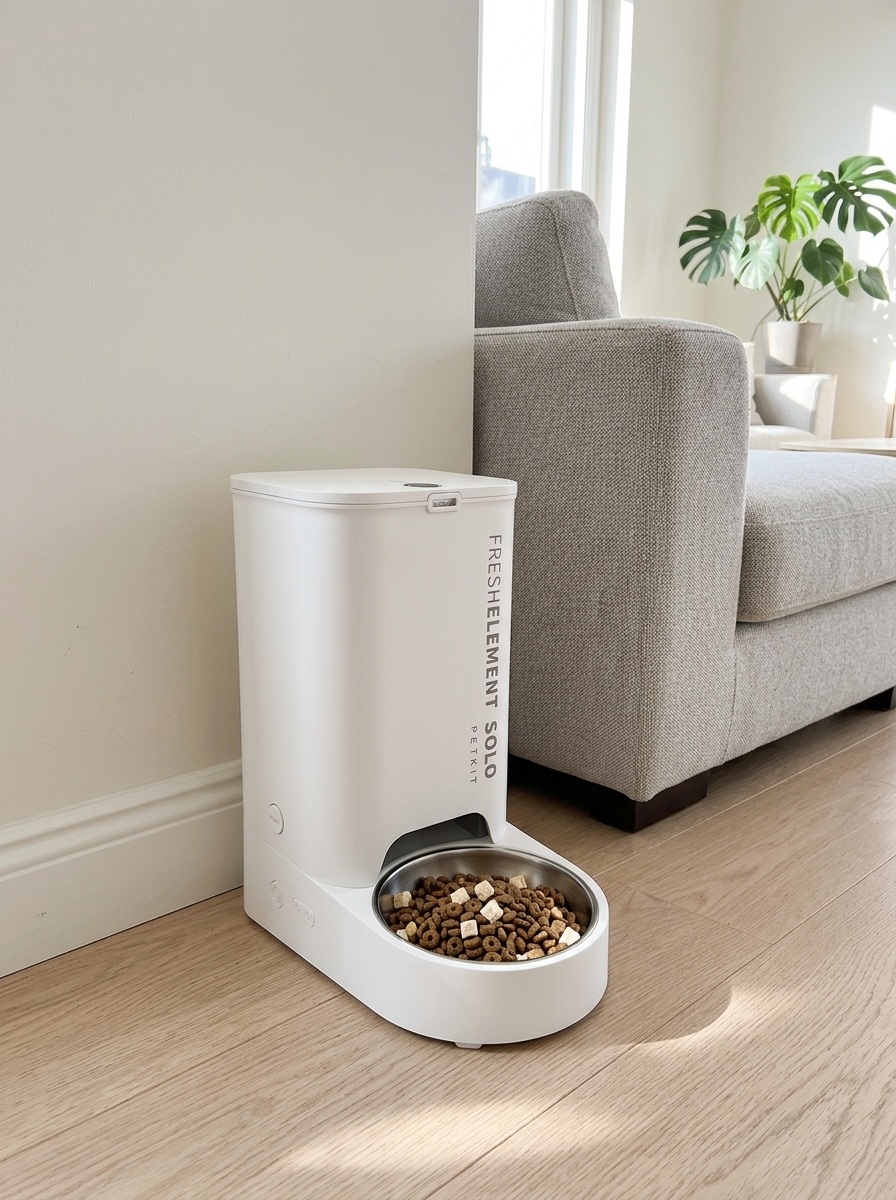
As of 2026-11-21, we track 16 automatic cat feeders from 9 brands, scored with Score v1.0 from owner ratings, spec strength and ownership cost. PETKIT Fresh Element Solo leads the list at 8.0/10. Tracked prices run from $47 to $299; the full table below is sortable by score and price.
The VOLUAS Automatic Cat Feeder 4L (Score 7.8 in our catalog) has no app, no camera, and no account — so its entire ownership contract is physical: desiccant, dust, seals, and batteries.
- The working


Discussion
No comments yet