Price alerts — WOPET Heritage View Pet Feeder with Camera (Dual Bowls)
Price-drop alert
Email me when WOPET Heritage View Pet Feeder with Camera (Dual Bowls) drops to my target price. The confirmation includes a manage link — use it any time to list or remove your alerts at Your price alerts. Lowest price tracked so far: USD 119.99 — a target below that is below the historical low and less likely to be reached.
Disclosure: AIBuyLab articles are desk research. We compile manufacturer specifications, catalog data, and published documentation — we do not hands-on test the products we cover, and nothing in this article should be read as a first-hand measurement. Where this guide models upkeep over time, every cadence is a planning estimate, not a manufacturer service interval.
TL;DR
The PETKIT Fresh Element Solo carries a Score of 8.0 in our catalog — one of the strongest ratings we track in the compact feeder class.
Our catalog tracks no consumable cost and no subscription for this feeder, so this true-cost model is built entirely in counts: desiccant cycles, seal replacements, deep cleans, and dispense events.
At its maximum schedule of 10 meals a day, the dispensing mechanism fires roughly 10,950 times over three years (simple arithmetic: 10 × 365 × 3). Most households will run far fewer.
The real 3-year cost of this feeder is not money — it is discipline. Skip the freshness chores and a high-Score feeder quietly becomes an ordinary one.
What the PETKIT Fresh Element Solo Is
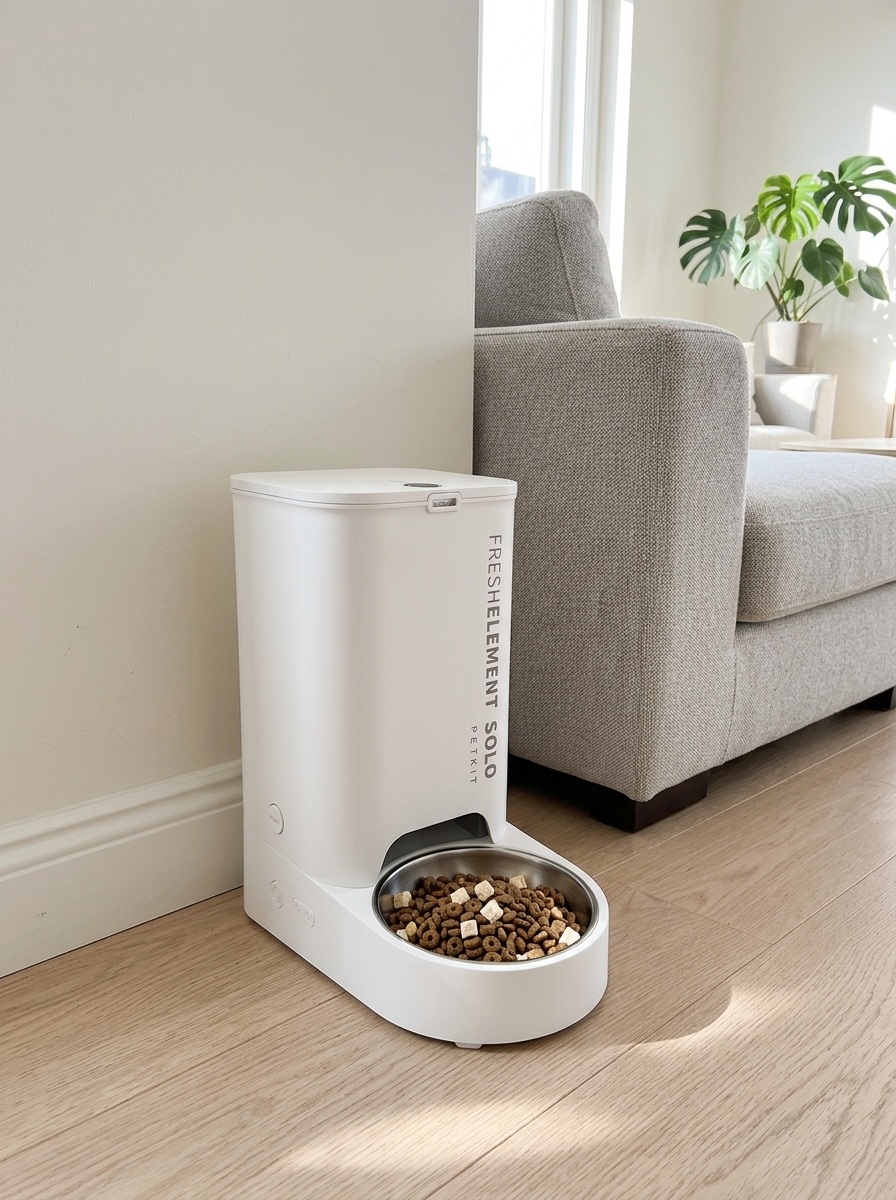
The PETKIT Fresh Element Solo is a compact automatic dry-food feeder for cats and small dogs. It holds 3 L of kibble in its hopper, dispenses up to 10 meals per day with a minimum portion of 10 g, and is controlled through an app. It weighs 1.32 kg, runs on dry food only, and includes a battery backup so scheduled meals continue through a power outage.
What it deliberately leaves out matters just as much for a cost analysis: there is no camera and no pet recognition. That means no video feed to maintain, no per-pet identification hardware, and — in our catalog — no subscription attached to it. The Fresh Element Solo is a portioning machine, and its long-term cost profile is the cost profile of a portioning machine: seals, desiccant, cleaning, and mechanical cycles.
The 3-Year Cost Model, in Counts
Because our catalog tracks no consumable price and no subscription fee for this feeder, we model three years of ownership the honest way: in counts of things you will actually do or replace. Every figure below is a planning estimate based on the feeder's tracked specifications and ordinary dry-feeder upkeep practice — not a figure published by PETKIT.
Cost item (3 years)
Count
Basis
Dispense events (maximum)
~10,950
Arithmetic: 10 meals/day × 365 days × 3 years
Dispense events (typical, 2 meals/day)
~2,190
Arithmetic at a common two-meal schedule
Desiccant cycles
~18–36
Planning estimate: refresh every 1–2 months
Lid seal replacements
~1–3
Planning estimate: inspect yearly, replace when it no longer seats firmly
Deep cleans of hopper and chute
~36
Planning estimate: roughly monthly
Quick wipe-downs of the bowl area
~150+
Planning estimate: roughly weekly
Battery-backup checks
~6
Planning estimate: twice a year
Subscriptions tracked in our catalog
0
Catalog fact
Consumable costs tracked in our catalog
0
Catalog fact
Read the table from the bottom up. The last two rows are the headline: over three years, this feeder asks for no tracked subscription and carries no tracked consumable line in our data. Everything above those rows is labor — yours.
Desiccant: The Freshness Subscription You Pay in Chores
A 3 L hopper of dry kibble is a food-storage problem before it is a feeding problem. Kibble begins losing freshness the moment the bag is opened, and a hopper that takes a small cat two or three weeks to empty holds food through a lot of warm, humid room air. The desiccant pack in the lid is the component standing between that air and the food.
Our planning estimate is a desiccant refresh every one to two months — roughly 18 to 36 cycles across three years. That cadence is the single most-skipped chore on feeders of this type, and the failure mode is silent: the feeder keeps dispensing on schedule, the app keeps confirming meals, and the only symptom is a cat growing less enthusiastic about food that has quietly gone stale. If you take one number from this article, take this one: put the desiccant cycle on the same calendar reminder as something you already never miss.
Seals: The Cheap Part That Decides Everything
The lid seal does two jobs — it keeps moisture out of the hopper and keeps determined paws from treating the feeder as a puzzle box. Seals age by compression: a lid opened and closed hundreds of times over three years gradually flattens the gasket until it no longer seats with a firm press.
Our planning estimate is one to three seal replacements across three years, driven by a simple yearly inspection: if the lid closes without resistance or rocks on its seat, the seal's working life is over. This is the cheapest maintenance item on the feeder and the one with the largest effect on food freshness, because a tired seal defeats fresh desiccant — dry air cannot stay dry in a hopper that breathes.
Cleaning: 36 Deep Cleans Is the Real Price Tag
Kibble is an oily food. Every portion that slides down the dispensing chute leaves a trace of fat behind, and fat films go rancid. A monthly deep clean of the hopper, chute, and bowl — our planning estimate, about 36 deep cleans over three years — is what keeps yesterday's kibble oil out of today's meals.
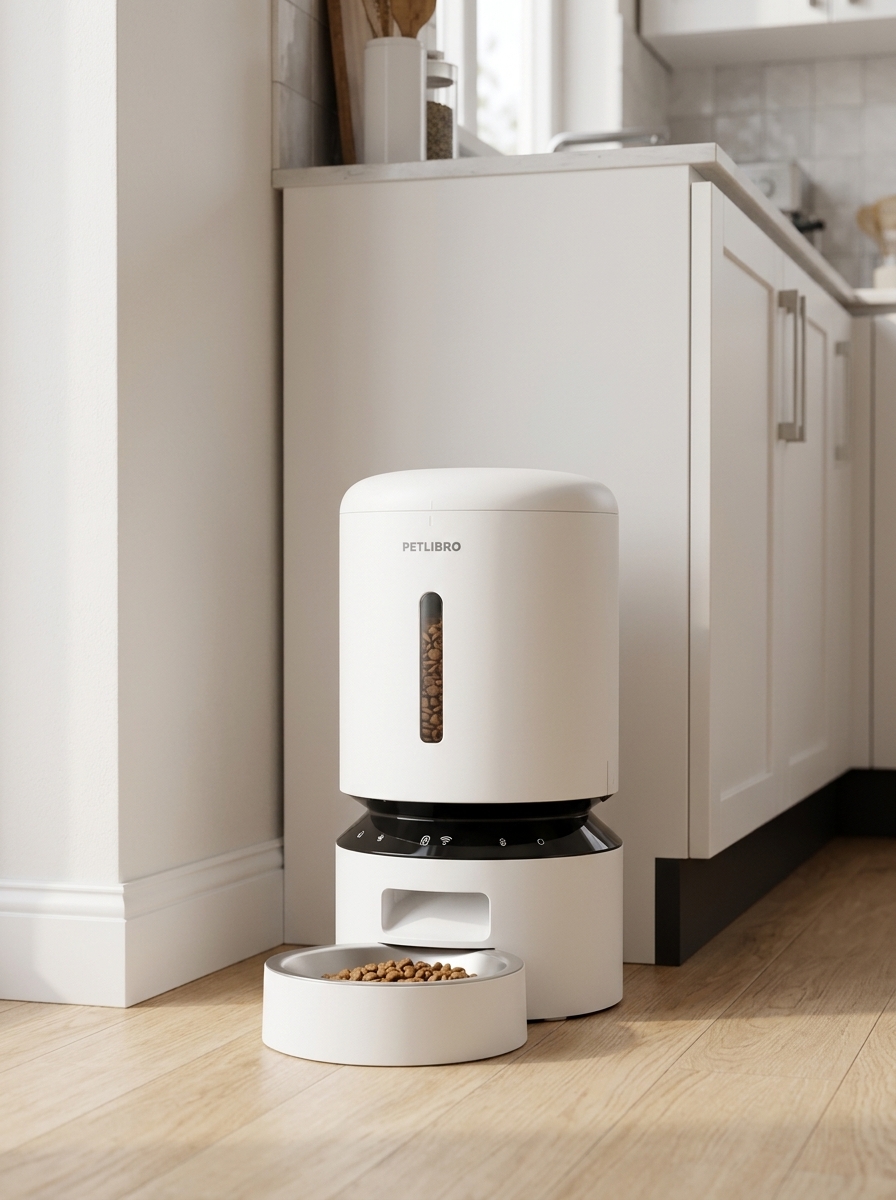
Add roughly weekly wipe-downs of the bowl area (150 or more across three years) and the picture is complete: the Fresh Element Solo's three-year cost is measured in minutes at the sink, not in purchases. Households that enjoy this kind of routine will find the feeder nearly free to run. Households that know they will not do it should weight that honestly — the same is true of the larger Petlibro Granary WiFi Feeder, which trades this compact footprint for a bigger hopper but asks for the same freshness discipline.
Mechanism Wear: Reading the 10,950 Number Correctly
The most dramatic figure in the model is the dispense count. At the feeder's maximum of 10 meals per day, the dispensing mechanism cycles about 10,950 times in three years — pure arithmetic from the tracked specification. Treat that number as an upper bound, not a prediction. A cat on two scheduled meals a day produces roughly 2,190 cycles in the same period, one fifth of the maximum.
Why publish the maximum at all? Because multi-pet households and portion-controlled diets are exactly the use cases that push toward many small meals — the 10 g minimum portion exists for grazers fed little and often. If your feeding plan genuinely approaches the feeder's ceiling, you are asking the most of its mechanism, and the chores above matter more, not less: kibble dust accumulates in the dispensing path with every cycle, and the monthly deep clean is what keeps portion accuracy from drifting as residue builds.
The battery backup deserves the same arithmetic honesty. It is insurance, and like all insurance it needs testing to be real: our planning estimate is a check twice a year — unplug the feeder, confirm a scheduled meal dispenses on battery, and note the date. Six checks in three years is a trivial count, but an untested backup is a hope, not a feature.
What the Score Does Not Capture
The Fresh Element Solo's 8.0 Score reflects its tracked specification set: portion precision down to 10 g, a 10-meal daily schedule, app control, battery backup, and a 1.32 kg footprint that suits small spaces. What no score captures is the owner variable. This feeder's design assumes a person who refreshes desiccant, wipes the bowl, and washes the hopper on a rhythm. In that home, three years of running cost is close to nothing but time. In a set-and-forget home, the same feeder degrades into stale food and drifting portions while its specification sheet stays excellent.
Verdict
The true 3-year cost of the PETKIT Fresh Element Solo is a discipline cost. Our catalog tracks zero subscriptions and zero consumable costs for it; the model above is desiccant cycles (roughly 18–36), seal replacements (roughly 1–3), deep cleans (roughly 36), and somewhere between about 2,190 and 10,950 dispense events depending on how hard you drive its schedule. If that chore list reads as reasonable, this is one of the most economical high-Score feeders to own over three years. If it reads as a list of things that will not happen, the honest conclusion is that no feeder in this class will stay fresh for you — and a simpler, cheaper-to-neglect design may serve your cat better.
FAQ
Does the Fresh Element Solo require a subscription? No subscription is tracked for it in our catalog. It has no camera and no pet recognition, so there is no cloud feature tier attached to it in our data.
How many meals can it dispense per day? Up to 10 meals per day, with a minimum portion of 10 g, per its tracked specifications. At that maximum schedule, the mechanism would cycle roughly 10,950 times over three years — arithmetic, not a durability rating.
How often should the desiccant be replaced? Our planning estimate is every one to two months, or about 18–36 times over three years. This is an upkeep guideline, not a manufacturer-published interval.
What does the battery backup actually protect against? It keeps scheduled meals dispensing during a power outage. We suggest testing it about twice a year (a planning estimate) so the first real outage is not also the first test.
Can it feed wet food? No. The Fresh Element Solo is tracked as dry-food only in our catalog.
How much does it weigh, and does size matter for cost? It weighs 1.32 kg with a 3 L hopper. The compact hopper is a quiet cost advantage: smaller batches of kibble turn over faster, so food spends less time exposed to air between refills.
Last updated: November 27, 2026
Related in this category
Pet Tech · Automatic Cat Feeders · Updated Nov 21, 2026
As of 2026-11-21, we track 16 automatic cat feeders from 9 brands, scored with Score v1.0 from owner ratings, spec strength and ownership cost. PETKIT Fresh Element Solo leads the list at 8.0/10. Tracked prices run from $47 to $299; the full table below is sortable by score and price.
The VOLUAS Automatic Cat Feeder 4L (Score 7.8 in our catalog) has no app, no camera, and no account — so its entire ownership contract is physical: desiccant, dust, seals, and batteries.
- The working


Discussion
No comments yet