Email me when PETKIT YumShare Dual-hopper drops to my target price. The confirmation includes a manage link — use it any time to list or remove your alerts at Your price alerts. Lowest price tracked so far: USD 104.49 — a target below that is below the historical low and less likely to be reached.
Disclosure: AIBuyLab articles are desk research. This piece is based on the specifications tracked in our product catalog and on how this class of device works mechanically — we did not hands-on test the YumShare Dual-Hopper, and we did not measure its noise or light output in a bedroom. Where our catalog has no data, we say so rather than estimate a number. If you buy through links on this site we may earn a commission, at no extra cost to you.
TL;DR
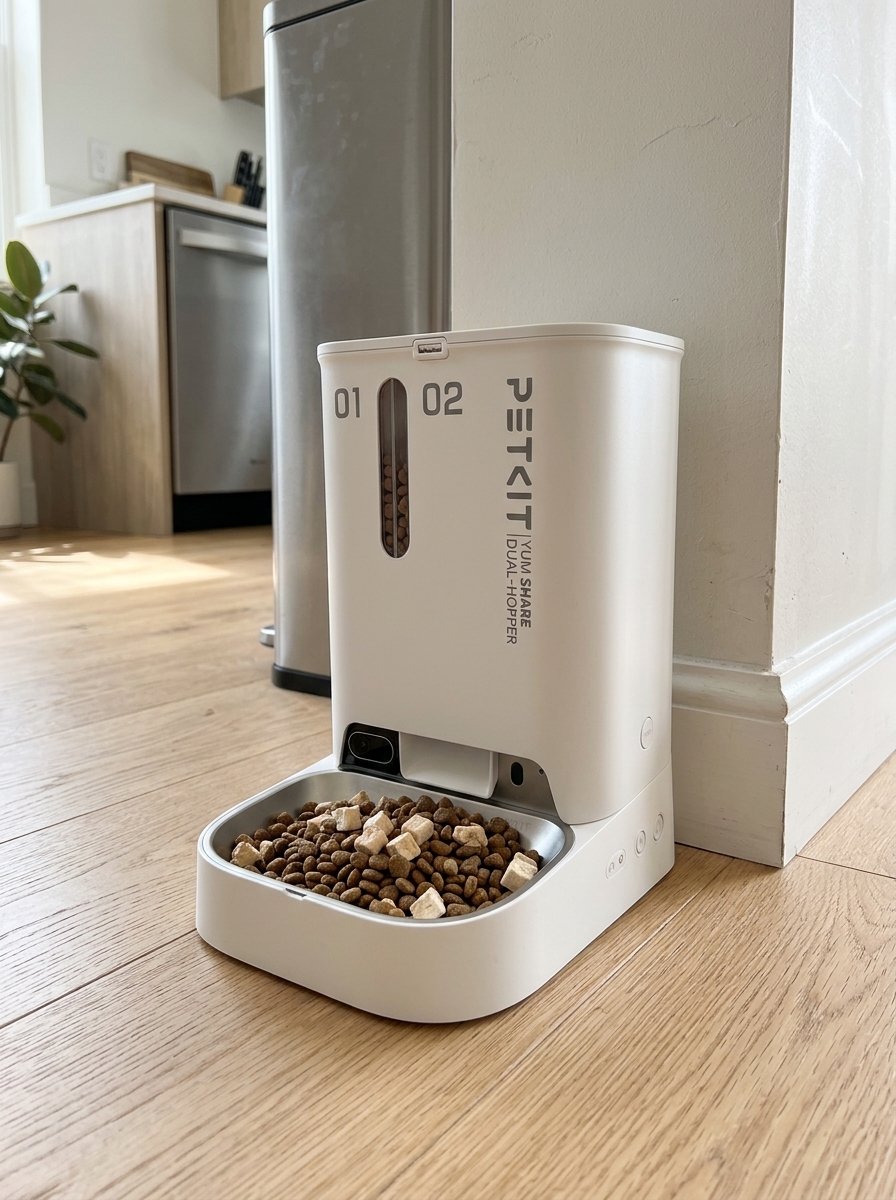
The PETKIT YumShare Dual-Hopper is a 5 L dual-hopper automatic feeder (Score 8.0 in our catalog) with a camera, camera-based pet recognition, app control, and battery backup — built for two foods or two pets, up to 10 meals a day.
Our catalog does not track a decibel rating or an LED specification for this feeder, so nobody can honestly quote you a night-noise number from spec data. What we can do is reason from the mechanism: the sounds that matter after dark are dispense events, not idle hum, and the lights that matter are camera status indicators.
The scheduling math is the real sleep feature: with 10 programmable meals a day, you can move the first dispense of the morning to after your alarm instead of letting a hungry cat set it for you.
The catch: the camera features require a subscription, and our catalog does not track its price. The camera that watches your pets at night is the part of this feeder with an ongoing, unlisted cost.
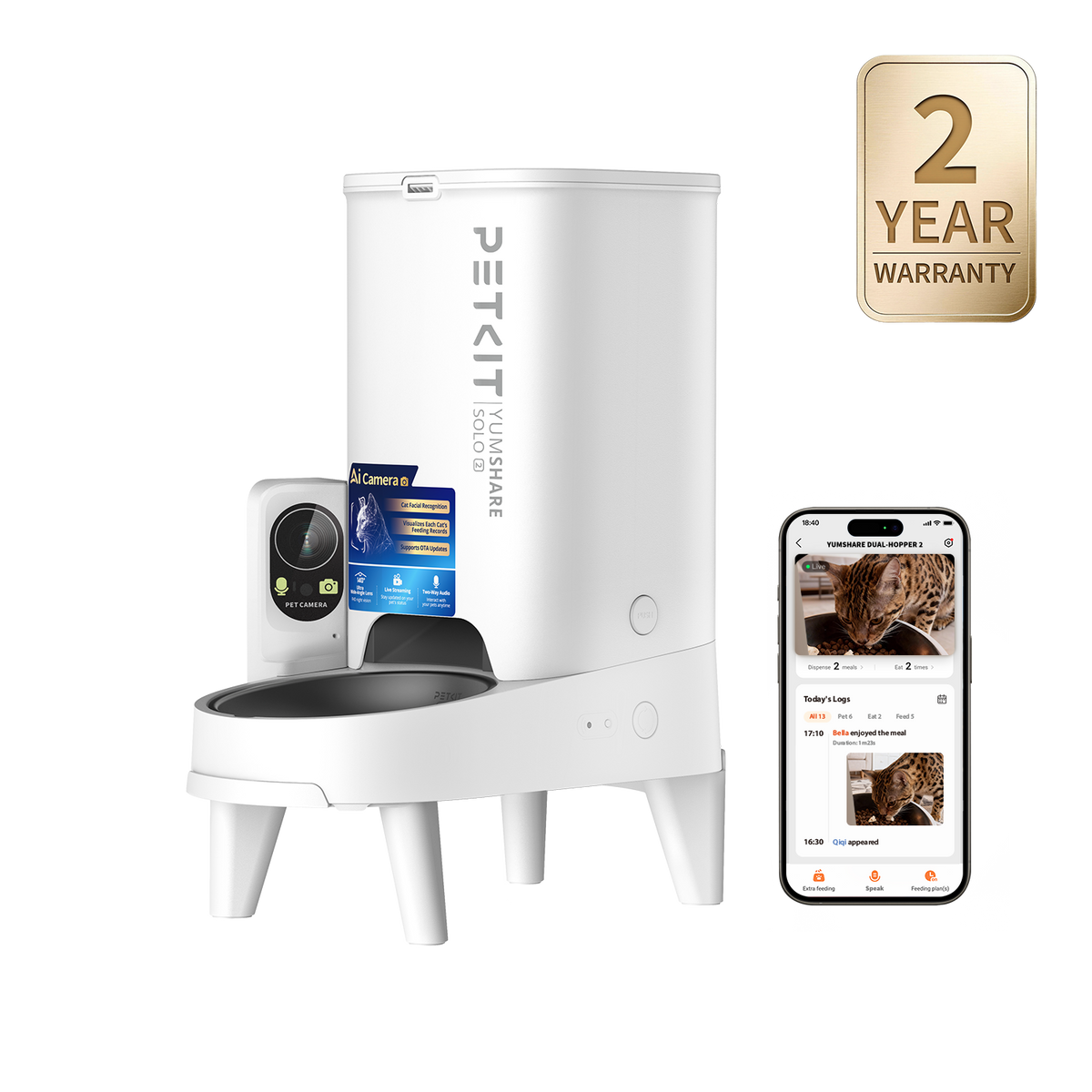
The YumShare Dual-Hopper is an automatic dry-food feeder from PETKIT with two separate hoppers feeding into one feeding routine — 5 L of total capacity, meant for households running two different kibbles or feeding two pets on different diets. It dispenses up to 10 meals per day in portions as small as 10 g, is controlled through an app, weighs 2.5 kg, and carries a battery backup so a power cut does not cancel dinner. A built-in camera with camera-based pet recognition distinguishes which pet is at the bowl — a step beyond the simpler single-hopper YumShare Solo, which shares the family design but not the dual-hopper layout. In our catalog it scores 8.0, among the stronger feeder scores we track.
That spec sheet is a daytime spec sheet. None of it tells you what the machine is like at 3 a.m. in a studio apartment or a hallway outside a bedroom door. This article works through the after-dark questions — noise, light, and scheduling — using the one honest tool available: how the mechanism actually behaves.
The Noise Question, Answered Honestly
Our catalog tracks no dB figure for the YumShare Dual-Hopper, and PETKIT's published specifications in our data do not supply one either. Any review quoting a precise decibel number for this feeder is either measuring it themselves under their own conditions or inventing it. We do neither here.
What can be said from the mechanism:
An automatic feeder is silent almost all of the time. There is no fan, no compressor, no continuous motor. Between meals, the machine draws power and does nothing audible. The entire noise question collapses into a few seconds per meal: the portioning mechanism cycles, kibble drops into the bowl, and that is the event. With up to 10 meals a day available but most households scheduling two to four, you are choosing how many of those brief events happen — and, crucially, when.
Kibble on the bowl is usually the loudest part. The mechanical cycle is muffled inside the housing; the rattle of dry food landing in a hard bowl is not. This is a property of the food and the bowl, not the brand, and it is why the same feeder seems quiet in a kitchen and startling in a silent flat at dawn. Placement — a mat under the feeder, distance from the bedroom door — does more for your sleep than any spec difference between feeders in this class.
Dual hoppers mean two mechanisms, not double noise. Each dispense event still runs one portioning cycle for one meal. A two-pet household does not get a louder feeder; it gets the same brief event, possibly at two different scheduled times if the pets eat on different clocks. Staggering those times away from your lightest sleep is a scheduling decision, not a hardware limitation.
The honest bottom line: if your current feeder wakes you, the fix is almost never a different feeder's dB rating — it is moving the feeding times and softening the landing. This machine gives you the scheduling range to do that.
Lights: The Camera Is the Only Real Source
The YumShare Dual-Hopper has no big display and no clock face glowing through the night. The light sources worth discussing are the camera's status indicators — the small LEDs that devices of this class use to show power, connection, and camera state.
Here again, our catalog tracks no LED specification for this model: no brightness, no color, no statement of whether indicators can be dimmed or disabled in the app. We will not guess. What general experience with camera feeders supports:
Status LEDs are small but directed — a pinpoint light in a dark room reads brighter than it is, especially at pet height near a doorway sightline.
Camera devices commonly keep at least one indicator active whenever the camera is live, because that light is partly a privacy signal to the humans in the room.
The practical mitigations are placement (angle the feeder so its face is not in your direct line of sight from the bed) and, where the app offers indicator controls, using them — check the app settings for your unit rather than assuming, because our data does not confirm the option exists for this model.
If a status light in the bedroom itself is a dealbreaker, the correct move is to place any camera feeder — this one included — outside the sleeping room. No spec in our catalog can promise you a dark unit, and we would rather say that plainly than rank feeders on light output we have not measured.
Scheduling Around Sleep: Where This Feeder Actually Helps
The strongest sleep feature on the spec sheet is not acoustic at all. It is the combination of 10 meals a day, 10 g minimum portions, and app control.
A cat that is fed at 5 a.m. by a machine is a cat that stops waking you at 4:30. A cat fed at 5 a.m. because that is when it demands food trains the household the other way. The useful pattern with a programmable feeder is to set the first meal a few minutes after your own alarm: the pet learns the machine, not you, controls breakfast, and the pre-dawn wake-up call loses its reward. Ten daily meal slots with small 10 g portions also let you split the evening ration — a larger dinner plus a small late-evening top-up can push the morning hunger peak later, which is the entire game for light sleepers.
App control matters here for a less obvious reason: notification discipline. A camera feeder with pet recognition generates events — pet at bowl, meal dispensed, hopper running low. Every one of those can become a phone buzz. The feeder itself may be silent while your phone lights up the nightstand at 2 a.m. because a cat had a snack. Set the app's notifications to silent delivery overnight, or restrict alerts to genuine faults like a blocked dispense. That is a phone-settings task, not a feeder flaw, but it is the most common way a "noisy" smart feeder actually disturbs a bedroom.
Battery backup closes the last night scenario: a power cut and restore will not erase the schedule or skip a meal, so the 6 a.m. feeding still happens even if the power blinked at 3 a.m. — and a hungry pet does not come to tell you about it.
The Subscription Catch
One line in our catalog deserves emphasis: the camera features of the YumShare Dual-Hopper require a subscription. The pet recognition — the feature that tells your two cats apart and logs who ate — sits behind that paywall, and our catalog does not track the subscription's price. We will not invent a figure.
For an after-dark buyer this matters twice. First, the camera is the feature you are most likely to use at night: checking that the shy cat actually ate, confirming the dispense happened while you were away overnight. Second, an unpriced ongoing cost changes what the feeder really is — not a one-time purchase but a service with a feeding bowl attached. Before buying, confirm the current subscription terms from the manufacturer and decide whether the recognition features are worth a recurring fee to you. If they are not, the honest comparison is against a non-camera feeder, where nothing about the night routine requires a plan at all. The camera-equipped Petlibro Granary Camera Feeder is the closest alternative in our catalog to weigh against it.
Who Should Keep It Out of the Bedroom
Light sleepers in studio flats: the dispense event is brief, but there is no tracked noise rating to hide behind. Kitchen placement and after-alarm scheduling are the fix; if neither is possible in your layout, no camera feeder is a safe bet.
Anyone who will not pay the subscription: without it, you are buying a dual-hopper feeder and leaving its headline feature off. Price the plan first.
Households wanting zero phone involvement: app control and event notifications are the operating model here. A timer feeder with no camera is a calmer device category.
Who It Suits After Dark
Two-pet, two-diet homes where recognition logs settle who ate what — checked from bed, not by getting up.
Owners whose cats run a dawn hunger campaign: 10 slots and small portions let you engineer the first meal to land after your alarm.
Anyone feeding away overnight who wants the camera confirmation and can accept the subscription as part of the deal.
How loud is the YumShare Dual-Hopper at night? Our catalog does not track a decibel rating for it, and we did not measure one. Mechanically, it is silent between meals; the only event is a brief portioning cycle and kibble landing in the bowl, a few seconds per scheduled meal. Placement and feeding times matter more than any feeder-to-feeder spec difference.
Does it have lights that stay on overnight? The relevant sources are the camera's status indicators, typical of this device class. Our catalog tracks no LED specification for this model — no brightness figure and no confirmation that indicators can be disabled in the app. If a pinpoint light in the sleeping room bothers you, place the feeder outside the bedroom.
Can I schedule the first meal after my alarm clock? Yes — that is the pattern we recommend. With up to 10 meals a day, a minimum portion of 10 g, and app control, you can set breakfast a few minutes after you wake and split the evening ration to push morning hunger later.
What does the subscription cover, and what does it cost? Per our catalog, the camera features — including camera-based pet recognition — require a subscription. Our catalog does not track its price, so check the manufacturer's current terms before buying; we do not publish figures we cannot source.
Will it still feed during a power cut at night? Yes. The feeder has battery backup, so a power interruption does not cancel scheduled meals or wipe the routine — the morning feeding still happens on time.
Is the dual hopper useful for a single pet? It can be: two hoppers can hold two different dry foods — a main kibble and a second formula — for one animal. But with one pet on one food, the dual-hopper layout is capacity you may never use, and simpler single-hopper models deserve a look.
Last updated: November 27, 2026
Changelog
November 27, 2026 — Added retailer buying links (Our pick and Where to buy) for the products covered in this article.
Related in this category
Pet Tech · Automatic Cat Feeders · Updated Nov 21, 2026
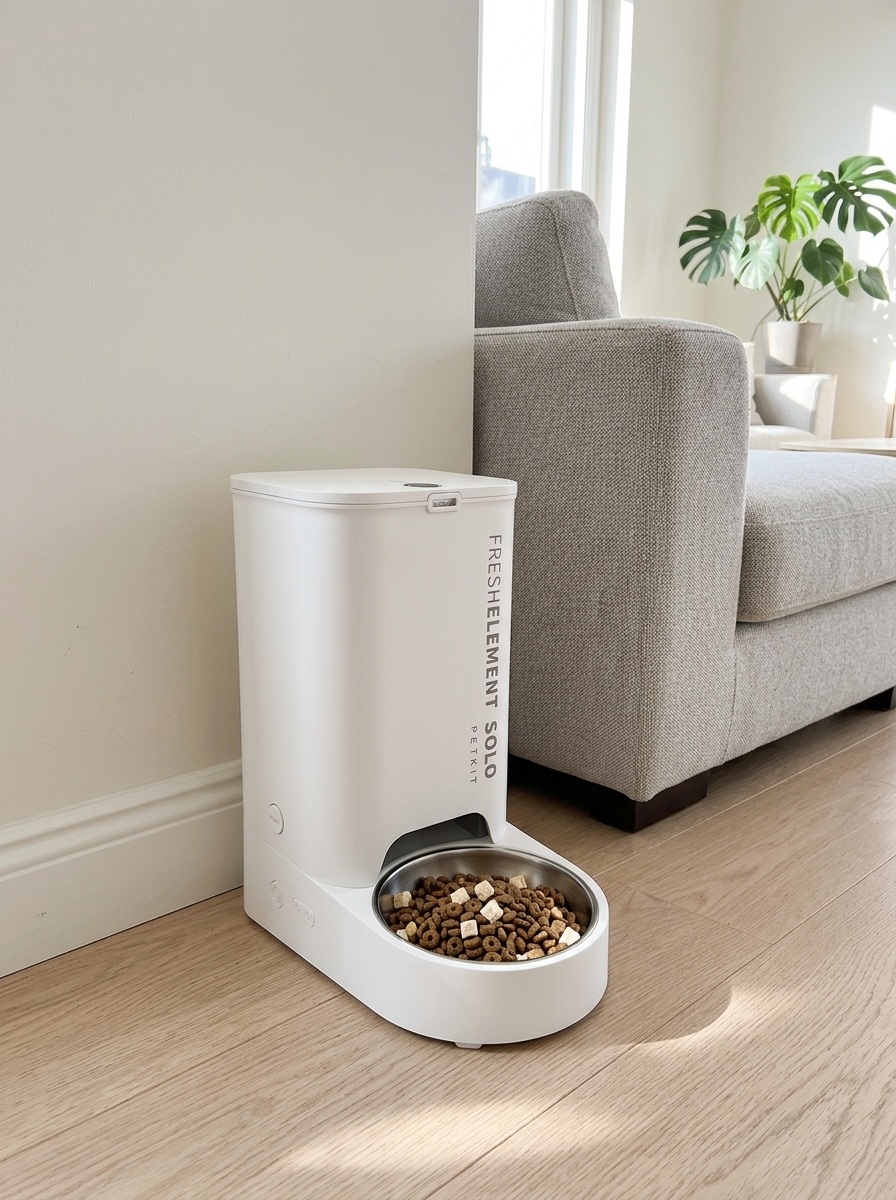
As of 2026-11-21, we track 16 automatic cat feeders from 9 brands, scored with Score v1.0 from owner ratings, spec strength and ownership cost. PETKIT Fresh Element Solo leads the list at 8.0/10. Tracked prices run from $47 to $299; the full table below is sortable by score and price.
The VOLUAS Automatic Cat Feeder 4L (Score 7.8 in our catalog) has no app, no camera, and no account — so its entire ownership contract is physical: desiccant, dust, seals, and batteries.
- The working

Discussion
No comments yet