Price alerts — PETKIT YumShare Solo
Price-drop alert
Email me when PETKIT YumShare Solo drops to my target price. The confirmation includes a manage link — use it any time to list or remove your alerts at Your price alerts. Lowest price tracked so far: USD 109.99 — a target below that is below the historical low and less likely to be reached.
PETKIT YumShare Solo vs Whisker Feeder-Robot: Camera or Capacity?
Affiliate disclosure: AIBuyLab may earn a commission when you buy through links on this page, at no extra cost to you. This comparison is based on published manufacturer specifications and our catalog data — we did not hands-on test either feeder, and no score or verdict here comes from in-person use.
TL;DR
The PETKIT YumShare Solo (Score 4.8/10) is the accountability pick: a built-in camera with camera-based pet recognition tells you which pet ate and when, but its 3 L hopper is the smaller tank in this matchup. The Whisker Feeder-Robot (Score 4.1/10) is the endurance pick: a 7.68 L hopper — about 2.5× the Solo's — feeds for weeks with no camera and no idea who showed up. Both are app-controlled, dry-food-only feeders with battery backup. Choose the Solo if you manage multiple pets or a pet on a monitored diet; choose the Feeder-Robot if your priority is maximum days between refills.
Our pick: PETKIT YumShare Solo vs Whisker Feeder-Robot — check current prices at the retailers.
What these two feeders actually are
An automatic pet feeder is a hopper-fed dispenser that releases measured portions of dry food on a schedule you set, usually through a phone app. Both models here fit that definition: app control, scheduled meals, dry food only, and a battery backup so a power outage doesn't skip a feeding.
Where they diverge is philosophy. The YumShare Solo treats feeding as an information problem — it watches the bowl and identifies the pet. The Feeder-Robot treats feeding as a logistics problem — it simply holds as much food as possible and dispenses it reliably. Neither approach is wrong; they solve different households' problems.
Spec comparison
Spec | PETKIT YumShare Solo | Whisker Feeder-Robot |
|---|
AIBuyLab Score (v1.0) | 4.8/10 | 4.1/10 |
Camera | Yes | No |
Pet recognition | Yes — camera-based | None |
Hopper capacity | 3 L | 7.68 L |
Meals per day | Up to 10 | Up to 8 |
Minimum portion | 10 g | Not specified in our catalog data |
Food type | Dry only | Dry only |
App control | Yes | Yes |
Battery backup | Yes | Yes |
Weight | 1.79 kg | Not specified in our catalog data |
Warranty | Not specified in our catalog data | 1 year |
The table makes the trade stark. The Solo wins on meals per day (10 vs. 8), recognition, and camera monitoring. The Feeder-Robot wins on exactly one number — hopper capacity — but it wins it by a landslide.
The recognition side: what the Solo's camera buys you
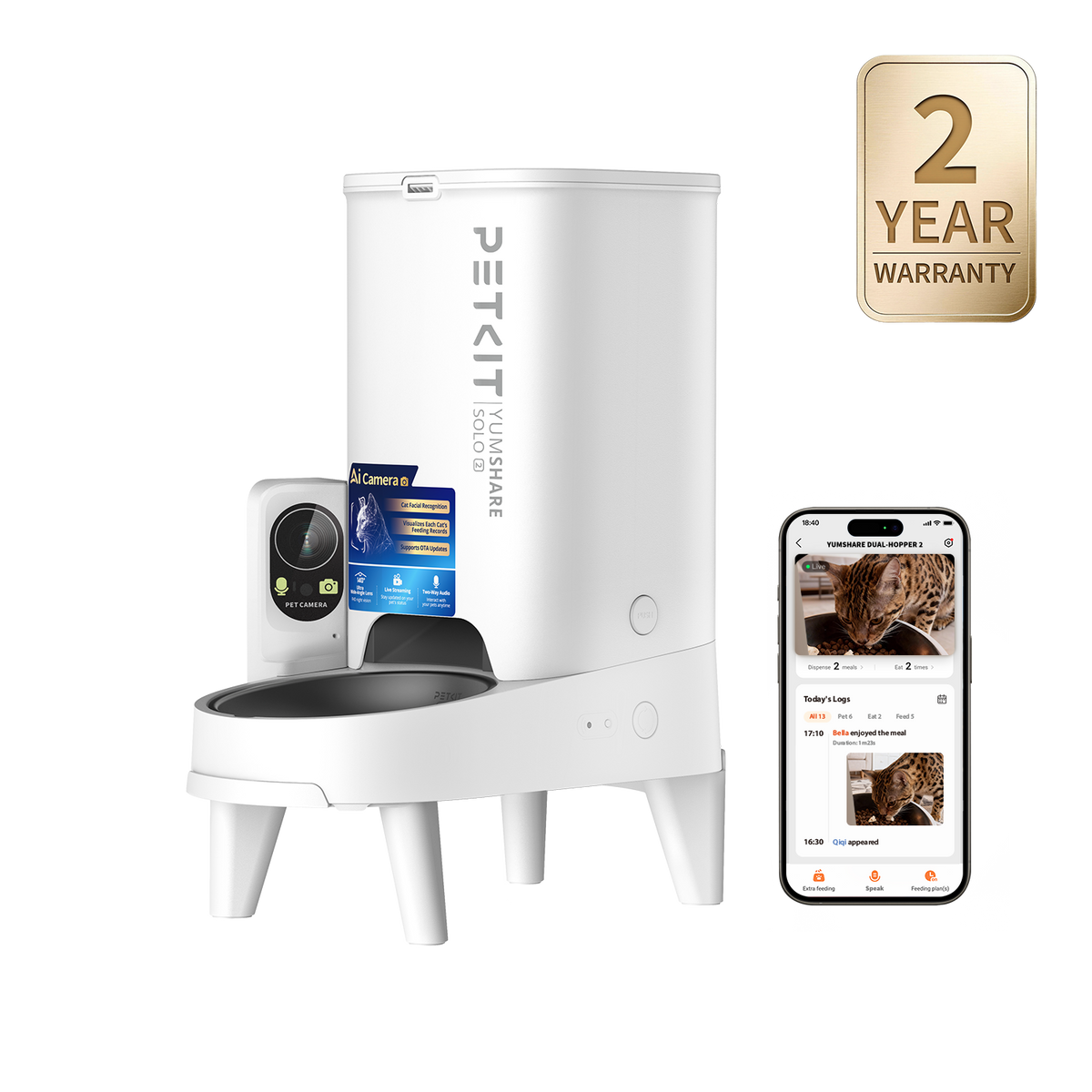
Camera-based pet recognition means the YumShare Solo can distinguish which pet is at the bowl and log the visit against that pet. In a multi-pet home, that is the difference between assuming the shy cat ate and knowing she did. It matters most in three situations:
- Prescription or weight-management diets, where one pet's food is another pet's problem.
- Food stealing, where a dominant pet eats two shares and a timid one eats none.
- Appetite monitoring, where a pet quietly going off its food is often the first visible sign of illness.
The camera also doubles as a check-in feed: you can look at the bowl area while you're away rather than wondering. The cost of all this awareness is capacity. A 3 L hopper is a modest reservoir, and every feature in the Solo is oriented toward supervision, not autonomy.
The reservoir side: the Feeder-Robot's vacation math
The Feeder-Robot's 7.68 L hopper is roughly 2.5× the Solo's 3 L. What does that mean in days? The following figures are estimates, based on typical dry kibble density (roughly 0.4–0.5 g per ml) and typical daily rations — your kibble shape, brand, and pet will shift them:
- Solo (3 L ≈ 1.2–1.5 kg of kibble): for one cat eating ~50–60 g/day, that's roughly 3–4 weeks of food. For two cats, roughly 10–14 days.
- Feeder-Robot (7.68 L ≈ 3.1–3.8 kg of kibble): for one cat at ~50–60 g/day, that's roughly 7–10 weeks. For two cats, roughly 4–5 weeks.
Read those numbers carefully, because they cut both ways. Even the Solo's "small" hopper covers a two-week trip for a single cat on paper. The Feeder-Robot's advantage becomes decisive for long trips, for multi-cat homes, and for owners who simply hate refilling. But note what the Feeder-Robot cannot tell you across those weeks: whether the food went to the right pet, or whether one pet stopped eating on day three. Its 8 meals per day is also slightly less granular than the Solo's 10, which matters if you feed many small portions rather than a few large ones.
A practical caution that applies to both: hopper math is capacity math, not a recommendation to leave a pet unattended for the full span. Fresh water, litter, and a human checking in remain necessary regardless of how many liters the feeder holds.
Where each one loses
The Solo's weaknesses are capacity and portion floor. Its 10 g minimum portion is fine for cats and small dogs but coarse for very small animals on tight rations. And if you travel for a month with two cats, the 3 L hopper makes the decision for you — it simply won't span the trip.
The Feeder-Robot's weaknesses are blindness and warranty. No camera and no recognition means zero accountability: in a multi-pet home it feeds the bowl, not a pet. Its 1-year warranty is also the shorter commitment in this comparison, and our catalog lists no weight figure for it, so we can't speak to how it compares on the counter.
Verdict: by trip length and pet count
- One pet, trips up to ~2 weeks, you want peace of mind: the YumShare Solo. Its hopper covers the trip (estimate), and the camera confirms your pet is eating.
- Multiple pets, any trip length, especially with a diet or stealing problem: the YumShare Solo. Recognition is the feature the Feeder-Robot cannot replicate at any capacity.
- One pet, long trips (3+ weeks) or refill-averse owners: the Feeder-Robot. The 7.68 L hopper is the entire argument, and it's a strong one.
- Multiple pets, long trips: the Feeder-Robot on capacity — but arrange a human check-in, because it cannot tell you if one pet has stopped eating.
Our Score gives the Solo the edge (4.8 vs. 4.1), reflecting its broader feature set. But this is a genuine split decision: the Solo knows who ate, the Feeder-Robot just keeps feeding. Pick based on which failure mode worries you more — the pet who didn't eat, or the hopper that ran dry.
Where to buy: PETKIT YumShare Solo · Whisker Feeder-Robot — retailer links run through our /go/ tracker; the product pages track prices daily.
FAQ
Can either feeder handle wet food? No. Both are dry-food-only in our catalog data. Wet food in a hopper feeder spoils quickly and clogs mechanisms; neither model is designed for it.
What happens during a power outage? Both models have battery backup, so scheduled feedings continue when mains power drops. App connectivity may still be interrupted if your home Wi-Fi goes down with the power.
Does the Feeder-Robot's bigger hopper mean food stays fresh longer? Not necessarily. Capacity and freshness are different things — a larger hopper holds more food for longer, which means the last portions have sat in the hopper the longest. The vacation-math estimates above describe how long the food lasts, not an ideal storage window.
How does the Solo's pet recognition work? Per the manufacturer's specifications in our catalog, it is camera-based: the built-in camera identifies which pet is at the bowl and logs the feeding accordingly. It is not a collar-tag or microchip system.
Which is better for a pet on a strict diet? The YumShare Solo. Camera-based recognition plus a defined 10 g minimum portion gives you both control over how much is dispensed and confirmation of which pet received it — the two things diet management depends on.
Is 8 vs. 10 meals per day a meaningful difference? Only for specific feeding plans. Most cats and dogs eat 2–4 scheduled meals a day, well within both limits. The gap matters if you deliberately feed many small portions across the day, where the Solo's 10-meal ceiling gives more room.
---
Last updated: November 27, 2026
Changelog
November 27, 2026 — Added retailer buying links (Our pick and Where to buy) for the products covered in this article.
Related in this category
Pet Tech · Automatic Cat Feeders · Updated Nov 21, 2026
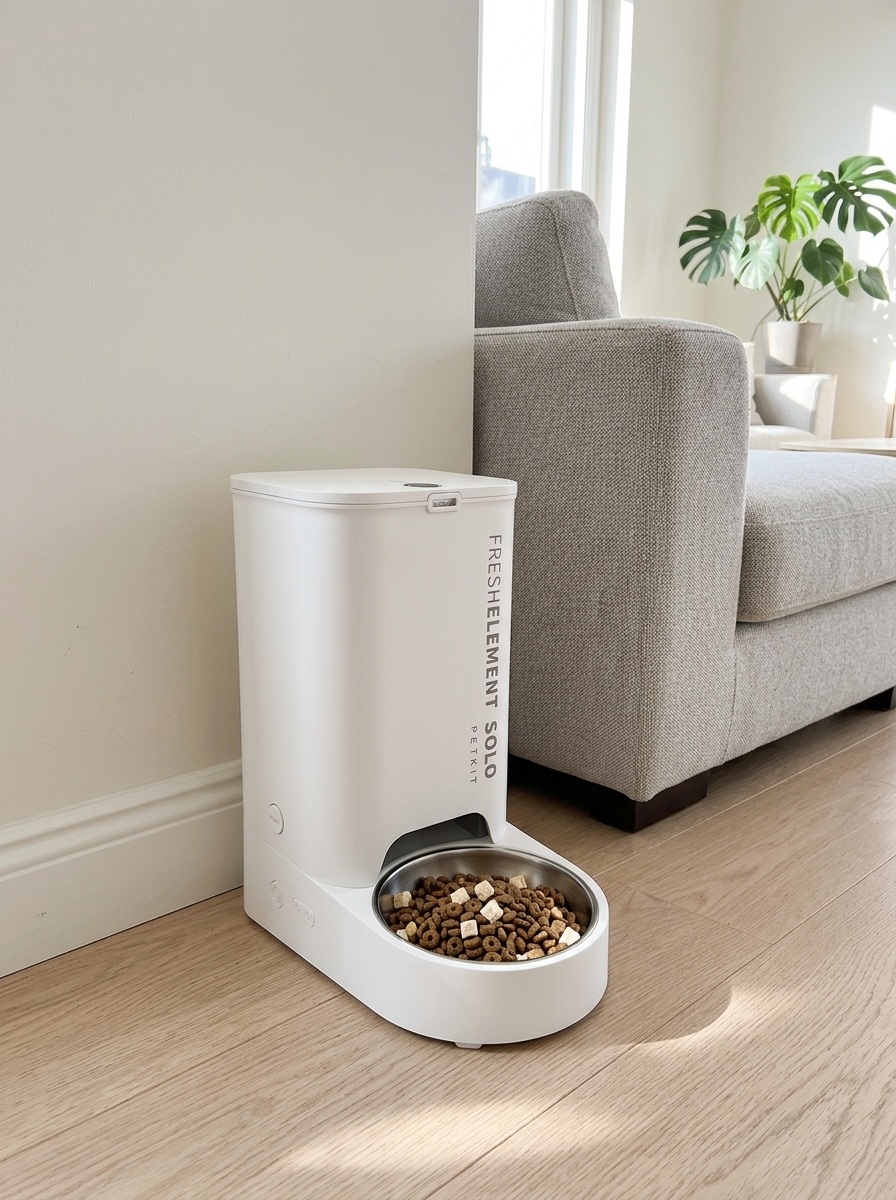
As of 2026-11-21, we track 16 automatic cat feeders from 9 brands, scored with Score v1.0 from owner ratings, spec strength and ownership cost. PETKIT Fresh Element Solo leads the list at 8.0/10. Tracked prices run from $47 to $299; the full table below is sortable by score and price.
Pet Tech · Automatic Cat Feeders
The VOLUAS Automatic Cat Feeder 4L (Score 7.8 in our catalog) has no app, no camera, and no account — so its entire ownership contract is physical: desiccant, dust, seals, and batteries.
- The working
Pet Tech · Automatic Cat Feeders
The PETKIT YumShare Dual-Hopper (Score 8.0 in our catalog) is built around one idea: two separate dry-food hoppers, 5 L combined, feeding u
Pet Tech · Automatic Cat Feeders
The PetSafe Smart Feed is the bigger, more flexible machine: a 5.76 L hopper and up to 12 meals a day, the deepest feeding schedule in this comparis
Report an error on this page
Discussion
No comments yet