Price alerts — WOPET Heritage View Pet Feeder with Camera (Dual Bowls)
Price-drop alert
Email me when WOPET Heritage View Pet Feeder with Camera (Dual Bowls) drops to my target price. The confirmation includes a manage link — use it any time to list or remove your alerts at Your price alerts. Lowest price tracked so far: USD 119.99 — a target below that is below the historical low and less likely to be reached.
Affiliate disclosure: AIBuyLab may earn a commission from qualifying purchases made through links on this page. This article is desk research based on the specifications tracked in our catalog; we did not hands-on test this feeder, and we have not measured its noise output or light emissions.
TL;DR
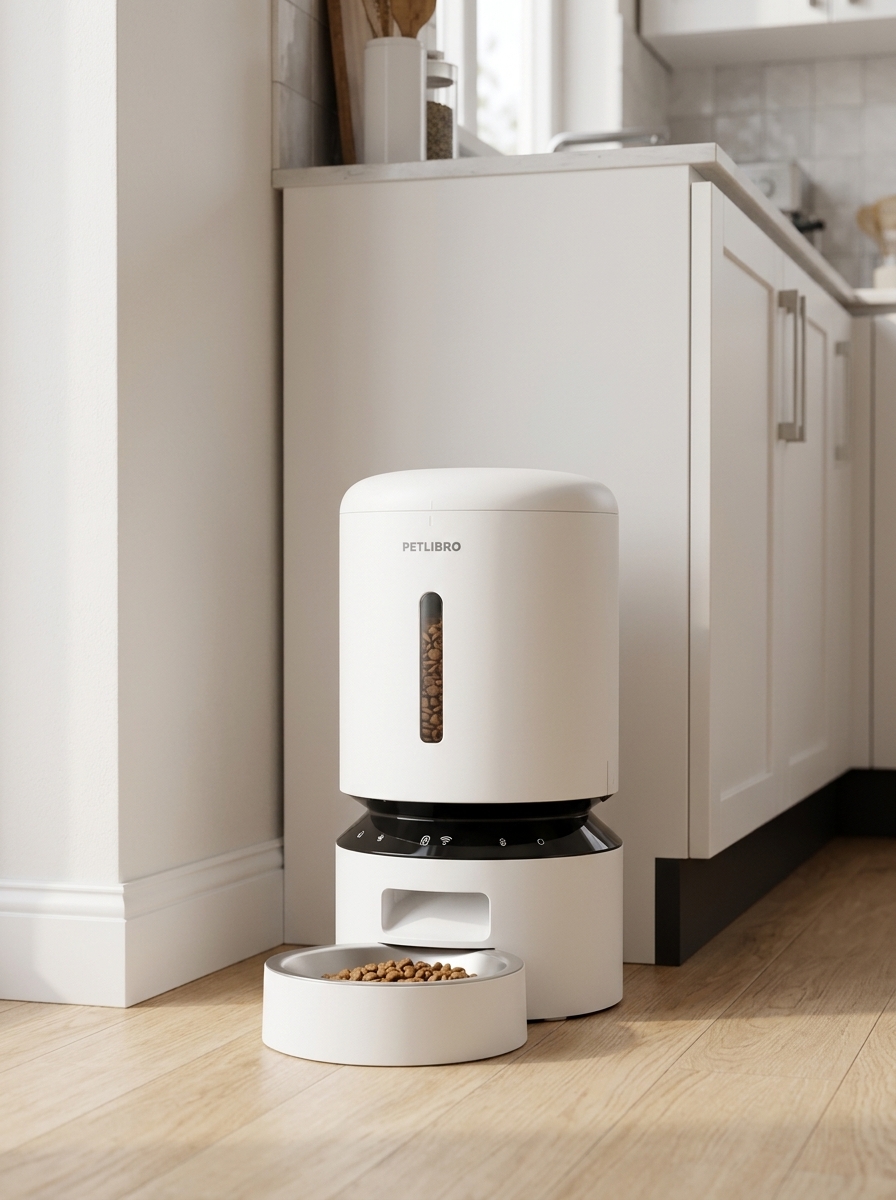
The Petlibro Granary WiFi Feeder (Score 8.1 in our catalog) is a 5 L, dry-food-only feeder with app control, up to 10 meals per day, a 10 g minimum portion, and battery backup.
Our catalog does not track a decibel rating or an LED/status-light specification for this model, so we cannot quote you a noise number — anyone who does is inventing it.
Reasoned from mechanism, the night-time sound of any portion-motor feeder is a chain: motor whir, kibble falling, kibble hitting the bowl, then the cat eating. The feeder is only the first three links.
The strongest sleep lever is not the machine, it is the schedule: with 10 programmable meals per day, the app lets you move the dawn feed instead of enduring it.
There is no camera on this model, so there is no night-vision illuminator to worry about — but also no way to visually confirm a 3 AM dispense happened.
What the Petlibro Granary WiFi Feeder is
The Petlibro Granary WiFi Feeder is an automatic dry-food dispenser for cats and small dogs. It stores up to 5 L of kibble in a sealed hopper and dispenses scheduled portions through an app-controlled portion motor. Owners can program up to 10 meals per day, with a minimum portion of 10 g, which makes it suited to grazing schedules and small, frequent feeds rather than one or two large dumps. It weighs 1.66 kg, carries a 2-year warranty, and includes battery backup so a power cut does not silently cancel a meal.
Two absences matter for this article. First, this Granary has no camera — Petlibro sells camera variants under similar names, and they are different products. Second, it has no pet recognition: it cannot tell one cat from another, so in a multi-cat home whichever animal reaches the bowl first eats the portion. Its Score of 8.1 in our catalog reflects the tracked feature set — capacity, scheduling depth, app control, backup power — not any measured acoustic performance, because we do not track one.
The honest gap: no dB rating, no LED spec in our data
Most "quiet feeder" claims in this category rest on a decibel figure measured who-knows-how: at what distance, in what room, dispensing how much kibble? Our catalog does not track a dB rating for the Granary WiFi Feeder, and it does not track an LED or status-light specification either. We are not going to fill that gap with a plausible-sounding number.
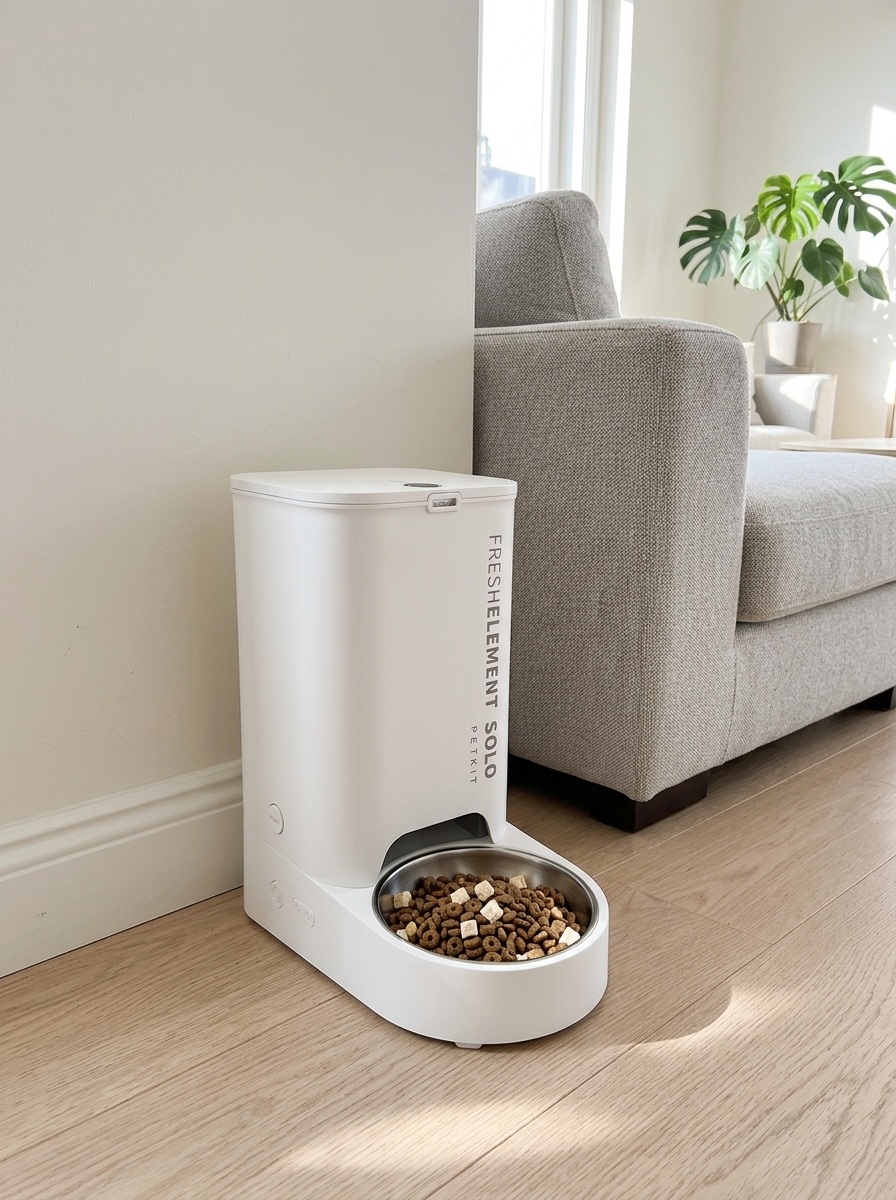
What we can do — and what this article does — is reason carefully from the mechanism every portion-motor feeder shares, and be explicit about which parts are inference. If a verified noise figure matters more to you than scheduling flexibility, treat the missing spec as a genuine unknown and weigh it against feeders whose makers publish one. For a comparison point in the same dry-feeder class, the PETKIT Fresh Element Solo is another app-controlled model worth cross-checking before you decide.
Anatomy of a 5:30 AM dispense: the four-link sound chain
Picture the classic problem. You set a 5:30 AM feed because your cat starts campaigning for breakfast at dawn. The question is whether the machine wakes you before the cat would have anyway. The sound arrives in four links:
The portion motor. A small motor turns an auger or paddle mechanism to meter out the portion. This is a short mechanical whir — brief, but it is the link most likely to carry through a closed door because it starts from silence.
Kibble in transit. Dry food tumbles through the chute. Hard kibble on plastic is a rattle, and its volume scales with portion size: a 10 g minimum portion is a short scatter, while a large portion is a longer pour.
Kibble landing in the bowl. This is usually the loudest link. Kibble striking a hard bowl rings; the same kibble landing on a mat, a rug, or an already-partly-full bowl is noticeably duller. Bowl material and floor surface are household variables, not product specs — which is exactly why a single dB number for any feeder is hard to trust.
The cat. Eating sounds, bowl nudging, and a satisfied cat leaving (or a still-hungry cat resuming the dawn campaign). No feeder spec controls this link at all.
The practical takeaway: the feeder's own contribution is links one through three, and link three is partly yours to engineer. A silicone mat under the bowl and a feeding spot away from the bedroom wall will do more for your sleep than the difference between two competing motor designs.
Scheduling is the real sleep feature
The Granary's most sleep-relevant specification is not acoustic at all: up to 10 meals per day, set from the app. That depth of scheduling gives you three strategies no single-meal timer feeder can match:
Move the dawn feed earlier, not later. A 4:45 AM portion, eaten before you are in light sleep, often beats a 5:30 AM portion that lands in your most wakeful hour. Counterintuitively, feeding before the cat's usual lobbying starts can also stop the lobbying, because the cat's alarm clock is the empty stomach, not the clock.
Split the dawn ration. Two small portions — say at 5:00 and 6:30 — mean the first event is small (shorter kibble rattle) and the second arrives closer to your own wake time. The 10 g minimum portion makes fine splits practical.
Shift the last evening meal later. A 10:30 PM feed shortens the overnight fast, which can push the whole morning hunger cycle later without touching the morning schedule at all.
Battery backup supports all of this quietly: if the power blips at 2 AM, the schedule survives, so you are not woken by a hungry cat whose 5 AM feed silently never happened.
Lights at night: what we can and cannot say
Feeders in this class typically carry a small status indicator showing power or Wi-Fi state. Our catalog does not track an LED specification for this Granary model — not its brightness, not whether it can be dimmed or disabled in the app — so we cannot promise it is bedroom-dark. What we can say definitively is negative and useful: because this model has no camera, it has no infrared night-vision illuminator and no camera status light, which removes the brightest and most common night-light source found on camera feeders.
If the feeder will live in a bedroom, the honest advice is to plan placement as if a small indicator light exists: below eye line, facing away from the bed, or behind the hopper's own shadow. If it lives in a kitchen or hallway — the more common setup — the light question is mostly moot, and the sound chain above is the real issue.
Notifications: the 3 AM buzz problem
An app-controlled feeder can wake you without making a sound in the room — through your phone. Dispense confirmations, low-food alerts, and offline warnings are genuinely useful at 7 PM and genuinely disruptive at 3 AM. The discipline here is on the phone side: use your phone's scheduled Do Not Disturb or focus mode so feeder notifications queue silently overnight and greet you in the morning instead. The one exception worth allowing through is a feeder-offline alert if you rely on the machine while traveling; for a feeder in your own home, nothing it has to say at night cannot wait until breakfast.
Who should place it where
Light sleepers with dawn-demanding cats: schedule-first setup — later last meal, split dawn portions, feeder in the kitchen on a mat. The Granary's scheduling depth is doing the work.
Bedroom feeding (small apartments): workable, but treat the untracked LED spec as an unknown and angle the unit away from the bed; the absence of a camera illuminator is in your favor.
Multi-cat homes: remember there is no pet recognition. A 3 AM portion goes to the boldest cat, not the intended one — a fact no schedule can fix.
Travelers: battery backup plus app control is the right combination, and silencing overnight notifications matters less than confirming the morning one arrived.
FAQ
How loud is the Petlibro Granary WiFi Feeder in decibels? We don't know, and neither does our catalog — no dB rating is tracked for this model. Noise in this feeder class comes mainly from the portion motor and kibble hitting the bowl, and the bowl-and-floor half of that equation depends on your home, not the spec sheet.
Does this feeder have a camera or night vision? No. The Granary WiFi Feeder covered here has no camera, so it has no infrared night-vision light. Petlibro sells separate camera models; check the exact product name before assuming any camera feature.
Can I turn off or dim its status light for a bedroom? Our catalog does not track an LED specification or a dimming option for this model, so we cannot confirm one exists. Plan placement — angle, height, distance from the bed — as if a small indicator light will be visible.
Will it still feed during a power cut at night? Yes — it has battery backup, so scheduled meals continue through an outage instead of being silently skipped.
What is the best feeding schedule for a cat that wakes me at dawn? Based on the mechanism rather than a product claim: move the last evening meal later, and split the morning ration into a small early portion and a second portion near your wake time. The feeder's 10-meal daily capacity and 10 g minimum portion make both adjustments easy to program.
Can it keep two cats on separate diets? No. It has no pet recognition, so any cat can eat any dispensed portion. Multi-cat dietary control needs a feeder with recognition or physical access control, which this model does not offer.
---
Last updated: November 27, 2026
Related in this category
Pet Tech · Automatic Cat Feeders · Updated Nov 21, 2026
As of 2026-11-21, we track 16 automatic cat feeders from 9 brands, scored with Score v1.0 from owner ratings, spec strength and ownership cost. PETKIT Fresh Element Solo leads the list at 8.0/10. Tracked prices run from $47 to $299; the full table below is sortable by score and price.
The VOLUAS Automatic Cat Feeder 4L (Score 7.8 in our catalog) has no app, no camera, and no account — so its entire ownership contract is physical: desiccant, dust, seals, and batteries.
- The working


Discussion
No comments yet