Email me when Petlibro Granary WiFi Feeder drops to my target price. The confirmation includes a manage link — use it any time to list or remove your alerts at Your price alerts. Lowest price tracked so far: USD 89.99 — a target below that is below the historical low and less likely to be reached.
Petlibro Granary WiFi Feeder: The True 3-Year Cost
Disclosure: This article is desk research based on published specifications and the data tracked in our catalog. We have not hands-on tested this feeder, and no dollar figures appear below because our catalog does not track a consumable cost or subscription price for this model — so the three-year model is expressed in counts: parts, cycles, and cadences. Cadences are planning estimates, not manufacturer promises. One naming note before anything else: this is the non-camera Granary WiFi feeder. A separate Granary Camera model exists; it is not the subject of this article, and nothing below attributes camera features to this unit.
TL;DR
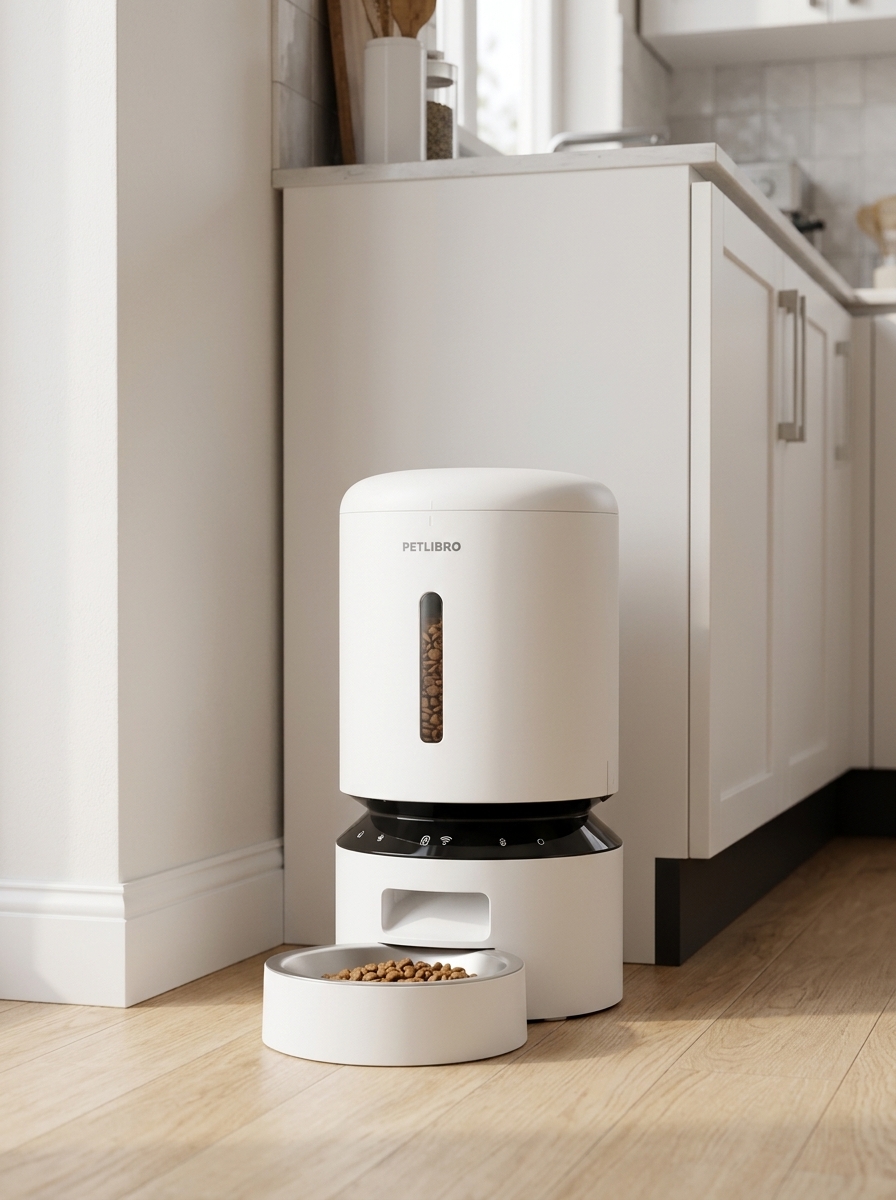
The Petlibro Granary WiFi Feeder scores 8.1 in our catalog (Score v1.0) — one of the highest feeder scores we track — with a 5 L hopper, up to 10 meals per day at a 10 g portion minimum, app control, and battery backup. It has no camera and no pet recognition.
Its tracked running cost is about as low as a connected feeder gets: no subscription in our catalog, no proprietary food format. The three-year consumable story is desiccant packs, backup battery sets, and seal inspections — all countable.
The real costs are mechanical and digital. At full schedule, the portion mechanism dispenses roughly 10,950 meals over three years (10 meals/day × 1,095 days — arithmetic on the tracked spec, not a durability rating), and every schedule change runs through the app.
Verdict: over three years, this is a low-upkeep feeder for owners who want precise, app-scheduled dry feeding without a camera or a subscription line item — provided they keep up a simple desiccant and seal routine.
The Petlibro Granary WiFi Feeder is an automatic dry-food feeder with WiFi app control and no camera. In our catalog it is defined by a short list of tracked facts: a 5 L hopper, up to 10 scheduled meals per day, a portion minimum of 10 g, dry food only, app control, battery backup, no pet recognition, a weight of 1.66 kg, and a 2-year warranty. Its Score v1.0 rating of 8.1 puts it near the top of the feeders we track. Because there is no camera and no recognition system, the three-year cost question for this model is narrower than for camera feeders: it is about the dispensing mechanism, the food-storage seals, and the app — nothing else.
The 3-year cost model, in counts
Our catalog tracks no consumable price and no subscription for this feeder, so the model below counts physical items and service events over 36 months of daily use. Every cadence is a planning estimate based on typical dry-feeder care practice, not a figure from the manufacturer.
Item
Cadence (planning estimate)
3-year count
Desiccant pack swaps
Every 1–2 months
18–36 packs
Backup battery sets
1 set per year if left installed
3 sets
Lid seal / gasket inspections
Every 6 months
6 inspections
Seal or gasket replacement
Only if an inspection fails
0–1
Hopper deep cleans
Monthly
36 cleans
Dispensed meals at full schedule
10/day (tracked spec)
~10,950 meals
Subscription payments
None tracked in our catalog
0
Proprietary food formats
None — standard dry kibble
0
Read the table as a workload, not a bill. The largest number in it is not a consumable at all — it is the meal count, which is where this feeder's real three-year cost accumulates: in mechanism cycles.
Desiccant and seal care: the freshness budget
A 5 L hopper holds enough kibble that food sits in the unit for days to weeks depending on how much your cat eats. Dry food stales by exposure to air and humidity, and the feeder's defenses are its lid seal and its desiccant pack. The desiccant is the one true consumable in this design: once saturated, it stops protecting the food, so swapping it every one to two months — 18 to 36 packs over three years — is the cadence that keeps the hopper's contents close to bag-fresh. Treat that range as a planning estimate: a humid kitchen pushes you toward the monthly end, a dry climate toward the longer end.
The seal is the zero-cost counterpart. Six inspections over three years — running a finger around the lid gasket, checking for cracks, warping, or trapped kibble crumbs that break the closure — cost nothing but attention, and a seal that passes every inspection never needs replacing. Budget for at most one replacement in three years, and only if an inspection actually finds damage. Owners who skip the inspections tend to discover seal failure indirectly, through a cat that starts refusing food that has gone stale in the hopper.
The portion mechanism: 10,950 cycles of wear
The tracked spec allows up to 10 meals per day. Run at that full schedule, the dispensing mechanism cycles about 10,950 times in three years — simple arithmetic on the spec (10 × 1,095 days), stated here to size the wear question, not as a claim about how long the mechanism will last; our catalog tracks no cycle-life rating for it. Most households will run two to four meals a day, which cuts the count proportionally, to roughly 2,190–4,380 cycles.
What wears in a portion mechanism is gradual: the rotor or auger that meters each 10 g-minimum portion, and the outlet path where kibble dust accumulates. The practical defenses are in the counts table — the monthly deep clean (36 over three years) is when dust and oil residue come out of the food path, and it is also when you would notice a portion size drifting before it becomes underfeeding. The 2-year warranty covers the first two of the three years in this model; year three is on you, which is exactly why the cleaning cadence matters more than any single part.
Battery backup: cheap insurance, on a schedule
The Granary WiFi Feeder runs on mains power with battery backup, so an outage does not erase the feeding schedule. Backup batteries are a consumable only in the slow sense: a set left installed should be replaced about once a year whether or not it ever carried the feeder through an outage — three sets over the three-year window, as a planning estimate. Batteries that sit untouched for years are the ones that fail silently, and a backup you never test is a hope, not a feature. The cheap discipline is to swap the set on a fixed date each year and confirm the feeder runs on battery power alone for one meal before putting the mains plug back.
The app is the real dependency
Every schedule change, portion adjustment, and feeding record on this model runs through the app — there is no camera feed to watch, but there is also no meaningful on-device scheduling interface to fall back on. That makes the three-year cost partly a software question. As a general connected-device consideration — not a claim about this brand's services — if an app or cloud service behind any WiFi feeder were discontinued, the hardware would still stand on your floor but remote scheduling would narrow or stop. Owners who care about that risk should keep the feeder's firmware and app updated, keep the account credentials somewhere durable, and note that the battery-backed schedule is the layer most likely to keep working through any service disruption.
The lighter side of app dependence is portion accuracy: a 10 g portion minimum is a fine-grained floor for a feeder, and it is the app that makes small, frequent meals practical to program. Ten small meals a day is a grazing schedule that would be tedious to maintain on a manual timer dial; here it is a one-time setup.
How it compares on running cost
Against a camera feeder such as the WOPET Heritage View Pet Feeder, the Granary WiFi gives up the visual check-in and, in exchange, removes the camera from the failure list entirely — no lens to clean, no feed to troubleshoot, and the same zero-subscription profile in our catalog. Both models land their three-year cost in the same place: desiccant, batteries, and attention. The Granary WiFi's 8.1 Score against the WOPET's 8.2 says our system rates them near-equal overall; the running-cost tiebreaker is simply which feature set you would rather maintain.
Verdict
Three years with the Petlibro Granary WiFi Feeder costs you 18–36 desiccant packs, about 3 battery sets, 6 seal inspections, and 36 deep cleans — no subscription, no proprietary consumables, nothing that bills monthly. What it asks in return is consistency: keep the desiccant fresh, keep the food path clean, and accept that the app is the control panel for the product's whole life. For an owner who wants high meal frequency and fine portions without paying for a camera they will not watch, that is one of the cheapest three-year ownership profiles in our feeder catalog — and the 8.1 Score suggests the low running cost is not bought with a weak feeder.
Does the Petlibro Granary WiFi Feeder have a camera? No. Our catalog tracks this model with no camera and no pet recognition. A different model, the Granary Camera, exists separately — do not let the shared Granary name merge the two spec sheets when you compare listings.
How many meals will it dispense over three years? At the maximum tracked schedule of 10 meals per day, the arithmetic is 10 × 1,095 days ≈ 10,950 meals. That is a wear-sizing figure derived from the spec, not a rated lifespan. At a typical two to four meals per day, expect roughly 2,190–4,380 cycles instead.
What consumables does it actually use? Desiccant packs (a planning estimate of 18–36 over three years, swapped every one to two months) and backup battery sets (about one per year, three total). The lid seal needs inspection twice a year and replacement only if an inspection finds damage — zero to one in three years.
Is there a subscription? Our catalog tracks no subscription for this model, and no proprietary food format — it dispenses standard dry kibble. If a listing you are reading mentions a paid plan, it is not a figure from our catalog data for this feeder.
What happens to the feeder if the app stops working? The battery backup is tracked in our catalog, so a power outage does not stop scheduled feeding. App or cloud discontinuation is a general risk for any WiFi feeder: remote scheduling would be affected even though the hardware is unchanged. Keeping the app and firmware updated and the account recoverable is the practical mitigation.
How does its running cost compare with camera feeders? Nearly identical in structure — desiccant, batteries, and cleaning — because our catalog tracks no subscription for either this model or the camera feeders we compare it with. The difference is maintenance surface: no camera means no lens or video feed to maintain, and no remote viewing in return.
Last updated: November 27, 2026
Changelog
November 27, 2026 — Added retailer buying links (Our pick and Where to buy) for the products covered in this article.
Related in this category
Pet Tech · Automatic Cat Feeders · Updated Nov 21, 2026
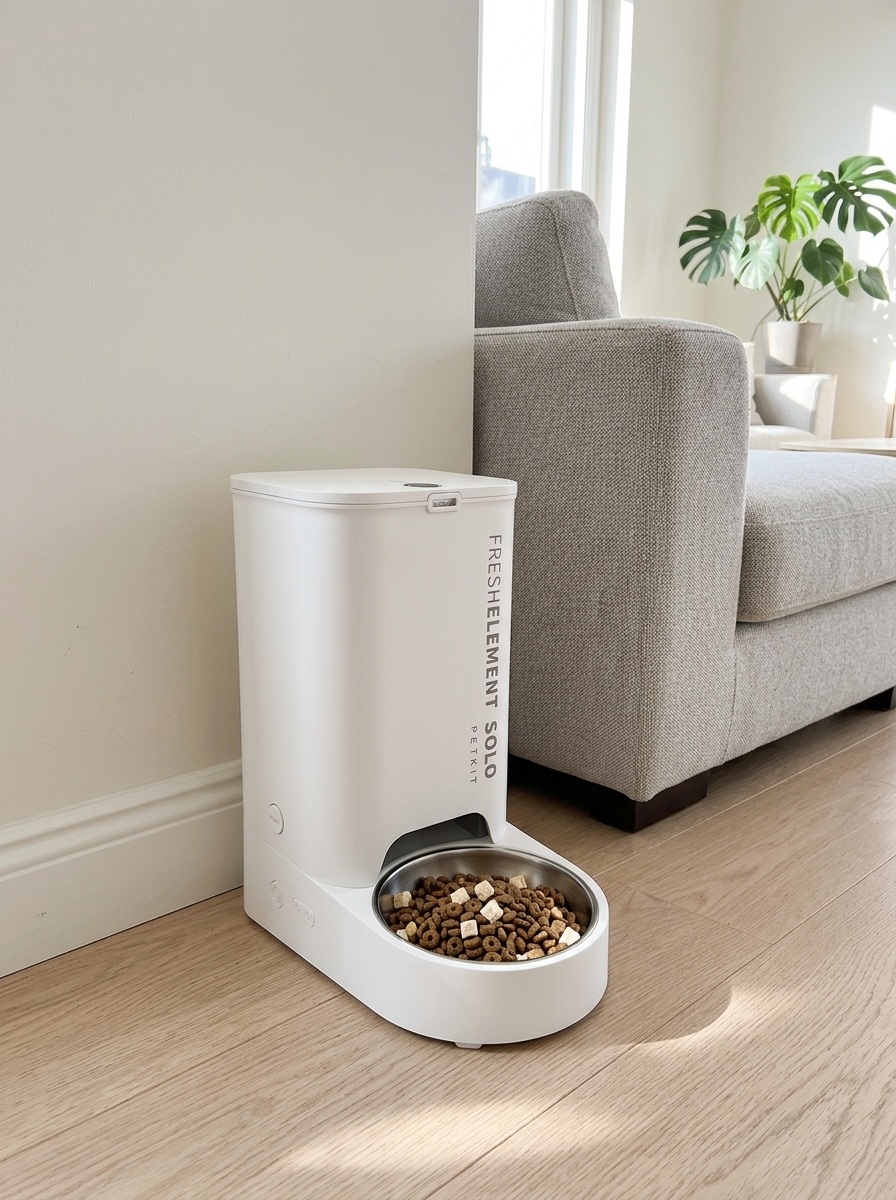
As of 2026-11-21, we track 16 automatic cat feeders from 9 brands, scored with Score v1.0 from owner ratings, spec strength and ownership cost. PETKIT Fresh Element Solo leads the list at 8.0/10. Tracked prices run from $47 to $299; the full table below is sortable by score and price.
The VOLUAS Automatic Cat Feeder 4L (Score 7.8 in our catalog) has no app, no camera, and no account — so its entire ownership contract is physical: desiccant, dust, seals, and batteries.
- The working

Discussion
No comments yet