Email me when Petlibro Polar Wet Food Feeder drops to my target price. The confirmation includes a manage link — use it any time to list or remove your alerts at Your price alerts. Lowest price tracked so far: USD 169.99 — a target below that is below the historical low and less likely to be reached.
Affiliate disclosure: AIBuyLab may earn a commission from qualifying purchases made through links on this page, at no extra cost to you. This article is desk research: we analyzed the manufacturer's published specifications and our own catalog data. We did not hands-on test this feeder, and we took no noise, light, or temperature measurements of it. Where our catalog does not track a figure, we say so rather than estimate one.
TL;DR
The Petlibro Polar is a wet-food-only automatic feeder (Score 4.7 in our catalog) that serves up to 3 meals per day, with app control, battery backup, and a 2-year warranty — and no camera or pet recognition.
Its night profile turns on one question we cannot answer with a number: our catalog tracks no decibel rating, no LED specification, and no refrigeration temperature for this feeder. Anyone who quotes you an exact dB figure for it is guessing.
What we can do is reason from mechanism: an actively cooled feeder makes its noise in cooling cycles and lid events, not in a constant hum you can schedule around — and app notifications are the one night-noise source fully in your control.
Placement does more for your sleep than any spec sheet: a hard, level surface in a ventilated spot, in a different room from where you sleep, beats a carpeted corner of the bedroom every time.
The Petlibro Polar Wet Food Feeder is an automatic feeder built exclusively for wet food. Where most automatic feeders are dry-kibble dispensers with a hopper and a rotating portion mechanism, the Polar belongs to the smaller refrigerated class: it holds prepared wet meals and keeps them chilled until a scheduled serving opens one to your cat. Our catalog records it at 3.4 kg, app-controlled, with battery backup, up to 3 meals per day, no camera, and no pet recognition, backed by a 2-year warranty. It scores 4.7 under our Score v1.0 system — a middling mark that reflects its narrow job (wet food only, three servings a day) rather than a defect.
That narrow job is exactly why the after-dark question matters more for this feeder than for a dry dispenser. A kibble feeder is mechanically silent between meals. A cooled wet feeder has a second life at night: it has to keep food cold while you sleep, and everything about its sleep-friendliness follows from how it does that.
The Honest Gap: No dB, No LED Spec, No Temperature in Our Catalog
Three figures would settle most of this article, and we do not have any of them:
Noise: our catalog tracks no decibel rating for the Polar. We will not convert "refrigerated feeder" into an invented number like "about 35 dB."
Light: our catalog tracks no LED specification — we cannot tell you from data whether its indicators are dimmable, always-on, or dark at idle.
Temperature: our catalog tracks no refrigeration temperature for this model. We cannot state how cold it keeps a meal, and we will not borrow a figure from a competitor or from general refrigerator standards and present it as this product's performance.
This matters beyond pedantry. Wet-food safety depends on holding temperature, and the general food-safety guidance is well established: perishable food should be kept at or below roughly 4 °C (40 °F), and wet pet food left in the warm danger zone for more than about two hours should be discarded rather than served. That is general guidance for any chilled feeder, not a measured property of the Polar. Treat it as the standard the product class has to meet — and as a question to put to the manufacturer's own documentation before you rely on overnight servings — not as a claim we are making about this unit.
Where the Night Noise Actually Comes From
With no rating to quote, the useful analysis is mechanical. A cooled feeder can make sound from three sources, and they behave very differently at 3 a.m.:
Cooling cycles. Active cooling — whether compressor-based or thermoelectric with a fan — runs in cycles, not continuously. The sound profile is a low background hum or fan wash that starts and stops. Two things follow. First, cycling noise is more noticeable in a quiet bedroom than a steady sound of the same level, because your ear catches the transitions. Second, cycle frequency depends on ambient temperature and how often the lid opens: a feeder in a warm room, opened three times a day, works harder at night than the same feeder in a cool pantry. Placement and room temperature are therefore noise controls, even though neither appears on a spec sheet.
Lid and serving events. Each scheduled meal is a discrete mechanical event — a lid or tray movement, possibly a soft chime or motor whir. At midday this is nothing. At a 5:30 a.m. feeding it is an alarm clock with good intentions. The Polar serves up to 3 meals per day, so the schedule is yours to set: nothing in the product forces a pre-dawn serving. If your cat demands breakfast at dawn, the feeder will be awake then — that is the trade you are buying, and it is a scheduling decision, not a defect.
The cat. Honestly, the loudest part of any feeder at night is usually the animal. A cat that learns the serving sound will arrive before it, and a cat eating wet food from a hard tray in a quiet flat is audible. No feeder spec fixes this; distance does.
Lights: The Unknown We Won't Dress Up
Because our catalog tracks no LED specification for the Polar, we can only frame the questions. Powered feeders typically carry at least a status indicator, and app-connected devices often add a connectivity light. In a dark bedroom, even a small steady LED is visible; a blinking one is worse. The practical mitigations are class-general and cost nothing: face the unit away from the bed, place it so furniture blocks the direct line of sight, or — decisively — keep it out of the bedroom altogether. If light output is a deciding factor for you, it is a legitimate reason to ask the manufacturer directly, because it is not a figure the spec summaries in our catalog carry.
App Notifications: The Noise You Fully Control
The Polar is app-controlled, and for night use that cuts both ways. The app is how you set the three daily servings, and battery backup means a power cut does not silently cancel a meal. But an app-connected feeder can also push alerts — low battery, a missed or completed serving, connectivity drops — and a phone buzzing at 2 a.m. is a sleep problem entirely of configuration. Set the app's notifications to silent or scheduled-summary mode overnight, and let the feeder's battery backup handle the night shift without narrating it. This is the one element of the Polar's after-dark profile that is completely in your hands, and it is worth setting up on day one rather than after the first interrupted night.
Placement Guidance: Distance, Surface, Airflow
General practice for any actively cooled feeder, applied to this one:
Room choice first. A kitchen, utility room, or hallway beats a bedroom or a studio flat's sleeping corner. Even a few metres and one closed door do more than any plausible difference between models' noise ratings.
Hard, level surface. A cooled unit on carpet can trap heat around its vents and sit unevenly; a hard surface keeps airflow clear and stops vibration transmitting through floorboards. If the unit must live on wood flooring near a bedroom, a thin rubber mat underneath damps structure-borne hum.
Ventilation space. Leave clearance around the sides and back. A feeder pushed into a closed cupboard will cycle more often and run louder doing it — the opposite of what the cupboard was for.
Away from heat sources. Radiators, sunlit windows, and the warm side of a refrigerator all raise the cooling load and therefore the cycle frequency at night.
If your home cannot offer a separate room — a studio, a small flat — the honest comparison is with a non-powered wet feeder such as the Cat Mate C500, which has no cooling system to cycle at all and is therefore mechanically silent between servings, at the cost of the chilling being passive rather than active. That trade — silence and simplicity against active cooling — is the real decision for light sleepers.
Who Should Skip It, Who It Suits After Dark
Skip the Polar as a bedroom feeder if you are a light sleeper in a small space and the only available spot is beside the bed: we cannot promise you a quiet unit, because no verified noise figure exists in our data, and a cycling cooling system is the wrong gamble at that distance. It suits owners who can place it in a kitchen or utility room, who want wet meals served on a schedule of up to three a day, and who value battery backup and app control over camera features it does not have. Judged as a kitchen appliance rather than a bedroom one, its after-dark profile is unremarkable — which is precisely what you want.
How loud is the Petlibro Polar at night? We don't know a number, and neither does our catalog: no decibel rating is tracked for this model. What we can say is that its noise comes from cooling cycles and serving events rather than a constant motor, so placement in another room matters more than any figure would.
Does the Polar have lights that stay on at night? Our catalog tracks no LED specification for it, so we can't confirm indicator brightness or behaviour from data. If it must sit in a bedroom, face it away from the bed; better, place it in another room.
How cold does it keep wet food overnight? Our catalog tracks no refrigeration temperature for this feeder, so we make no claim. As general food-safety guidance for any chilled feeder, perishable food should be held at or below about 4 °C (40 °F), and wet food left warm for more than roughly two hours should be discarded. Check the manufacturer's documentation for this model's stated temperature before relying on overnight servings.
Will the feeder wake me up when it serves a meal? A serving is a brief mechanical event. With up to 3 meals per day under your scheduling control, you can keep servings out of your sleep window entirely — unless your cat's dawn breakfast is the point, in which case the sound is the feature working as intended.
What happens if the power goes out at night? The Polar has battery backup, so scheduled meals are not silently cancelled by an outage. Pair that with silenced overnight app notifications so the backup does its job without waking you.
Is there a quieter alternative for wet food? A non-powered tray feeder such as the Cat Mate C500 has no cooling system and makes no cycle noise at all; the trade is passive rather than active chilling. For a bedroom-adjacent setup, that trade can be worth it.
---
Last updated: November 27, 2026
Changelog
November 27, 2026 — Added retailer buying links (Our pick and Where to buy) for the products covered in this article.
Related in this category
Pet Tech · Automatic Cat Feeders · Updated Nov 21, 2026
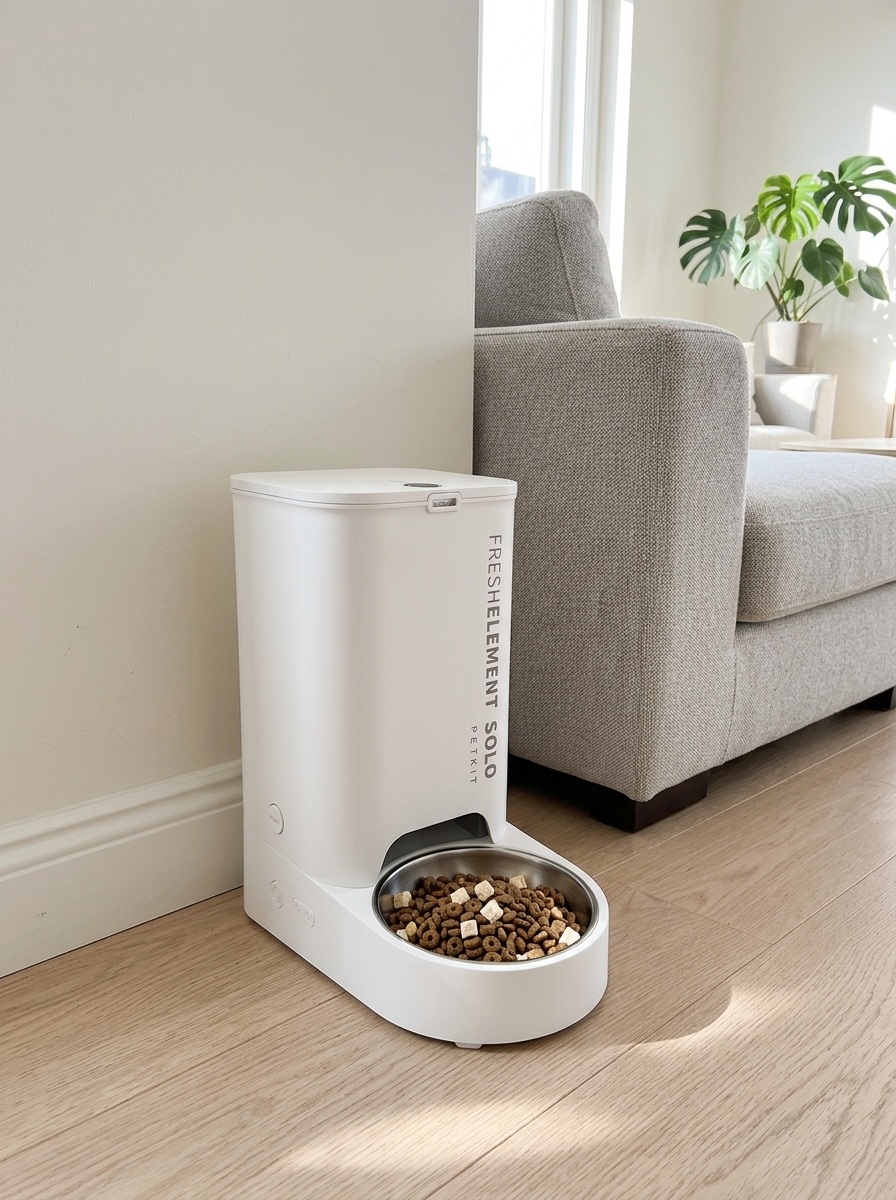
As of 2026-11-21, we track 16 automatic cat feeders from 9 brands, scored with Score v1.0 from owner ratings, spec strength and ownership cost. PETKIT Fresh Element Solo leads the list at 8.0/10. Tracked prices run from $47 to $299; the full table below is sortable by score and price.
The VOLUAS Automatic Cat Feeder 4L (Score 7.8 in our catalog) has no app, no camera, and no account — so its entire ownership contract is physical: desiccant, dust, seals, and batteries.
- The working

Discussion
No comments yet