Email me when Petlibro Polar Wet Food Feeder drops to my target price. The confirmation includes a manage link — use it any time to list or remove your alerts at Your price alerts. Lowest price tracked so far: USD 169.99 — a target below that is below the historical low and less likely to be reached.
Disclosure: This article is desk research based on the manufacturer's published specifications and our catalog data. We did not hands-on test this feeder, and no maintenance interval below is a measured result — every cadence is labeled a planning estimate so you can build a routine before the habits are forced on you.
TL;DR
The Petlibro Polar Wet Food Feeder is a wet-food-only automatic feeder (Score 4.7 in our catalog) serving 3 meals a day, with app control, battery backup, and a 2-year warranty.
Wet food turns maintenance from a weekly chore into a daily contract: every tray or bowl that held wet food gets washed after each meal cycle, not at the end of the week.
The core routine has four layers — per-meal washing, a weekly seal-and-gasket inspection, a monthly deep clean of every food-contact surface, and a standing rule that opened wet food never sits out beyond general food-safety windows.
The app is not a convenience extra on this category; its reminders are the mechanism that keeps the schedule real. Turn them on.
At 3.4 kg, this is a fixed countertop appliance. Plan its spot, its washing access, and its routine around the sink — it is not moving for cleaning day.
The Petlibro Polar Wet Food Feeder is an automatic pet feeder built exclusively for wet food. Where most automatic feeders are dry-kibble dispensers with sealed hoppers, the Polar exists for the opposite problem: portioning fresh, perishable food on a schedule. Our catalog records it at a Score of 4.7, serving up to 3 meals per day, with app control for scheduling, battery backup so a power cut does not silently cancel a meal, no camera, and no pet recognition — it feeds on a clock, not on identifying which animal showed up. It weighs 3.4 kg and carries a 2-year warranty.
That spec sheet explains the maintenance burden. A dry feeder's food sits in a sealed hopper and stays shelf-stable for weeks, so its cleaning schedule is measured in weeks. Wet food is perishable from the moment the can or pouch opens. Every surface it touches becomes a surface that needs washing on a daily rhythm, and the feeder's job — holding portions ready across the day — sits in direct tension with food-safety basics. Owning this category means signing up for the routine below.
One honest limit before the schedule: our catalog does not track a temperature or refrigeration specification for this model, so this article asserts no cooling temperatures and no compressor details. For the feeder's rated hold times and any temperature figures, the model's own manual is the authority. Everything here is framed as general wet-food handling practice applied to this feeder's format.
The Maintenance Schedule at a Glance
All intervals below are planning estimates — sensible starting cadences for a wet-food routine, not figures from the manufacturer or from testing.
Task
Cadence (planning estimate)
Why
Wash tray/bowl and any food-contact insert
After every meal cycle, daily at minimum
Wet food residue is perishable and breeds odor and bacteria fast
Wipe the serving area and lid underside
Daily, with the tray wash
Splatter and condensation collect where food is portioned
Inspect seals and gaskets for residue, warping, odor
Weekly
A compromised seal lets air at stored portions and traps residue in the seam
Deep clean all removable food-contact parts
Monthly
Biofilm builds invisibly on surfaces that look clean
Check battery backup function
Monthly
Backup you never test is a hope, not a feature
Review app schedule and reminder settings
Monthly, and after any routine change
The schedule only protects food if it matches your real day
Replace worn seals/gaskets
When inspection shows warping, cracks, or persistent odor
Seals are consumables on any food appliance
After Every Meal: The Wash Is the Product
The single non-negotiable habit: whatever held the wet food gets washed after the meal cycle, every time. Wet food leaves a protein-and-fat film that a rinse does not remove and that turns within hours at room temperature. Hot water, dish soap, and a brush or sponge dedicated to pet dishes is the whole technique. If parts are dishwasher-safe per the manual, the dishwasher is fine — confirm in the manual rather than assuming, because heat warps some plastics and a warped tray is a seal problem later.
Do not top up. The temptation with any scheduled feeder is to add fresh food over the remains of the last portion. With wet food, the old residue seeds the new portion, and the clock on the fresh food effectively starts from the oldest food in the tray. Empty, wash, dry, then load.
Drying matters more than it looks. A tray put back wet dilutes the next portion's surface and keeps the serving area damp between meals, which is exactly the environment residue needs. Air-dry on a rack or towel-dry with a clean cloth as part of the same wash cycle.
The Standing-Food Rule
General food-safety guidance for perishable food is consistent across sources: wet pet food should not sit out at room temperature for extended periods — a commonly cited safe window is around two hours, less in a warm room — and opened wet food belongs under refrigeration and used within a few days. Treat those as general practice, not as this feeder's rated performance; the manual's stated hold times for this model govern what the appliance itself promises.
The practical consequence for scheduling: the three daily meals should be spaced so no portion waits far beyond what you are comfortable with, and a portion your pet walks away from is finished — it gets discarded and the tray washed, not left for the next cycle. If your pet routinely ignores a scheduled meal, the fix is a smaller portion or a different schedule in the app, not a longer stand time.
Seals and Gaskets: The Weekly Five Minutes
On a wet-food feeder, seals do double duty: they limit air exposure on stored portions and they close the gap between the cold, food-side interior and the room. They are also residue traps. Once a week (planning estimate), run a finger along every seal and gasket you can reach. You are checking for three things: sticky residue hiding in the seam, warping or flattening that stops the seal seating evenly, and odor that survives washing — the tell that residue has worked into the material.
Clean seals with the same soap-and-water wash, then dry them fully before closing the unit up; a seal closed damp keeps its seam damp. If a seal stays tacky, warped, or smelly after a proper wash, it is done — seals are replaceable consumables on food appliances, and a tired seal quietly degrades every portion the feeder holds.
Why the App Reminders Exist
App control on a dry feeder is mostly convenience — set portions from the couch. On a wet-food feeder it is load-bearing. The schedule in the app is what stands between "the feeder holds perishable food" and "the food was out too long," and the reminder notifications are prompts for the human half of the system: load the tray, wash the tray, check the tray.
Set up the reminders when you set up the feeder, not after the first forgotten wash. Useful ones: a prompt shortly before each scheduled meal if you load portions fresh, a prompt after the last meal of the day for the full wash, and the built-in low-battery or missed-meal alerts if the app offers them — battery backup (which this model has) covers a power cut, but only the app tells you it happened. A monthly two-minute review of the schedule against your actual routine keeps the automation honest; a schedule built for a workday you no longer work is how portions end up standing.
The Monthly Deep Clean and the Fixed-Spot Reality
Once a month (planning estimate), take every removable food-contact part out and wash it thoroughly, including the corners and seams a daily wash passes over, and wipe down the non-removable food path and serving area. This is also the moment to test the battery backup — unplug the unit briefly and confirm it stays alive and keeps its schedule — and to inspect the power cord and the counter area underneath, where drips migrate.
Plan for the weight. At 3.4 kg the Polar is not heavy to lift, but it is heavy enough that nobody moves it casually, and it will live in one spot. Choose that spot with the routine in mind: near the sink if possible, on a surface that tolerates daily wiping, with clearance to open it fully for loading and washing. A feeder parked in an awkward corner gets its daily wash skipped; a feeder next to the sink gets it done. Compare that fixed-appliance reality with rotating-tray designs like the PetSafe Eatwell 5-Meal if counter space and washing access are your binding constraints.
Verdict
The Petlibro Polar's maintenance schedule is the category's schedule, not a flaw in this model: wet food demands a wash after every meal cycle, a weekly seal check, a monthly deep clean, and a hard rule against standing food. Budget ten minutes a day and the feeder does what it promises — three scheduled wet meals with app control and battery backup under a 2-year warranty. Skip the routine and no feeder in this category can protect the food. Buy it if your pet needs wet meals on a clock and you will run the daily wash; skip it if what you actually want is a fill-it-and-forget-it feeder, because wet food does not offer that product.
How often does the Petlibro Polar's tray need washing? After every meal cycle — daily at minimum. Wet food residue is perishable, and a rinse is not enough; wash with hot water and dish soap. All cadences here are planning estimates, not manufacturer figures.
Does the feeder refrigerate the food? Our catalog does not track a temperature or refrigeration specification for this model, so we do not assert cooling temperatures or hold times. The model's manual is the authority for its rated performance; the food-handling guidance in this article is general wet-food practice.
How long can wet food sit in the feeder? Follow the manual's rated hold times for the appliance. As general food-safety practice, perishable food should not stand at room temperature for extended periods — around two hours is the commonly cited window — and an uneaten portion should be discarded and the tray washed rather than carried into the next cycle.
What does the battery backup actually protect? It keeps the feeder running and on schedule through a power cut, so a meal is not silently skipped. Test it monthly (planning estimate) by unplugging briefly; an untested backup is an assumption.
Can I just top up the tray with fresh food? No. Fresh food over old residue inherits the oldest food's clock and its contamination. Empty, wash, dry, then load — that sequence is the core of owning a wet-food feeder.
Is 3.4 kg a problem? Only for placement. It is a fixed countertop appliance, not a travel feeder. Put it near the sink with room to open fully, and the daily wash becomes easy to keep.
Last updated: November 27, 2026
Changelog
November 27, 2026 — Added retailer buying links (Our pick and Where to buy) for the products covered in this article.
Related in this category
Pet Tech · Automatic Cat Feeders · Updated Nov 21, 2026
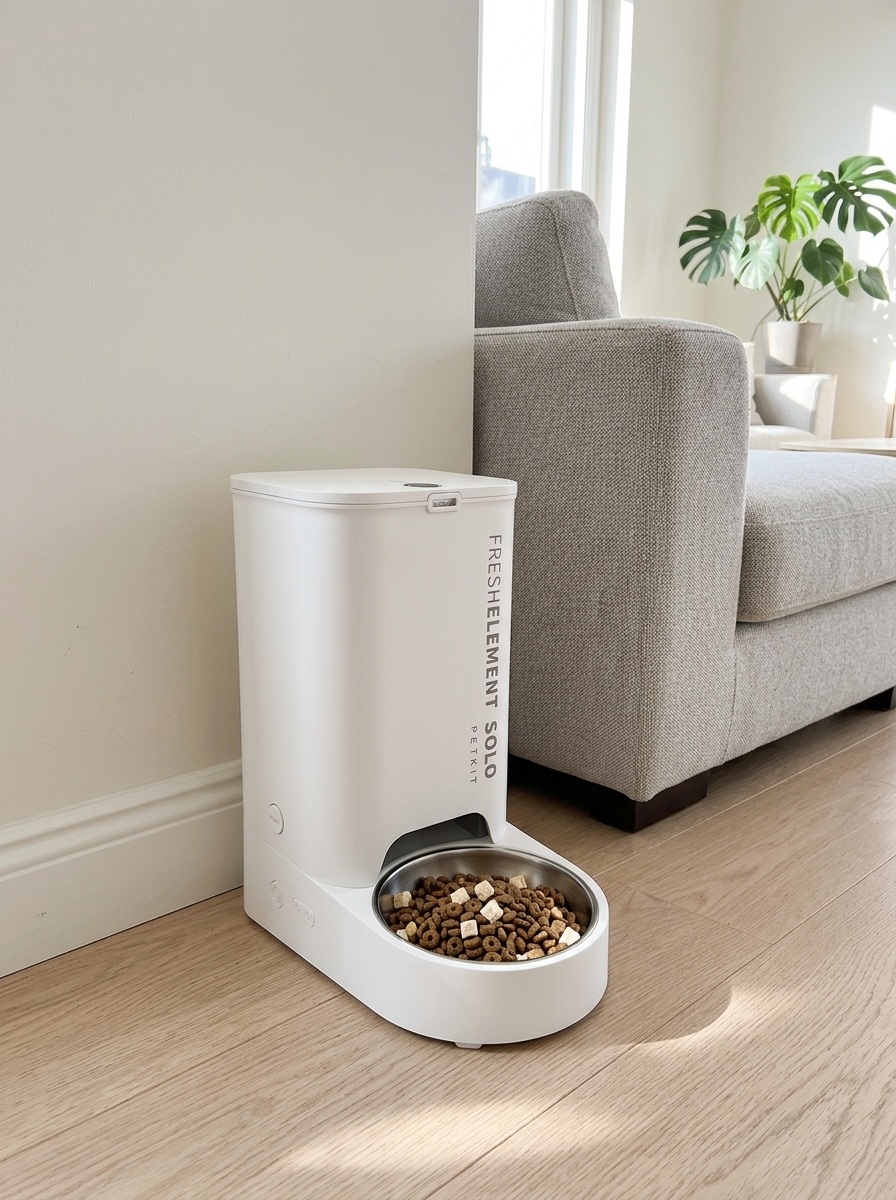
As of 2026-11-21, we track 16 automatic cat feeders from 9 brands, scored with Score v1.0 from owner ratings, spec strength and ownership cost. PETKIT Fresh Element Solo leads the list at 8.0/10. Tracked prices run from $47 to $299; the full table below is sortable by score and price.
The VOLUAS Automatic Cat Feeder 4L (Score 7.8 in our catalog) has no app, no camera, and no account — so its entire ownership contract is physical: desiccant, dust, seals, and batteries.
- The working


Discussion
No comments yet