Email me when PetSafe Eatwell 5-Meal Automatic Feeder drops to my target price. The confirmation includes a manage link — use it any time to list or remove your alerts at Your price alerts. Lowest price tracked so far: USD 59.99 — a target below that is below the historical low and less likely to be reached.
Disclosure: This article is desk research based on the specifications tracked in our catalog. We have not hands-on tested this feeder, and our catalog does not track a consumable cost or subscription price for it — which is why the entire cost model below is expressed in counts, not dollars. Where we estimate a cadence (battery changes, washes), it is labeled a planning estimate, not a measured figure.
TL;DR
The PetSafe Eatwell 5-Meal Automatic Feeder carries a Score of 6.2 in our catalog — respectable for a machine with no app, no camera, and no account of any kind.
Over three years, its tracked running costs are almost absurdly simple: a handful of battery sets, roughly a thousand tray washes, and zero subscriptions, zero filters, zero desiccant, zero anything else.
The real cost is not parts. It is you. The Eatwell holds five meals — about one day of feeding — so the dominant line item in its 3-year ledger is roughly 1,095 daily refills performed by a human.
It is a 1-day machine, not a vacation machine. Buy it for same-day schedule coverage and outage-proof simplicity, not for trips.
The PetSafe Eatwell 5-Meal Automatic Feeder is a rotating-tray automatic pet feeder: a covered tray divided into five compartments that advances on a timer, exposing one meal at a time. In our catalog it is tracked with five meal compartments and roughly 1.2 L of total capacity across them. It belongs to the dial-timer class of feeders — you set the schedule mechanically on the unit itself.
What it deliberately does not have defines it as much as what it does. There is no app control. There is no camera. There is no pet recognition — any pet in the room can eat from the exposed compartment. There is no Wi-Fi radio, no cloud account, and no subscription in our catalog's tracking. It is battery-powered (tracked in our catalog as having battery backup), which means a power outage at the wall simply does not enter its life.
That combination — a timer, a tray, and batteries — is the entire machine. The 3-year cost model below is short precisely because the parts list is short.
The 3-Year Cost Model, in Counts
Our catalog tracks no consumable cost and no subscription for the Eatwell, so this model counts physical events over three years (1,095 days) instead of dollars.
Cost item (3 years)
Count
Notes
Subscription payments
0
No subscription is tracked for this feeder
Accounts, apps, cloud services
0
Nothing to sign up for, nothing to sunset
Battery sets
~4–6 sets
Planning estimate; battery-powered class, cadence varies with use
Tray washes
~550–1,095
Daily washing = 1,095; every-other-day = ~550
Compartment refills
~1,095
One full tray cycle per day — the dominant "cost"
Desiccant packs
0
No sealed hopper to keep fresh
Filters or portion-wheel parts
0 tracked
Our catalog tracks no replaceable consumables for it
Camera/cloud storage fees
0
There is no camera
Two rows do all the work in this table: refills and washes. Everything a smart feeder charges you for — storage, connectivity, recognition features — is absent, and everything the Eatwell asks of you is measured in minutes at the sink and the food bin.
Batteries: The Only Recurring Part
The Eatwell's battery-powered design is its reliability argument and its only real consumable. A planning estimate of four to six battery sets over three years is reasonable for a timer mechanism that advances a tray a few times a day — the motor load is tiny compared with a Wi-Fi feeder that also powers a radio and, often, a camera around the clock.
The trade is worth stating plainly. A plugged-in smart feeder fails when the power or the router does, unless it carries its own battery backup. The Eatwell never plugs in at all, so the entire category of outage failure does not apply. What you give up for that is any way of knowing, from outside the room, whether a meal was served. There is no notification because there is nothing to send one.
Our honest framing: budget the battery sets, keep a spare set in the drawer, and treat a mid-cycle battery change as a planning estimate you can absorb without drama — the schedule consequence of a dead battery is a tray that stops advancing, which a daily refill habit (see below) will surface within a day anyway.
Tray Washing: The Dominant Chore
Five compartments, rotated daily, means the tray is in near-constant contact with food. The arithmetic is unforgiving:
Wash the tray every day and you will wash it roughly 1,095 times in three years.
Wash it every other day and the count falls to roughly 550 — still the largest single chore count in this feeder's life.
This is the honest center of the Eatwell's cost profile. Compartment feeders trade the sealed-hopper convenience of a kibble dispenser for portion control: each meal is pre-portioned by you, in advance, by hand. That is exactly what some households want — a cat on measured meals, or multiple small meals spread across a workday — and it is exactly what makes the machine labor-bound. The tray format is also the reason this style of feeder is commonly used for fresh or wet-style portions in general feeding practice; we note that as a format observation, not a catalog specification, since our catalog tracks this model as dry-only in its food-type field.
Compare the shape of the work with a hopper feeder such as the Cat Mate C500, which shares the compartment-tray philosophy: in this class, the owner's hands are the mechanism, and the 3-year "cost" is a routine, not a parts budget.
What Zero Connectivity Buys — and What It Costs You
Three years with the Eatwell includes:
Zero subscription renewals. Nothing is billed, nothing lapses, no feature is paywalled after purchase.
Zero account risk. There is no app to be discontinued, no cloud service to shut down, no login to break after a phone upgrade.
Zero network failure modes. Router changes, Wi-Fi password rotations, and ISP outages are non-events.
And it excludes, permanently:
Zero remote changes. A delayed flight home cannot be answered with an extra meal from the airport. The schedule is whatever you set before you left.
Zero confirmation. No photo, no log, no "meal served" ping. You verify feeding by looking at the tray when you get home.
Zero per-pet control. With no pet recognition tracked in our catalog, the exposed compartment serves whichever pet arrives first — a real limitation in multi-pet homes where one animal needs a different diet.
The Honest Cost: It Is a 1-Day Machine
Five compartments is one day of typical feeding — say, a day's meals portioned out before a long workday, or a single overnight. It is not a long weekend. Any 3-year cost model that ignores this misprices the machine: the Eatwell's true operating cost is a daily human refill, roughly 1,095 of them across three years, plus the washing routine above.
That is not a flaw to be fixed; it is the product. Households that are home every day and want feeding times enforced while they are at work get exactly what they pay for. Households that travel need a hopper machine with days of capacity — a different category, with the subscriptions and app dependencies this one avoids.
Verdict
The PetSafe Eatwell 5-Meal Feeder's true 3-year cost is the smallest parts bill in the feeder category and the largest labor bill: a few battery sets, several hundred to a thousand tray washes, roughly 1,095 refills, and nothing else — no dollars tracked because there is almost nothing to spend them on. Its Score of 6.2 reflects a machine that does one day, reliably, with no infrastructure. If your life is home-based and your problem is daytime schedule discipline, that trade is genuinely good. If your problem is travel, no cost model will save this from being the wrong tool.
Does the PetSafe Eatwell 5-Meal Feeder require a subscription? No. Our catalog tracks no subscription for this feeder, and there is no app or account associated with it. Over three years, the subscription line item is zero.
How many batteries will it use in three years? Our planning estimate is roughly four to six battery sets over three years. The feeder is battery-powered (tracked in our catalog as having battery backup), and the timer mechanism's draw is small; your actual cadence will vary with how often the tray advances.
Can it feed my pets while I am on vacation? Not beyond about a day. It holds five meals — roughly 1.2 L of total capacity across five compartments in our catalog's tracking — so it covers a workday or a single overnight, not a trip. It is a 1-day machine by design.
Does it work during a power outage? Yes, in the only way that matters: it never uses wall power in the first place. Battery operation means outages, unplugged cords, and router failures do not interrupt the feeding schedule.
Can it keep one pet out of another pet's food? No. Our catalog tracks no pet recognition for this model, and there is no camera. Whichever pet reaches the exposed compartment eats the meal, so it is not a solution for prescription-diet separation in multi-pet homes.
What is the biggest hidden cost of owning one? Your time. The dominant 3-year counts are roughly 1,095 daily refills and somewhere between 550 and 1,095 tray washes, depending on your washing cadence. There are no tracked consumable parts to buy — the cost is a daily routine.
Last updated: November 27, 2026
Changelog
November 27, 2026 — Added retailer buying links (Our pick and Where to buy) for the products covered in this article.
Related in this category
Pet Tech · Automatic Cat Feeders · Updated Nov 21, 2026
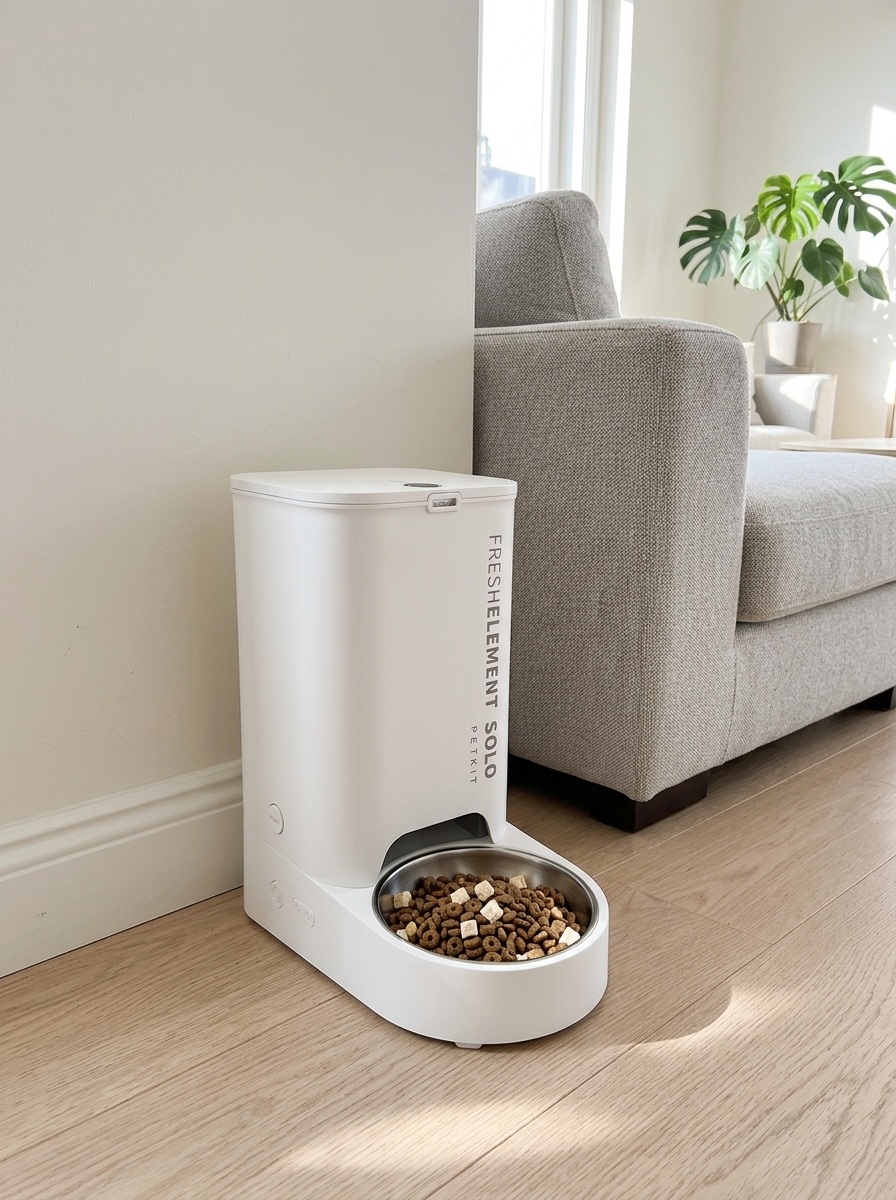
As of 2026-11-21, we track 16 automatic cat feeders from 9 brands, scored with Score v1.0 from owner ratings, spec strength and ownership cost. PETKIT Fresh Element Solo leads the list at 8.0/10. Tracked prices run from $47 to $299; the full table below is sortable by score and price.
The VOLUAS Automatic Cat Feeder 4L (Score 7.8 in our catalog) has no app, no camera, and no account — so its entire ownership contract is physical: desiccant, dust, seals, and batteries.
- The working

Discussion
No comments yet