Price alerts — PetSafe Smart Feed
Price-drop alert
Email me when PetSafe Smart Feed drops to my target price. The confirmation includes a manage link — use it any time to list or remove your alerts at Your price alerts. Lowest price tracked so far: USD 134.99 — a target below that is below the historical low and less likely to be reached.
PetSafe Smart Feed vs HoneyGuaridan 5G Feeder: Capacity Test
Disclosure: This comparison is based on catalog data and manufacturer specifications. We have not hands-on tested either feeder, and this article contains no affiliate pricing — we judge both machines strictly on their published specs.
TL;DR
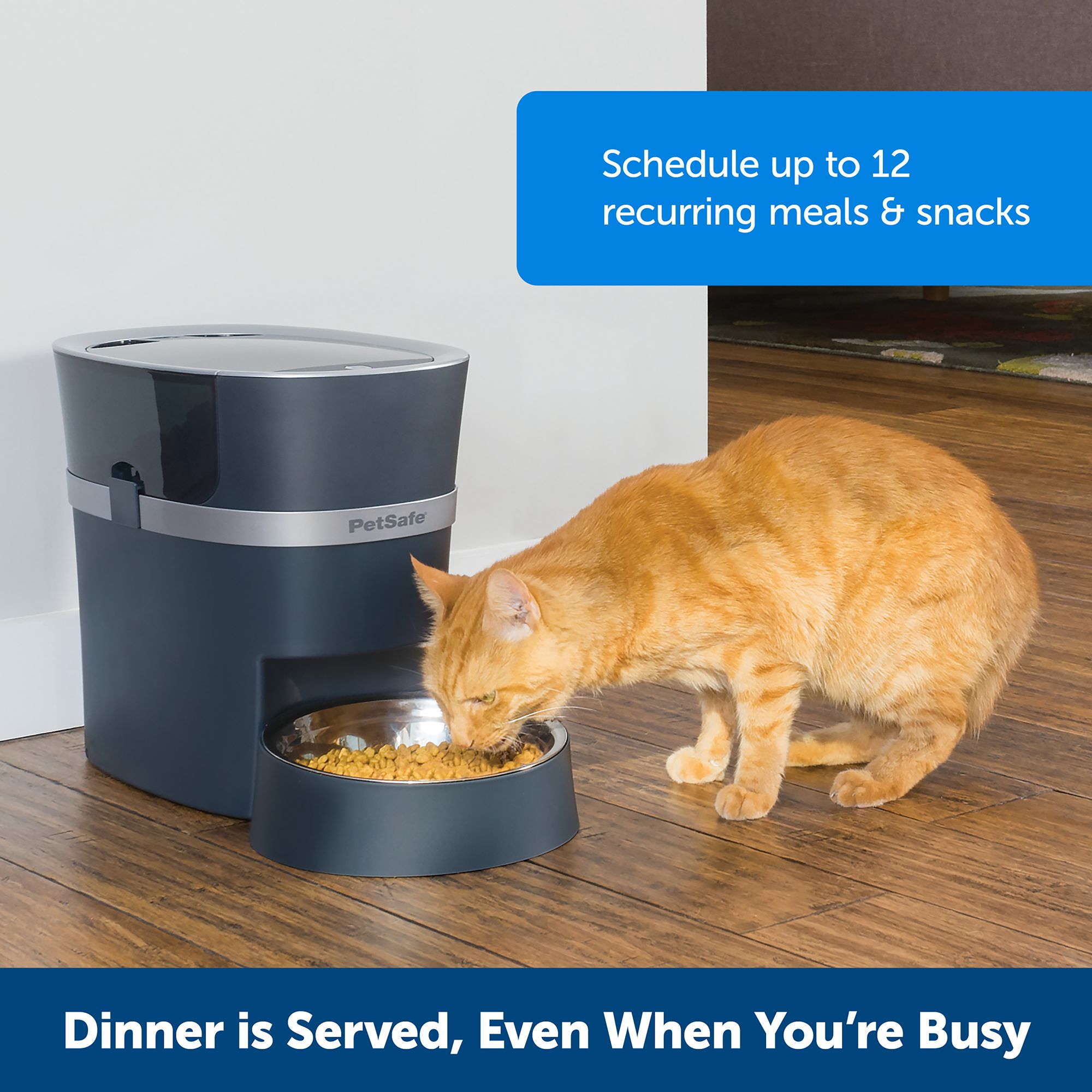
The PetSafe Smart Feed is the bigger, more flexible machine: a 5.76 L hopper and up to 12 scheduled meals per day, earning it a Score of 7.8 in our catalog. The HoneyGuaridan Automatic 5G WiFi Cat Feeder 3.5L is the compact alternative — 3.5 L and 6 meals per day, Score 5.7. Both are app-controlled, dry-food-only feeders with battery backup, and neither has a camera or pet recognition. If you feed multiple cats or run a grazer-style schedule with many small portions, the Smart Feed is the clear pick. If one cat eats two set meals a day and counter space is tight, the HoneyGuaridan covers the job in a smaller footprint.
Our pick: PetSafe Smart Feed vs HoneyGuaridan Automatic 5G WiFi Cat Feeder 3.5L — check current prices at the retailers.
What Is an Automatic WiFi Cat Feeder?
An automatic WiFi cat feeder is a countertop appliance that stores dry kibble in a sealed hopper and dispenses measured portions into a bowl on a schedule you set from a phone app. The category exists to solve three problems: portion control for cats that overeat from an open bowl, consistent meal timing when owners work irregular hours, and multi-day coverage during short trips. The two feeders compared here sit in the "connected but camera-free" tier of the category — they automate the schedule and report through an app, but they do not watch your cat, identify individual pets, or dispense wet food. Choosing between them comes down to how much food they hold, how granular the schedule can be, and how those two numbers map onto your household.
Spec Comparison
Spec | PetSafe Smart Feed | HoneyGuaridan 5G WiFi Feeder 3.5L |
|---|
Catalog Score (v1.0) | 7.8 | 5.7 |
Hopper capacity | 5.76 L | 3.5 L |
Max scheduled meals/day | 12 | 6 |
App control | Yes | Yes |
Battery backup | Yes | Yes |
Food type | Dry only | Dry only |
Camera | No | No |
Pet recognition | None | None |
The table tells most of the story. These are mechanically similar feeders — same control method, same backup power approach, same dry-only limitation — separated by scale. The Smart Feed's hopper holds roughly 65% more kibble, and its scheduler allows twice as many dispensing events per day. Everything else is effectively tied, which is why the Score gap (7.8 vs 5.7) tracks the capacity and scheduling differences so closely.
Capacity: What 5.76 L vs 3.5 L Actually Means
Hopper size determines refill frequency, and refill frequency determines how hands-off the feeder really is. A typical adult cat eats roughly 200–250 kcal of dry food per day, which works out to around 50–70 g of kibble depending on the formula. On that basis, the Smart Feed's 5.76 L hopper can plausibly carry a single cat for several weeks between refills, while the HoneyGuaridan's 3.5 L lands closer to two to three weeks. Exact stretches vary with kibble density and your cat's ration, but the ratio holds: the PetSafe holds about 65% more, so it needs topping up about 40% less often.
The gap widens in multi-cat homes. Two cats drawing on one feeder double the consumption rate, and a 3.5 L hopper starts to feel like a weekly chore rather than an appliance. For a weekend trip with two cats, the Smart Feed's reserve is also the safer margin — you are not calculating whether the last portion will drop on Sunday morning. The HoneyGuaridan's smaller bin is not a defect so much as a design brief: it is built for a single cat in a small kitchen, where a 5.76 L tower would dominate the counter. If your constraint is space rather than capacity, the smaller hopper is the feature.
Scheduling Depth: 12 Meals vs 6 Meals
Meal count per day sounds like a spec-sheet flourish until you meet a cat whose feeding plan actually needs it. Six meals a day comfortably covers the standard patterns: two main meals, three measured feedings, or a meal every four hours across the active day. For most single-cat households, the HoneyGuaridan's ceiling of six is never the limiting factor.
Twelve meals a day serves a different set of use cases:
- Grazers on a diet. Cats that bolt a full meal and vomit, or that are on a vet-directed weight plan, often do better with the same daily ration split into many small portions. Twelve dispensing slots let you spread food across the whole day in snack-sized drops.
- Dawn-demand cats. A 5 a.m. mini-portion can defuse the wake-up routine without committing to a full early breakfast; fine-grained schedules make that easy to layer in.
- Multi-cat staggering. In homes where one cat eats faster, back-to-back small portions at short intervals can give the slower cat repeated chances at the bowl (though with no pet recognition on either feeder, neither machine can enforce who eats what).
If none of those describe your household, the scheduling advantage is theoretical. If one of them does, it is decisive — no firmware update will give the HoneyGuaridan a thirteenth slot it does not have, and the Smart Feed's depth is there from day one.
Shared Ground: App Control and Battery Backup
Both feeders are app-controlled, which means schedule changes, manual feedings, and portion adjustments happen from your phone rather than through button combinations on the unit. Both also carry battery backup, so a power outage does not erase the schedule or skip meals — the feeder keeps dispensing on stored power until mains return. For a device whose entire purpose is reliability in your absence, battery backup is close to non-negotiable, and it is good to see it on both rather than reserved for the premium model.
The shared limitations matter just as much. Both are dry-food only: neither can handle wet food, fresh food, or freeze-dried mixes with moisture content. Neither has a camera, so you cannot visually confirm a meal was eaten. And neither offers pet recognition — in a multi-cat home, both feeders serve whoever arrives first. If any of those three capabilities is a requirement, neither of these is your feeder, and you should be looking at a different tier of the category entirely.
Verdict: Match the Feeder to the Household
Choose the PetSafe Smart Feed if you have two or more cats, a cat on a many-small-meals plan, or a strong preference for refilling rarely. Its 5.76 L hopper and 12-meal scheduling ceiling are not marginal upgrades — they are roughly 65% more capacity and double the schedule depth, and the 7.8 Score reflects that headroom. It is the feeder you buy when you want the automation to disappear into the background for weeks at a time.
Choose the HoneyGuaridan 5G WiFi Feeder if you have one cat on a simple two-to-three-meal routine and limited counter space. Six meals a day is more than that cat will ever need, the 3.5 L hopper still holds weeks of food for a single animal, and you give up nothing in app control or outage protection. Its 5.7 Score reflects narrower headroom, not unreliability — for the household it is sized for, the specs are sufficient.
The short version: pet count and schedule complexity decide this one. Complex household, complex schedule — Smart Feed. One cat, simple routine, small kitchen — HoneyGuaridan.
Where to buy: PetSafe Smart Feed · HoneyGuaridan Automatic 5G WiFi Cat Feeder 3.5L — retailer links run through our /go/ tracker; the product pages track prices daily.
FAQ
Can either feeder handle wet food? No. Both the PetSafe Smart Feed and the HoneyGuaridan 5G WiFi Feeder are dry-food-only machines. Wet food would spoil in the hopper and jam the dispensing mechanism. If you feed wet food, you need a refrigerated or ice-pack feeder designed for it.
What happens to the feeding schedule during a power outage? Both feeders have battery backup, so scheduled meals continue to dispense while mains power is out. The app connection may drop if your router loses power, but the programmed schedule stored on the feeder keeps running.
Can these feeders stop one cat from eating another cat's food? No. Neither feeder has pet recognition — no microchip reader, no camera identification, no collar tag system. In multi-cat homes, food goes to whichever cat reaches the bowl first. Separating cats at mealtimes requires a feeder with recognition technology or physical separation.
How often will I need to refill each feeder? It depends on your cat's daily ration and kibble density, but the ratio is fixed: the Smart Feed's 5.76 L hopper holds about 65% more than the HoneyGuaridan's 3.5 L. For a single average cat, expect the PetSafe to run several weeks between refills and the HoneyGuaridan roughly two to three weeks. Two cats halve both figures.
Is 12 meals a day actually useful, or just a spec-sheet number? It is useful for specific cats: grazers prone to eating too fast, cats on strict portion-controlled weight plans, and cats that demand food at dawn. Splitting the same daily ration into many small drops solves all three patterns. For a cat happily eating two meals a day, the extra slots go unused — which is exactly the HoneyGuaridan's design assumption.
Do I need WiFi running for the feeders to work? You need WiFi for setup, schedule changes, and app-triggered manual feedings. Once a schedule is programmed, the feeder dispenses on time from its stored settings; a temporary WiFi drop does not stop meals, though you would lose remote control until the connection returns.
---
Last updated: November 27, 2026
Changelog
November 27, 2026 — Added retailer buying links (Our pick and Where to buy) for the products covered in this article.
Related in this category
Pet Tech · Automatic Cat Feeders · Updated Nov 21, 2026
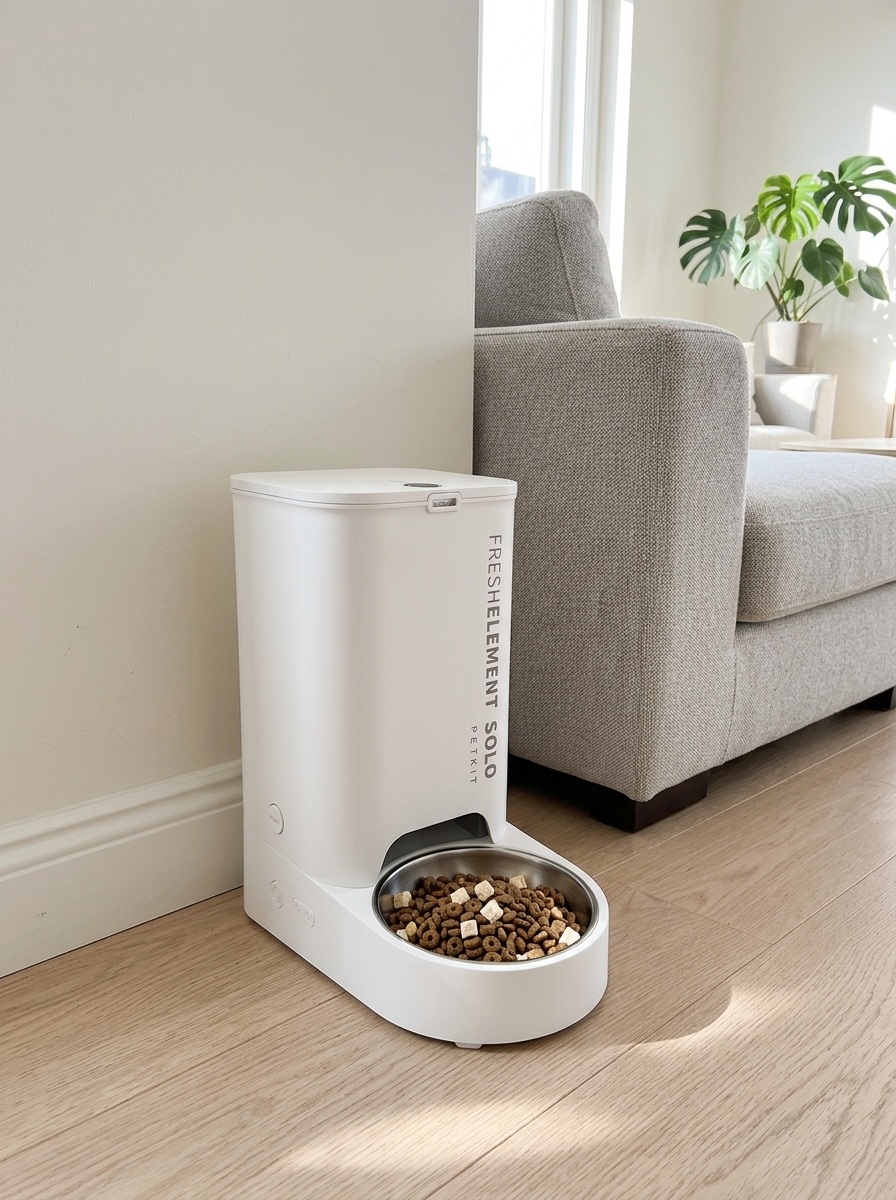
As of 2026-11-21, we track 16 automatic cat feeders from 9 brands, scored with Score v1.0 from owner ratings, spec strength and ownership cost. PETKIT Fresh Element Solo leads the list at 8.0/10. Tracked prices run from $47 to $299; the full table below is sortable by score and price.
Pet Tech · Automatic Cat Feeders
The VOLUAS Automatic Cat Feeder 4L (Score 7.8 in our catalog) has no app, no camera, and no account — so its entire ownership contract is physical: desiccant, dust, seals, and batteries.
- The working
Pet Tech · Automatic Cat Feeders
The PETKIT YumShare Dual-Hopper (Score 8.0 in our catalog) is built around one idea: two separate dry-food hoppers, 5 L combined, feeding u
Pet Tech · Automatic Cat Feeders
The PetSafe Smart Feed is the bigger, more flexible machine: a 5.76 L hopper and up to 12 meals a day, the deepest feeding schedule in this comparis
Report an error on this page
Discussion
No comments yet