Email me when Roborock H60 drops to my target price. The confirmation includes a manage link — use it any time to list or remove your alerts at Your price alerts. Lowest price tracked so far: USD 269.99 — a target below that is below the historical low and less likely to be reached.
Affiliate disclosure: AIBuyLab may earn a commission from qualifying purchases made through links on this page, at no extra cost to you. This comparison is desk research built from manufacturer specifications and our product catalog — we did not hands-on test either vacuum, and no score or claim below comes from a lab of our own.
TL;DR
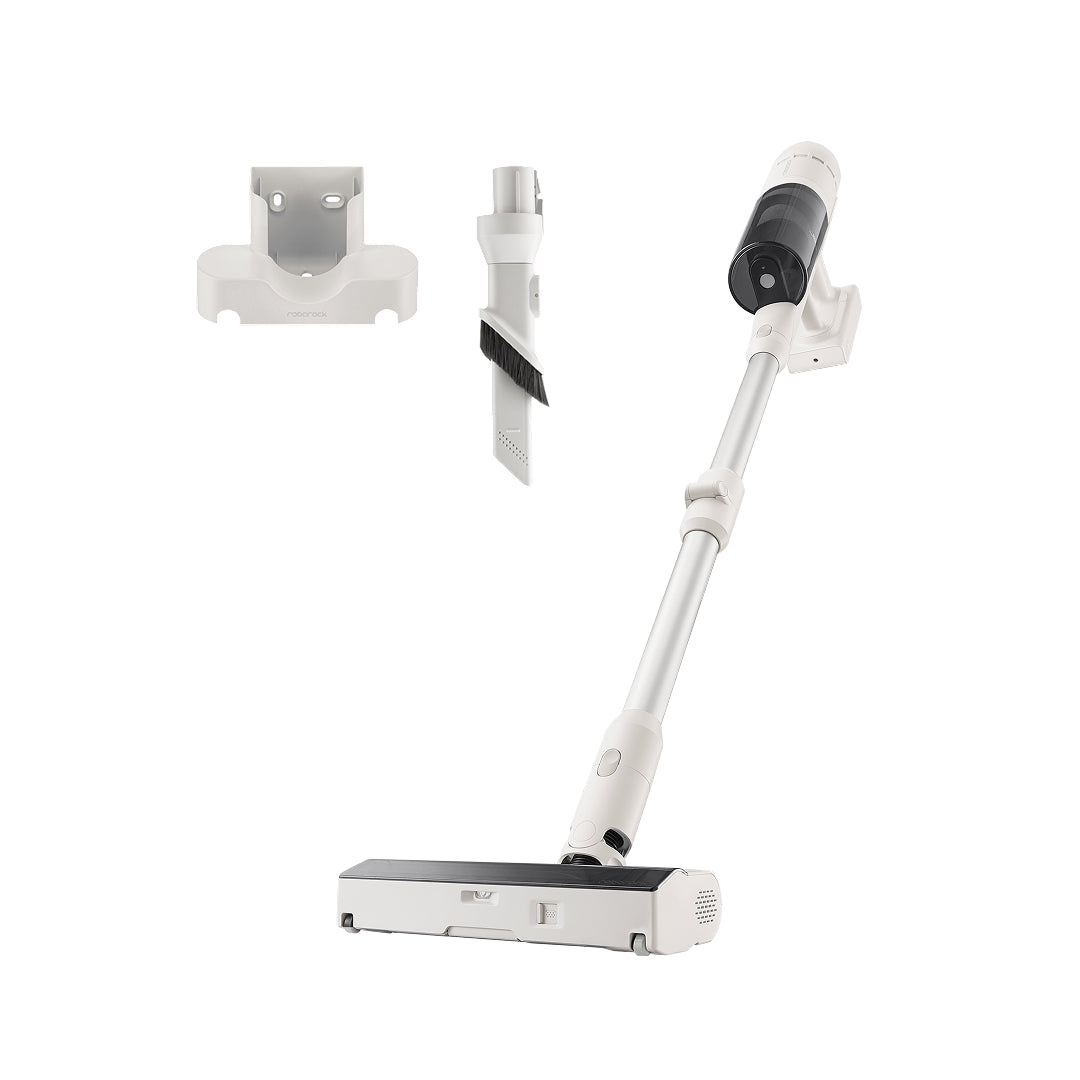
Same battery story, opposite machines: both the Roborock H60 and the Dyson V15 Detect Absolute run for up to 60 minutes per charge in our catalog — after that, everything diverges.
The Dyson doubles the H60's suction (240 AW vs 115 AW) and carries a bigger bin (0.77 L vs 0.49 L), at nearly double the weight (3.1 kg vs 1.68 kg).
Our Score v1.0 rates the H60 higher (4.1 vs 3.4) despite the suction gap — the score weighs more than peak AW, and we say so plainly rather than pretend the ranking is a suction ranking.
Verdict in one line: hard floors, stairs, and one-handed carrying favor the H60; deep carpet and attachment-heavy cleaning favor the V15.
A cordless stick vacuum is a battery-powered upright built around a slim wand: a motor and dustbin sit in the hand unit at the top, a cleaning head rides the floor at the bottom, and the whole machine stores on a wall mount or in a closet. The format trades the unlimited runtime and raw capacity of a corded upright for grab-and-go convenience — you clean a room, a staircase, or a spilled bowl of cereal without hunting for an outlet. Both machines in this comparison follow that template, both use HEPA filtration, and neither offers app control, a self-empty station, or any subscription. What separates them is where each brand spent its engineering budget: Roborock spent it on weight, Dyson spent it on suction.
Spec comparison
Spec
Roborock H60
Dyson V15 Detect Absolute
AIBuyLab Score v1.0
4.1
3.4
Suction
115 AW
240 AW
Dustbin capacity
0.49 L
0.77 L
Runtime
60 min
60 min
Weight
1.68 kg
3.1 kg
Filtration
HEPA
HEPA
Attachments
Not tracked in our catalog
7
Warranty
Not tracked in our catalog
2 years
App control
No
No
Self-empty station
None
None
Subscription
None
None
Fields marked "not tracked" are gaps in our catalog data, not claims that the feature or coverage is absent — we only print what our records hold.
Suction: the Dyson's headline number is real — and narrower than it looks
On paper this is a blowout. The V15 Detect Absolute's 240 AW is more than double the H60's 115 AW, and suction is the spec most buyers shop first. For deep-pile carpet, that gap matters: pulling embedded grit and pet hair up through dense fibers is exactly the job where air watts earn their keep, and the H60 will need more passes to do the same work — or leave some of it behind.
But peak suction is a ceiling, not a description of a whole clean. On hard floors — wood, tile, laminate — both machines operate far below their maximums in normal use, because hard surfaces need airflow across the floor, not maximum pull. A vacuum with double the suction does not pick up double the crumbs off a kitchen tile; it mostly picks up the same crumbs with more headroom it never uses. The honest summary: the Dyson's advantage is real on carpet, theoretical on hard floors, and the size of your carpeted area decides how much of it you will ever feel.
Weight: the spec you feel on every single clean
If suction is the number buyers shop, weight is the number owners live with. The H60 weighs 1.68 kg; the V15 weighs 3.1 kg — nearly double. That difference shows up in the moments that define stick-vacuum ownership:
Stairs. A stick vacuum's whole pitch is carrying it between floors. At 1.68 kg the H60 is a one-handed carry with a free hand for the rail; at 3.1 kg the Dyson is a deliberate trip.
High and overhead work. Cobwebs, curtain tops, ceiling corners — every gram multiplies when the machine is at arm's length above your shoulder. The H60 wins this outright.
Quick pickups. The five-minute tidy is the most common clean a stick vacuum ever does. A machine that feels effortless gets grabbed more often; a heavier one gets saved for "proper" cleans.
Neither machine's weight is a defect — the Dyson's extra mass is the motor and bin that produce its numbers. But buyers choosing between them should be honest about which kind of cleaning dominates their week: the frequent light pass or the weekly deep clean.
Bin size, attachments, and the ownership details
The V15's 0.77 L bin holds roughly 57% more than the H60's 0.49 L bin. In practice that means fewer mid-clean emptying trips in larger homes, and it pairs with the Dyson's broader kit: our catalog records 7 attachments for the V15, a spread aimed at crevices, upholstery, and stairs. The H60's attachment set is not tracked in our catalog, so we won't invent one — check the Roborock H60 product page for what our records hold before treating the kit as a deciding factor.
Ownership is otherwise simple on both sides. Both use HEPA filtration, which is the line that matters for allergy-sensitive homes. Neither has app control — no scheduling, no phone dashboards, nothing to pair or update. Neither offers a self-empty station, so emptying the bin by hand is part of life with both. Neither requires a subscription. The Dyson carries a 2-year warranty in our records; the H60's warranty term is not tracked in our catalog.
About the scores: why the weaker-suction vacuum ranks higher
Our Score v1.0 puts the H60 at 4.1 and the V15 at 3.4, and a reader comparing spec sheets deserves an explanation rather than a shrug. Score v1.0 is a composite: it weighs more than peak AW, folding the full spec record — runtime, weight, capacity, filtration, and the rest of the catalog fields — into a single number. A featherweight machine with an hour of runtime scores differently from a heavyweight built around one headline figure, even when that headline figure is genuinely better.
We publish the score because a single comparable number helps readers triage a catalog. We explain it because a score that contradicts the most obvious spec on the page, unexplained, looks like an error. It isn't one — but it is a composite, and composites hide trade-offs. This article exists to un-hide them.
Verdict: choose by floor type and by who carries it
Choose the Roborock H60 if your home is mostly hard flooring with rugs rather than wall-to-wall carpet, if the vacuum will travel stairs weekly, or if the person doing most of the cleaning values a machine they can lift, carry, and hold overhead without thinking about it. It is the better tool for frequent light cleaning, and frequent light cleaning is what most homes actually need.
Choose the Dyson V15 Detect Absolute if carpet is your primary surface — especially thicker pile — if pet hair works its way deep into rugs, or if you want the larger bin and the 7-attachment kit for a genuine whole-home deep clean. Its weight is the price of its suction, and on carpet that price buys something real.
Skip both if you want a self-empty station, app scheduling, or hands-off maintenance — neither machine offers any of it, and no spec above changes that. Full records for both models live on the Dyson V15 Detect Absolute product page and the H60 page linked throughout.
Is 240 AW twice as good as 115 AW? No. Suction figures describe peak pull, not cleaning results. The gap matters most on deep carpet, where the V15's extra power does real work; on hard floors both machines clean well within their limits and the difference largely disappears.
Which vacuum is better for stairs? The Roborock H60. At 1.68 kg it weighs barely more than half the Dyson's 3.1 kg, and stairs are where carry weight is felt most directly.
Do either of them empty themselves? No. Neither model offers a self-empty station in our catalog, so both bins are emptied by hand. The Dyson's larger 0.77 L bin means doing it less often.
Why does AIBuyLab score the H60 higher if the Dyson is more powerful? Because Score v1.0 is a composite across the full spec record — runtime, weight, capacity, filtration, and more — not a suction ranking. The H60's 4.1 vs the V15's 3.4 reflects that blend, and the body of this comparison lays out where each machine actually wins.
Which is better for pet hair? It depends on the surface. Pet hair embedded in carpet favors the Dyson's suction and larger bin; pet hair on hard floors, furniture, and stairs is a lighter job where the H60's weight makes it the easier tool to reach for.
Do they need a subscription or an app? Neither. Both vacuums have no app control and no subscription in our catalog — you charge them, run them, and empty them, and that is the whole ownership model.
Last updated: November 27, 2026
Changelog
November 27, 2026 — Added retailer buying links (Our pick and Where to buy) for the products covered in this article.
As of 2026-11-22, we track 13 cordless stick vacuums from 5 brands, scored with Score v1.0 from owner ratings, spec strength and ownership cost. Dreame Z30 leads the list at 7.9/10. Tracked prices run from $130 to $1,100; the full table below is sortable by score and price.
Discussion
No comments yet