Price alerts — SureFeed Microchip Pet Feeder
Price-drop alert
Email me when SureFeed Microchip Pet Feeder drops to my target price. The confirmation includes a manage link — use it any time to list or remove your alerts at Your price alerts. Lowest price tracked so far: USD 169.99 — a target below that is below the historical low and less likely to be reached.
SureFeed Microchip Feeder After Dark: Noise, Light, Sleep
Disclosure: This article is desk research. It is based on the manufacturer's published specifications and the data tracked in our catalog; we did not hands-on test this feeder, and we have no measured noise or light readings for it. Where the data runs out, we say so and reason from how the mechanism works instead.
TL;DR
- The SureFeed Microchip Pet Feeder has exactly one moving part that matters at night: a motorized lid that opens when it reads the registered pet's microchip or collar tag, and closes when that pet walks away.
- There is no app, no camera, and no cloud connection — so there is nothing to push a notification, stream a feed, or wake a phone at 3 a.m.
- Our catalog tracks no noise (dB) figure and no light/LED specification for this model, and we will not invent one. What we can do is reason from the mechanism: a small lid cycling a few times per meal is a different night-time proposition than an always-on connected feeder.
- Its real after-dark value is access control: in a multi-pet home, the registered pet eats and everyone else is locked out — no 3 a.m. food theft, no prescription diet raided by the wrong cat.
- Verdict: a strong bedroom-adjacent candidate for multi-pet homes, with the honest caveat that lid noise is unquantified in any data we track.
Our pick: SureFeed Microchip Pet Feeder — check the current price at the retailer.
What the SureFeed Microchip Pet Feeder Is
The SureFeed Microchip Pet Feeder is a single-pet access-controlled feeder. Instead of dispensing food on a timer, it keeps food under a sealed motorized lid and reads the pet's implanted microchip (or an RFID collar tag) when the pet approaches. If the chip matches the registered pet, the lid slides open; when the pet leaves, the lid closes again. It serves both dry and wet food, holds 0.4 L — a single-pet portion format, not a bulk hopper — weighs 1.49 kg, and carries a 3-year warranty, which is long for this class. It scores 4.5 in our catalog's Score v1.0 system. There is no app control and no camera; battery backup is included, so the lid keeps working through a power outage.
That spec sheet — one sensor, one motor, no radios doing anything interesting — is exactly why it deserves an after-dark look. Most feeder night-time problems come from connectivity and dispensing machinery. This feeder has neither.
What Can Actually Make Sound at Night
Strip the product down and there is one candidate noise source: the lid mechanism. When a registered pet approaches, a small motor moves the lid open; when the pet finishes and steps away, the motor closes it. Each eating visit therefore means a small number of short mechanical cycles — open, close — rather than a continuous hum, a fan, or a dispensing auger grinding out kibble.
Reasoning from mechanism, three things follow. First, the sound is event-driven, not constant: a feeder that only moves when a pet is actively eating is silent for the long stretches of the night when nobody is at the bowl. Second, the events are tied to your pet's own schedule — a cat that eats at 3 a.m. will trigger lid cycles at 3 a.m., while a pet that sleeps through will not trigger any. Third, the moving mass is small: a lid over a 0.4 L bowl on a 1.49 kg unit is light hardware, and light hardware generally has less to rattle, thump, or resonate against a floor or countertop than a bulk dispenser's drivetrain.
What we cannot tell you is how loud those cycles are in decibels — see the data-gap section below. Anyone who gives you a precise dB number for this model is working from data we have not seen.
What Cannot Glow, Ping, or Stream
The other half of sleep-friendliness is what a device doesn't do, and here the spec sheet is genuinely favorable:
- No app control means no companion app pushing "feeding complete" alerts, no firmware-update prompts, and no phone lighting up on the nightstand because of the feeder.
- No camera means no night-vision feed being streamed, no motion-detection events being logged and pushed, and no recording indicator behavior to wonder about in a dark room.
- No portion dispenser means no scheduled 5 a.m. mechanical portion drop — food is already in the bowl, under the lid, whenever the registered pet wants it.
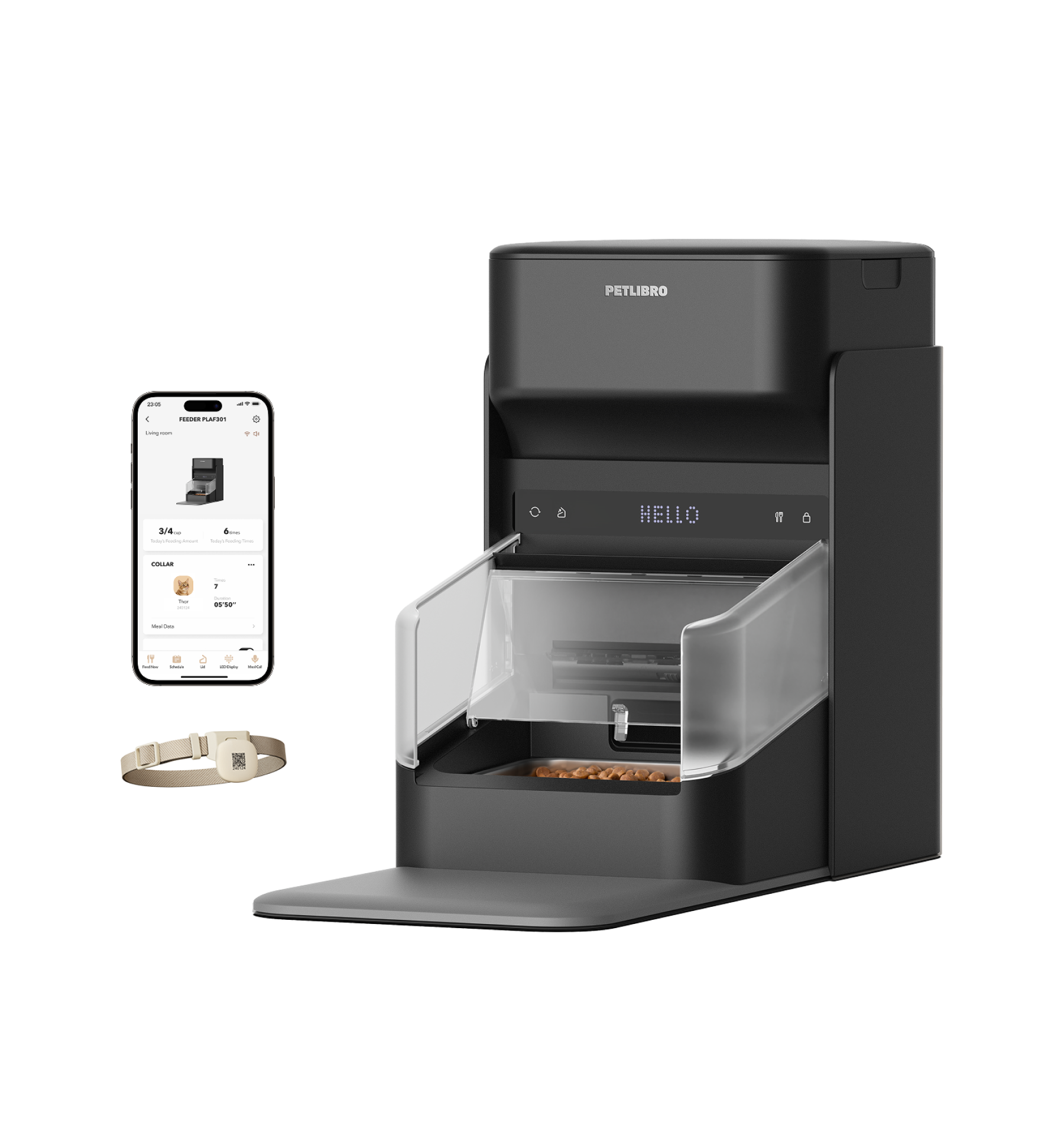
In other words, the feeder's entire night-time footprint is local and physical: a lid that opens for one specific animal. Compare that with connected RFID feeders such as the Petlibro One RFID Feeder, which add app features and connectivity on top of the same basic access-control idea — useful in the daytime, but every connected feature is one more thing that can light up, buzz, or demand attention at night. The SureFeed's lack of features is, after dark, a feature.
Why Multi-Pet Homes Use It at Night
The strongest after-dark argument for this feeder is not noise at all — it is what it prevents. In a multi-pet home, the classic night-time problem is food theft: one pet is on a prescription or weight-control diet, and the other pet raids the bowl at 3 a.m. when nobody is awake to intervene. A timer feeder cannot solve that; it opens for whoever shows up.
The microchip lid inverts the problem. The bowl is sealed by default, and it opens only for the animal whose chip is registered. The pet on the special diet can graze through the night on its own schedule — including the small hours, when cats naturally like to eat — while the other pet gets nothing but a closed lid. Because it handles wet food as well as dry, this works for prescription wet diets too, and the sealed lid also slows the food from drying out between visits.
For the humans, the benefit is indirect but real: no getting up to referee the food bowl, no separating pets into closed rooms overnight, and no early-morning yowling from a pet whose dinner was stolen. The feeder does its one job silently in the background of the household's sleep, even if the lid itself is not literally silent.
What We Don't Have Data For
Honesty section, plainly stated: our catalog tracks no noise (dB) figure and no light/LED specification for the SureFeed Microchip Pet Feeder, and the manufacturer data we work from does not supply a decibel rating we can cite. That means:
- We cannot rank this feeder against others on measured quietness, and this article deliberately does not try.
- We cannot confirm the exact behavior or brightness of any small indicator the unit may have; no LED spec is tracked, so we describe none.
- Everything in the noise section above is mechanism reasoning — what the design implies — not measurement. It is a basis for a shortlist, not a lab result.
If measured noise data is the deciding factor for you, treat this model as "unquantified" rather than "quiet," and weigh that gap accordingly. We would rather hand you the gap than a made-up number.
Bedroom-Placement Verdict
Putting it together: the case for placing this feeder in or near a bedroom is that its night-time behavior is minimal and predictable — no alerts, no streams, no scheduled dispensing events, just occasional lid cycles when the registered pet chooses to eat. The case against is a single unknown: the actual loudness of those lid cycles is not in any data we track, and a very light sleeper sharing a small room with a pet that eats in short bursts all night would accumulate more open-close events than a pet that eats twice and sleeps.
Our read: for multi-pet homes, the access control alone justifies the placement — the feeder solves a night-time problem (food theft and diet enforcement) that otherwise wakes humans up. For a single-pet home buying purely on quietness, the honest answer is that the data to confirm it does not exist in our catalog, and the score of 4.5 reflects a solid, simple machine rather than a measured silence champion. Either way, the battery backup means a power cut at 2 a.m. does not turn into a hungry, loud pet at 2:05.
Where to buy: SureFeed Microchip Pet Feeder · Petlibro One RFID Smart Feeder — retailer links run through our /go/ tracker; the product pages track prices daily.
FAQ
Does the SureFeed feeder make noise at night? It has one moving mechanism — the motorized lid that opens for the registered pet's microchip and closes when the pet leaves — so any sound is brief and tied to actual eating visits, not continuous. However, our catalog tracks no decibel figure for this model, so we cannot quantify how loud the lid is; the noise discussion in this article is reasoning from the mechanism, not measurement.
Will it light up the room or send phone notifications? There is nothing in the tracked spec to do either: it has no app control and no camera, so there are no push alerts, no streaming, and no motion events. Our catalog also tracks no light/LED specification for this model, so we cannot describe indicator brightness — only that there is no connected-light ecosystem attached to it.
How does it stop one pet stealing another's food at night? The lid stays sealed and opens only when it reads the registered pet's implanted microchip or RFID collar tag. An unregistered pet gets a closed lid, which makes it effective for prescription and weight-control diets in multi-pet homes — including overnight, when food theft usually happens.
Does it work during a power outage? Yes — battery backup is included in the tracked spec, so the chip reader and lid keep functioning if the power goes out overnight.
Can it serve wet food? Yes. It serves both dry and wet food, and its capacity is 0.4 L — a single-pet portion format rather than a bulk storage hopper, which suits measured prescription or wet-food servings.
What does the 4.5 score mean? It is the feeder's rating under our catalog's Score v1.0 system, which weighs the tracked specification set. In this case it reflects a simple, well-warrantied (3-year) access-control feeder — not a measurement of quietness, since no noise data is tracked.
Last updated: November 27, 2026
Changelog
November 27, 2026 — Added retailer buying links (Our pick and Where to buy) for the products covered in this article.
Related in this category
Pet Tech · Automatic Cat Feeders · Updated Nov 21, 2026
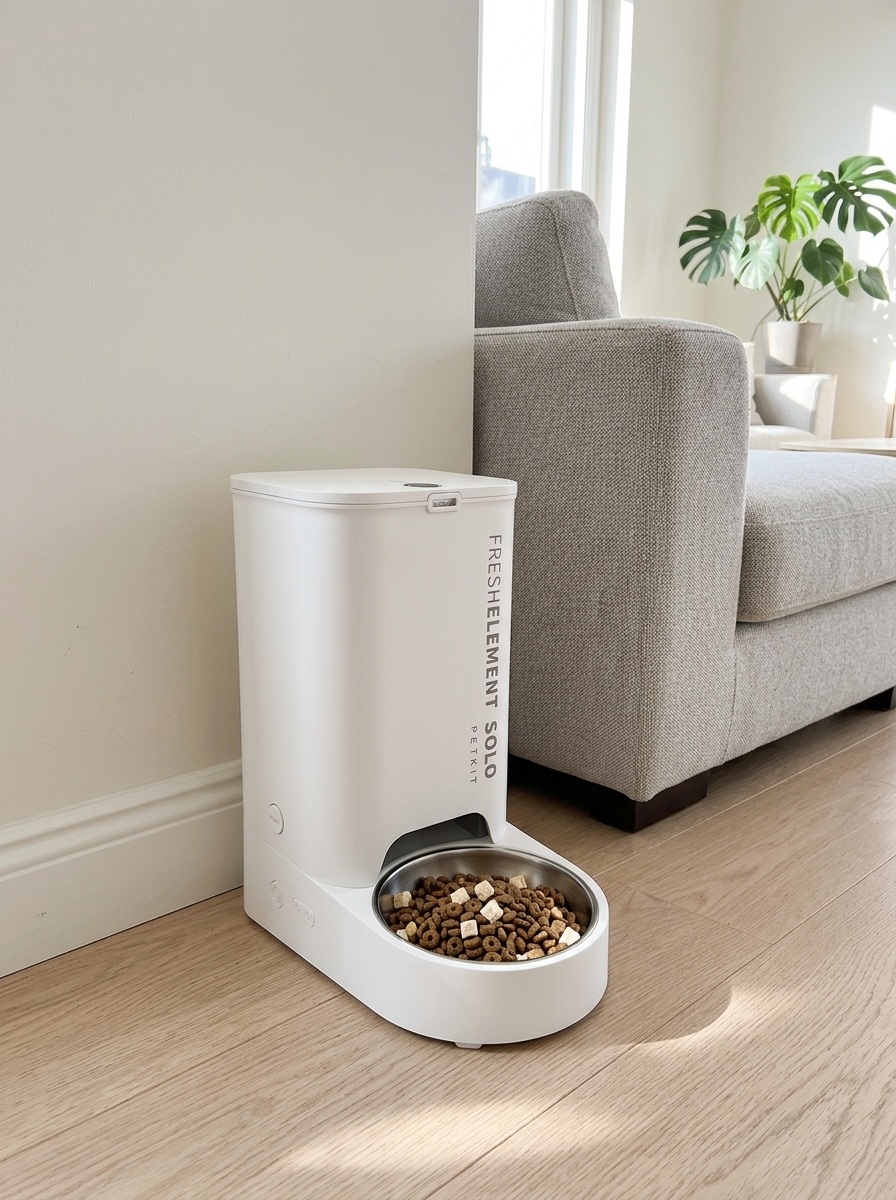
As of 2026-11-21, we track 16 automatic cat feeders from 9 brands, scored with Score v1.0 from owner ratings, spec strength and ownership cost. PETKIT Fresh Element Solo leads the list at 8.0/10. Tracked prices run from $47 to $299; the full table below is sortable by score and price.
Pet Tech · Automatic Cat Feeders
The VOLUAS Automatic Cat Feeder 4L (Score 7.8 in our catalog) has no app, no camera, and no account — so its entire ownership contract is physical: desiccant, dust, seals, and batteries.
- The working
Pet Tech · Automatic Cat Feeders
The PETKIT YumShare Dual-Hopper (Score 8.0 in our catalog) is built around one idea: two separate dry-food hoppers, 5 L combined, feeding u
Pet Tech · Automatic Cat Feeders
The PetSafe Smart Feed is the bigger, more flexible machine: a 5.76 L hopper and up to 12 meals a day, the deepest feeding schedule in this comparis
Report an error on this page
Discussion
No comments yet