Price alerts — WOPET Heritage View Pet Feeder with Camera (Dual Bowls)
Price-drop alert
Email me when WOPET Heritage View Pet Feeder with Camera (Dual Bowls) drops to my target price. The confirmation includes a manage link — use it any time to list or remove your alerts at Your price alerts. Lowest price tracked so far: USD 119.99 — a target below that is below the historical low and less likely to be reached.
Affiliate disclosure: This article is desk research built from manufacturer specifications and our catalog data — we did not hands-on test this feeder. AIBuyLab may earn a commission from qualifying purchases made through links on this page, at no extra cost to you. Every maintenance interval below is a planning estimate, not a manufacturer-stated service schedule or a measured result.
TL;DR
- The WOPET Heritage View Pet Feeder scores 8.2 in our catalog — one of the strongest feeder scores we track — but its 6 L hopper is exactly why it needs more upkeep discipline than a small feeder, not less.
- A 6 L fill of dry kibble can sit for weeks, so the desiccant pack, the hopper walls, and the lid seal age against food that stays in the machine far longer than it would in a 2 L feeder.
- The schedule that matters: desiccant check monthly, hopper empty-and-wash at every refill cycle, portion-mechanism dust clearing monthly, camera lens wipe weekly, seal inspection quarterly, battery-backup test twice a year. All are planning estimates.
- None of this is hard. It is simply easy to skip, because a big hopper hides staleness instead of announcing it.
Our pick: WOPET Heritage View Pet Feeder with Camera (Dual Bowls) — check the current price at the retailer.
What the WOPET Heritage View Pet Feeder Is
The WOPET Heritage View is an app-controlled automatic pet feeder with a built-in camera and a 6 L dry-food hopper. Per our catalog (Score v1.0), it serves up to 10 meals per day, handles dry food only, includes battery backup so a power cut does not cancel dinner, and carries a 2-year warranty. It scores 8.2 in our system.
One honest limitation to name up front: it has no pet recognition. The camera lets you watch the bowl area, but the feeder does not know which animal ate. In a multi-pet home, that makes your maintenance routine — especially keeping the camera lens clean enough to actually see the bowl — part of how you verify meals happened.
The Maintenance Schedule at a Glance
Every interval in this table is a planning estimate based on the machine's format (large hopper, dry food only, portion mechanism, camera), not a figure from WOPET's documentation.
Task | Cadence (planning estimate) | Why it matters on this model |
|---|
Desiccant pack check / replacement | Monthly | A 6 L fill can sit for weeks; the desiccant is the only thing fighting moisture the whole time |
Hopper empty-and-wash | At every full refill cycle | Kibble oils coat the walls and go rancid against the next fill |
Portion-mechanism dust clearing | Monthly | Kibble dust accumulates where portions are metered and can skew serving sizes |
Camera lens wipe | Weekly | No pet recognition — your eyes through this lens are the meal verification |
Lid seal inspection | Quarterly | A tired seal quietly defeats the desiccant and invites pests |
Battery-backup test | Twice a year | Backup you never test is a hope, not a feature |
App / firmware check | Monthly | App control is the scheduling layer; stale firmware is a feeding risk |
Why a 6 L Hopper Changes the Math
Small feeders force freshness. A 2 L hopper empties in days, so the food inside is always young and the walls get washed by default every time you refill. The Heritage View's 6 L capacity removes that forcing function. Depending on your cat's ration, a single fill can sit in the hopper for several weeks — through kitchen humidity swings, warm afternoons, and the slow oxidation of the fats coating every kibble piece.
That is the entire maintenance story of this machine: the convenience of fewer refills is paid for with older food, unless you manage the three things that slow the aging — moisture control (desiccant), surface hygiene (hopper walls), and air exchange (the lid seal).
A practical rule, offered as a planning estimate: if your household's consumption means a fill lasts longer than roughly a month, consider filling the hopper only partway and storing the remainder in its original bag, sealed, elsewhere. The feeder's capacity is a ceiling, not a quota.
Desiccant: The Monthly Non-Negotiable
The desiccant pack in the lid is doing quiet, continuous work against the moisture that enters every time the lid opens and every time a portion drops. On a small feeder, a tired desiccant pack is a minor sin — the food turns over before it matters. On a 6 L hopper holding weeks of food, a saturated desiccant pack means the last week of every fill sits in uncontrolled humidity.
Our planning estimate: inspect the pack monthly and replace it on the cadence its indicator or texture suggests — a pack that feels soft and swollen instead of dry and firm has done its work. When in doubt, replace it; desiccant is the cheapest insurance in this entire schedule.
Hopper Walls and the Refill Wash
Dry kibble is coated in fats and flavoring oils. Those oils transfer to the hopper walls, and the residue film oxidizes — this is the stale smell owners notice near the end of a long fill. The fix is unglamorous: every time the hopper runs fully empty, wash it before refilling (planning estimate: this is the single highest-value habit in this article). Warm water, mild detergent, and — critically — complete drying before the new fill goes in. Refilling over a damp hopper undoes the desiccant's work on day one.
If you top up rather than run to empty, build in a full empty-and-wash at least every second or third cycle (planning estimate). Topping up indefinitely is how a feeder becomes a rancid-oil dispenser with a camera attached.
Portion-Mechanism Dust
Every portion this feeder serves — up to 10 a day — passes through a metering mechanism, and every pass sheds a little kibble dust. Dust cakes in the dispensing path over weeks and can gradually narrow it, which is how a feeder slowly starts under-serving without any error appearing in the app.
Monthly, as a planning estimate: empty the bowl area, brush or vacuum loose dust from the dispensing outlet and chute, and confirm a test portion drops cleanly and completely. If your portions ever look inconsistent, dust buildup is the first suspect to rule out — before assuming a motor or app fault.
Camera Lens Care
Because the Heritage View has no pet recognition, the camera is your only remote evidence that a meal was eaten and by whom. A lens filmed with kitchen grease and kibble dust degrades that evidence quietly — the feed still "works," it just shows you a fog.
Weekly, as a planning estimate: wipe the lens with a dry microfiber cloth. No solvents, no paper towels (they scratch). While you are there, confirm the camera's view still frames the bowl — a feeder nudged by an enthusiastic cat can spend weeks filming the wall.
Seal Checks and Battery-Backup Tests
Quarterly (planning estimate): run a fingertip around the lid seal. It should feel continuous and springy. Cracks, flattening, or a lid that no longer pulls down snugly mean air is exchanging freely — and both your desiccant and your freshness math are fiction until the seal is sorted.
Twice a year (planning estimate): test the battery backup on purpose. Unplug the feeder, confirm it keeps its schedule and serves a portion on battery, then plug it back in. Battery backup is a headline feature of this model, and it is only real if you have watched it work. Replace backup batteries on the schedule their type requires, and after any test where the feeder fails to complete a serving.
Verdict
The WOPET Heritage View earns its 8.2 Score on capacity, camera, scheduling depth, and battery backup. Its maintenance burden is not higher than other feeders' — it is easier to postpone, because a 6 L hopper never forces the issue. Owners who run the simple cadence above — monthly desiccant and dust, a wash at every true refill, a weekly lens wipe, quarterly seals, twice-yearly battery tests — get the freshness of a small feeder with the convenience of a big one. Owners who treat the hopper as a silo get neither.
If your household would rather have freshness forced by design than managed by habit, a smaller-hopper model like the Petlibro Granary Camera Feeder turns its food over faster by construction. The full spec sheet for this feeder is on the WOPET Heritage View product page.
Where to buy: WOPET Heritage View Pet Feeder with Camera (Dual Bowls) · Petlibro Granary Camera Monitoring Feeder — retailer links run through our /go/ tracker; the product pages track prices daily.
FAQ
How often should I replace the desiccant in the WOPET Heritage View? Monthly checks are our planning estimate. Because a 6 L fill can sit for weeks, the desiccant works against that food for its entire stay — replace the pack whenever it feels saturated, and err on the side of replacing early.
Do I really need to wash the hopper if I only ever add fresh kibble? Yes. Topping up leaves the oldest residue film on the walls indefinitely, and that oxidized oil film is what makes food taste stale. A full empty-and-wash every refill — or at least every second or third cycle — is a planning estimate we would not skip on a hopper this size.
Why does portion size drift over time? The most common cause in this feeder class is kibble dust caking in the dispensing path. A monthly brush-out (planning estimate) rules it out before you suspect the motor or the app.
Does the camera tell me which pet ate? No. Per our catalog, the Heritage View has no pet recognition. The camera shows the bowl area; interpreting who ate is up to you, which is why keeping the lens clean matters.
How do I know the battery backup still works? Test it deliberately twice a year (planning estimate): unplug the feeder and confirm it serves a scheduled portion on battery. Backup that has never been observed working should be treated as unverified.
Can I just fill the hopper halfway to keep food fresher? Yes, and for slow-consumption households it is a sound habit. Capacity is a maximum, not a target — partial fills plus a sealed storage bag elsewhere will age better than a full 6 L sitting for many weeks.
Last updated: November 27, 2026
Changelog
November 27, 2026 — Added retailer buying links (Our pick and Where to buy) for the products covered in this article.
Related in this category
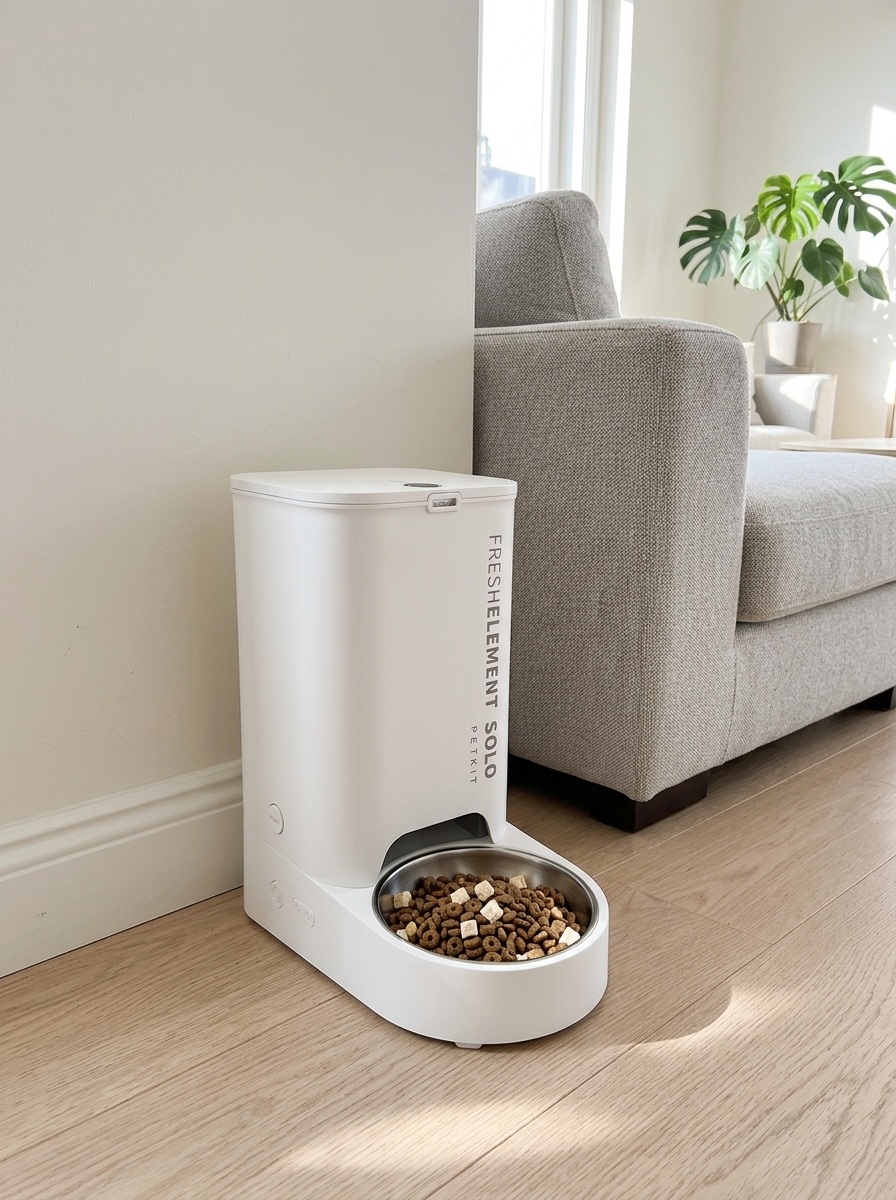
Pet Tech · Automatic Cat Feeders · Updated Nov 21, 2026
As of 2026-11-21, we track 16 automatic cat feeders from 9 brands, scored with Score v1.0 from owner ratings, spec strength and ownership cost. PETKIT Fresh Element Solo leads the list at 8.0/10. Tracked prices run from $47 to $299; the full table below is sortable by score and price.
Pet Tech · Automatic Cat Feeders
The VOLUAS Automatic Cat Feeder 4L (Score 7.8 in our catalog) has no app, no camera, and no account — so its entire ownership contract is physical: desiccant, dust, seals, and batteries.
- The working
Pet Tech · Automatic Cat Feeders
The PETKIT YumShare Dual-Hopper (Score 8.0 in our catalog) is built around one idea: two separate dry-food hoppers, 5 L combined, feeding u
Pet Tech · Automatic Cat Feeders
The PetSafe Smart Feed is the bigger, more flexible machine: a 5.76 L hopper and up to 12 meals a day, the deepest feeding schedule in this comparis
Report an error on this page

Discussion
No comments yet