Price alerts — WOPET Heritage View Pet Feeder with Camera (Dual Bowls)
Price-drop alert
Email me when WOPET Heritage View Pet Feeder with Camera (Dual Bowls) drops to my target price. The confirmation includes a manage link — use it any time to list or remove your alerts at Your price alerts. Lowest price tracked so far: USD 119.99 — a target below that is below the historical low and less likely to be reached.
WOPET Heritage View Feeder: The True 3-Year Cost
Disclosure: This article is desk research based on published specifications and the data tracked in our catalog. We have not hands-on tested this feeder, and no dollar figures appear below because our catalog does not track a consumable cost or subscription price for this model — so the three-year model is expressed in counts: parts, cycles, and cadences. Cadences are planning estimates, not manufacturer promises.
TL;DR
- The WOPET Heritage View Pet Feeder scores 8.2 in our catalog (Score v1.0) — one of the highest feeder scores we track — with a camera, a 6 L hopper, up to 10 meals per day, app control, and battery backup.
- Its tracked running cost is about as low as a connected feeder gets: there is no subscription in our catalog and no proprietary food format. The three-year consumable story is desiccant packs, backup batteries, and seal care — all countable on two hands.
- The real costs are attention costs. The camera and scheduling live behind the app, so part of your three-year budget is phone time, and part of the risk is the general connected-device risk: if any app or cloud service behind a product like this were discontinued, the smart features would narrow even though the hardware still stands on your floor.
- Verdict: over three years, this is a low-upkeep feeder for owners who want camera check-ins without a subscription line item — provided they accept app dependence as the trade.
Our pick: WOPET Heritage View Pet Feeder with Camera (Dual Bowls) — check the current price at the retailer.
What the WOPET Heritage View Pet Feeder is
The WOPET Heritage View Pet Feeder is an automatic dry-food feeder with a built-in camera. In our catalog it is defined by a short list of tracked facts: a 6 L hopper, up to 10 scheduled meals per day, dry food only, app control, battery backup, no pet recognition, and a 2-year warranty. Its Score v1.0 rating of 8.2 puts it near the top of the feeders we track.
That spec sheet shapes its cost profile. A large hopper and many small meals mean the machine cycles often but refills rarely. A camera and an app mean some of its "cost" is not parts at all — it is connectivity. And the absence of pet recognition means there is no per-pet hardware, no collar tags, and no recognition accessory to replace.
The three-year cost model, in counts
Because our catalog tracks no consumable price and no subscription for this feeder, the honest way to model three years is to count the things that wear, cycle, or need refreshing. The table below uses planning estimates — reasonable household cadences, labeled as estimates — across 36 months of daily use.
Item | Cadence (planning estimate) | 3-year count |
|---|
Desiccant pack swaps | Every 30–45 days | 24–36 packs |
Backup battery sets (if run unplugged part-time) | Every 4–6 months | 6–9 sets |
Backup battery sets (plugged in, backup only) | Replaced on a refresh cycle, ~every 12 months | ~3 sets |
Hopper seal / gasket inspections | Quarterly | 12 inspections |
Hopper seal / gasket replacement | If it stiffens or stops sealing, ~once in year 2–3 | 0–1 replacements |
Full hopper deep-clean (beyond wipe-downs) | Monthly | 36 cleans |
Camera lens wipe | Monthly, with the deep-clean | 36 wipes |
Subscription payments tracked in our catalog | None | 0 |
Proprietary food formats or cartridges | None — standard dry kibble | 0 |
Read the table as a rhythm, not a bill. Nothing on it is exotic: desiccant to keep kibble dry in a 6 L hopper, batteries that exist so a power cut does not become a missed meal, and a rubber seal that does quiet work every single day. If you run the feeder plugged in — the normal setup — the battery line shrinks to a once-a-year freshness swap, because the backup set only discharges during outages.
Desiccant: the one true consumable
A 6 L hopper holds many days of kibble, and that convenience has a condition: the food sits in a sealed box at room temperature, so moisture control matters. Desiccant packs in the lid are what keep the last cup of kibble as dry as the first. On a 30-to-45-day swap cadence (planning estimate), three years consumes roughly 24 to 36 packs. Let a pack saturate and the cost does not show up as a part failure — it shows up as stale food a picky cat refuses, which is a wasted-hopper cost instead. This is the feeder's only genuine recurring consumable, and it is driven by the calendar, not by how many meals you schedule.
Batteries: cheap insurance, two different stories
Battery backup is the feature owners forget until the first outage. There are two three-year stories:
- Plugged in (typical): the batteries idle as insurance. They still age, so a yearly refresh — about 3 sets over three years (planning estimate) — keeps the insurance real. A feeder whose backup batteries died silently two years ago has no backup at all.
- Run unplugged part-time: some owners place the feeder where no outlet reaches. Then batteries become a fuel, not an insurance policy: expect a set every 4 to 6 months (planning estimate), or 6 to 9 sets across three years, and a stricter swap discipline, because a feeder that dies at 3 a.m. simply skips meals until someone notices.
Either way, the count is small. The planning point is not the batteries themselves — it is putting the swap on the same calendar as the desiccant, so the two chores happen together.
Seals and gaskets: the slow wear nobody prices
The hopper lid seal is what makes the desiccant strategy work: it keeps humid room air out between openings. Seals age by compression and by kitchen heat, not by meal count. A quarterly look — 12 inspections over three years (planning estimate) — is enough: check that the gasket is still springy, still continuous, and not flattened on one side. Most owners will replace it zero or one time in three years. Skip the inspections and the failure mode is invisible: the desiccant saturates faster, the kibble stales sooner, and the feeder gets blamed for what is really a worn ring of rubber.
The attention costs: app dependence is a real line item
Here is the honest part of the ledger. The Heritage View's camera, scheduling, and feeding logs live in its app. That creates costs that never appear in a parts table:
- Setup and re-setup time. Wi-Fi changes, a new router, a new phone — each one costs a reconnection session. Over three years, plan on a handful.
- Notification attention. A camera feeder generates things to look at. That is the point of the product, but it is still a daily drip of phone checks that a dumb timer feeder never asks for.
- Feature dependence. Remote feeding and camera viewing depend on the app and its cloud working. This is a general risk of connected pet devices, not a claim about WOPET's servers specifically: if the service behind any app-controlled feeder were ever shut down, the typical outcome is that remote features stop while local scheduled feeding usually continues — but "usually" is doing work in that sentence, and it is the one three-year risk you cannot maintain your way out of.
Compare the opposite design: the VOLUAS Automatic Cat Feeder 4L has no app and no camera at all in our catalog, so its attention cost is near zero — and so is its check-in value. The Heritage View's 8.2 score reflects the other side of that trade: you get eyes on the bowl, and you pay in attention and app reliance rather than in parts.
What three years does not cost
It is worth listing the zeros, because they are the reason this feeder's running-cost story is short:
- No subscription tracked in our catalog. The camera features are not, in the data we track, gated behind a monthly plan.
- No proprietary food format. It meters standard dry kibble from a 6 L hopper — no cartridges, pods, or branded refills.
- No recognition hardware. Pet recognition is listed as none, so there are no collar tags or chip accessories in the replacement stream.
- Warranty cover for the first two years. The 2-year warranty spans two-thirds of this model window, so early failures are the manufacturer's problem, not a parts cost.
Verdict
Over three years, the WOPET Heritage View asks for roughly two to three dozen desiccant packs, a handful of battery sets, a dozen seal inspections, and a standing relationship with its app. In counts, that is one of the lightest ownership profiles among the camera feeders we track, and it pairs with an 8.2 Score and a 2-year warranty. Buy it if you want camera check-ins without a subscription line and you are comfortable that the smart features ride on an app. Skip it if the app-dependence risk bothers you more than stale-kibble logistics — in that case a simpler, app-free feeder trades the camera for independence, and that can be the right trade.
Where to buy: WOPET Heritage View Pet Feeder with Camera (Dual Bowls) · VOLUAS Automatic Cat Feeder 4L — retailer links run through our /go/ tracker; the product pages track prices daily.
FAQ
Does the WOPET Heritage View require a subscription? Our catalog does not track a subscription for this feeder. The costs we can identify are consumables in counts — desiccant packs and backup batteries — plus your own time in the app.
How many desiccant packs will I use in three years? On a 30-to-45-day swap cadence (a planning estimate), about 24 to 36 packs over 36 months. The hopper holds 6 L of kibble, so keeping it dry is the feeder's one true recurring chore.
What happens to the feeder if the power goes out? It has battery backup, so scheduled meals continue during an outage — as long as the backup batteries are fresh. Plugged-in owners should still refresh the backup set about once a year (planning estimate); a dead backup set means no protection at all.
What stops working if the app or cloud service goes away? Framed generally for connected feeders: remote camera viewing, remote feeding, and app scheduling are the features at risk, while the hardware itself remains. This is a category-wide consideration for app-controlled devices, not a statement about this brand's service status.
Is the camera the reason to pick this over a cheaper feeder? It is the main differentiator in our catalog data: camera, app control, 10 meals a day, and a 6 L hopper at an 8.2 Score. If you will not use the camera, an app-free feeder gives up the check-ins and also gives up the app dependence.
How much maintenance does the seal actually need? A quarterly visual check — 12 over three years (planning estimate) — and likely zero or one replacement. The seal matters because it makes the desiccant work; a flattened gasket shows up as stale food, not as an error message.
---
Last updated: November 27, 2026
Changelog
November 27, 2026 — Added retailer buying links (Our pick and Where to buy) for the products covered in this article.
Related in this category
Pet Tech · Automatic Cat Feeders · Updated Nov 21, 2026
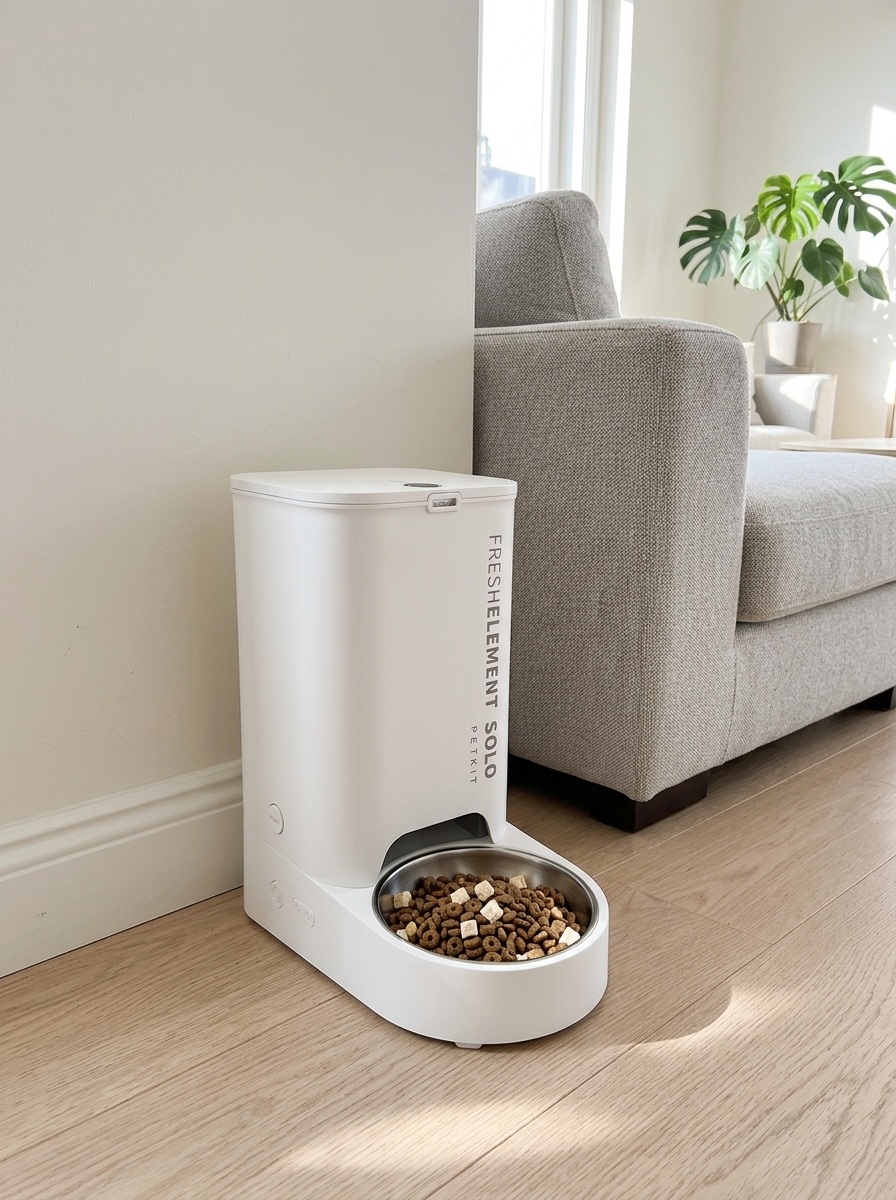
As of 2026-11-21, we track 16 automatic cat feeders from 9 brands, scored with Score v1.0 from owner ratings, spec strength and ownership cost. PETKIT Fresh Element Solo leads the list at 8.0/10. Tracked prices run from $47 to $299; the full table below is sortable by score and price.
Pet Tech · Automatic Cat Feeders
The VOLUAS Automatic Cat Feeder 4L (Score 7.8 in our catalog) has no app, no camera, and no account — so its entire ownership contract is physical: desiccant, dust, seals, and batteries.
- The working
Pet Tech · Automatic Cat Feeders
The PETKIT YumShare Dual-Hopper (Score 8.0 in our catalog) is built around one idea: two separate dry-food hoppers, 5 L combined, feeding u
Pet Tech · Automatic Cat Feeders
The PetSafe Smart Feed is the bigger, more flexible machine: a 5.76 L hopper and up to 12 meals a day, the deepest feeding schedule in this comparis
Report an error on this page

Discussion
No comments yet