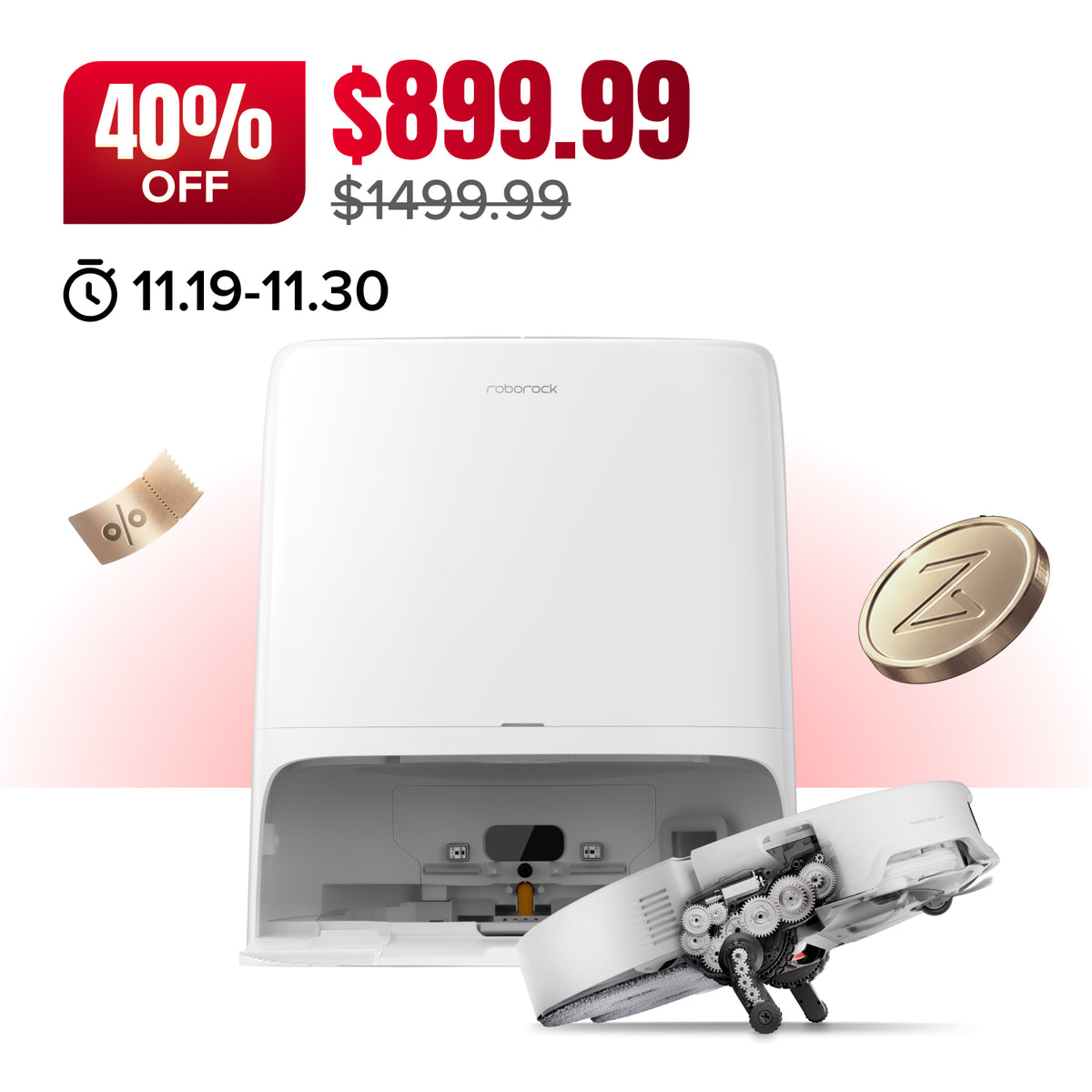
Email me when Roborock Qrevo Edge 3 Pro drops to my target price. The confirmation includes a manage link — use it any time to list or remove your alerts at Your price alerts. Lowest price tracked so far: USD 899.99 — a target below that is below the historical low and less likely to be reached.
Disclosure: This comparison is based on published manufacturer specifications and our catalog data (Score v1.0). We have not hands-on tested either robot, and we do not present any figure here as a measured result from our own testing. Noise figures are manufacturer-stated values, not our measurements.
TL;DR
The Roborock Qrevo Edge 3 Pro and the Ecovacs Deebot T30S land on the exact same Score v1.0 in our catalog: 6.7 each. They share the same core architecture — LiDAR navigation, structured-light obstacle avoidance, rotating-pad mopping, multi-floor maps, and bagged self-empty docks. The tie breaks on three things: the Deebot T30S runs 34 minutes longer (290 vs 256 minutes), which matters in large homes; the Qrevo Edge 3 Pro has a known running cost in our catalog (a tracked consumable cost of $2.13/month), while the T30S's consumable cost is not tracked in our catalog at all; and the T30S publishes dock and dustbin capacities (3 L dock bag, 275 ml onboard bin) that frame its maintenance rhythm. Pick by floor area and by how much you care about cost certainty.
A robot vacuum-mop with a self-empty dock is a floor-cleaning appliance that vacuums and mops autonomously, navigates by laser mapping rather than random bumping, and returns to a base station that pulls debris out of the robot's small onboard bin into a larger disposable bag. The category exists for one reason: to stretch the interval between human interventions from "after every run" to "every few weeks."
Both robots in this comparison sit in the same tier of that category. Each uses LiDAR navigation with multi-floor map storage, so either can hold maps for more than one level of a home. Each uses structured-light obstacle avoidance to steer around objects on the floor rather than pushing through them. Each mops with rotating pads rather than a static drag cloth. And each empties into a bagged dock, which keeps dust sealed at disposal time. On paper, these are near-identical formulas — which is exactly why the Score tie is believable, and why the decision has to come from the details that differ.
Spec Comparison
Spec
Roborock Qrevo Edge 3 Pro
Ecovacs Deebot T30S
Score v1.0
6.7
6.7
App control
Yes
Yes
Navigation
LiDAR
LiDAR
Obstacle avoidance
Structured light
Structured light
Mopping
Rotating pads
Rotating pads
Multi-floor maps
Yes
Yes
Self-empty dock
Bagged
Bagged
Runtime
256 min
290 min
Noise (manufacturer figure)
64 dB
65 dB
Dock bag capacity
Not listed here
3 L
Onboard dustbin
Not listed here
275 ml
Mop lift
Not listed here
9 mm
Tracked consumable cost (our catalog)
$2.13/month
Not tracked
Where a cell says "not listed here," it means the figure was not part of the catalog data supplied for this comparison — not that the feature is absent. We would rather leave a gap than fill one with a guess.
Runtime: The T30S's Clearest Win
The single largest measurable gap between these two robots is runtime: 290 minutes for the Deebot T30S against 256 minutes for the Qrevo Edge 3 Pro — a 34-minute advantage, roughly 13% more cleaning time per charge.
Whether that gap matters depends entirely on your floor plan. In an apartment or a small single-story home, both robots will finish a full clean with charge to spare, and the extra 34 minutes will never be used. Runtime only becomes a deciding factor when a home is large enough that the robot cannot finish in one pass: at that point, the shorter-runtime robot has to interrupt the job, recharge, and resume, which stretches total job time far more than the raw minute difference suggests. If your home regularly pushes a robot vacuum toward a mid-job recharge, the T30S's longer legs are a genuine, practical advantage. If it doesn't, this row of the table should carry no weight in your decision.
Running Cost: Known vs Unknown
This is the section most comparisons skip, and it is where these two robots differ in a way that has nothing to do with hardware.
For the Qrevo Edge 3 Pro, our catalog tracks a consumable cost of $2.13/month — the figure our catalog records for the recurring consumables (bags, filters, and wear items) this model uses. Because that figure is tracked, it is a number you can project across a multi-year ownership window and budget around with reasonable confidence.
For the Deebot T30S, our catalog does not track a consumable cost. That is not a claim that the T30S is free to run — it uses a bagged dock, and bags and filters are consumables on any such system. It means the data is not in our catalog, and we will not invent a figure to fill the gap. The honest finding is asymmetry of information: with the Roborock, the ongoing cost is a known line item; with the Ecovacs, it is an unknown you would need to price out yourself from the manufacturer's consumable listings before the total cost of ownership is comparably clear.
If predictable running costs matter to you — if you are the kind of buyer who totals three years of bags and filters before purchasing — the Qrevo Edge 3 Pro is the safer choice today, not because it is proven cheaper, but because its cost is proven, period. If you are comfortable doing that homework yourself, the T30S's unknown is a research task, not a disqualifier.
Dock, Dustbin, and Mop Lift
The T30S publishes two capacity figures that shape daily ownership. Its dock bag holds 3 L, which sets the ceiling on how much debris the system can collect before a bag change. Its onboard dustbin is 275 ml — small, but on a self-empty system the onboard bin is a shuttle, not a warehouse: it only needs to hold one run's worth of debris before the dock takes over. The pairing of a modest onboard bin with a 3 L dock bag is the standard self-empty arrangement, and nothing in these figures is a red flag.
The T30S also lists a 9 mm mop lift: the mechanism that raises the rotating pads when the robot crosses carpet, so damp pads are not dragged across rugs. For homes mixing hard floors with low-pile carpet or rugs, mop lift is the feature that makes a vacuum-mop practical as a single device rather than two separate passes.
For the Qrevo Edge 3 Pro, the corresponding capacity figures were not part of the catalog data supplied for this comparison, so we do not present equivalents. If dock capacity or mop lift height is your deciding factor, check the Qrevo Edge 3 Pro's product page and manufacturer listing for its published values before deciding — do not assume parity in either direction.
Noise
On manufacturer-stated figures, the Qrevo Edge 3 Pro is listed at 64 dB and the Deebot T30S at 65 dB. A 1 dB difference is below the threshold most people can reliably distinguish, and manufacturer noise figures are measured under each brand's own conditions, so cross-brand comparisons at this granularity should be treated as "effectively the same." Neither robot differentiates itself here; both sit in the range where running the robot while you are in the next room is reasonable and running it during a nap in the same room is optimistic.
Verdict
Choose the Ecovacs Deebot T30S if your home is large — the kind of floor area where a robot vacuum risks a mid-job recharge. The extra 34 minutes of runtime is the most concrete advantage in this comparison, and the published 3 L dock bag and 9 mm mop lift round out a spec sheet that is unusually complete. Accept that you will need to price its consumables yourself, because our catalog does not track them.
Choose the Roborock Qrevo Edge 3 Pro if your home is small to mid-sized and cost certainty matters to you. Its runtime is ample for anything short of a large floor plan, and it is the only one of the two with a tracked consumable cost in our catalog — $2.13/month — which makes its three-year cost of ownership the one you can actually compute today.
Either way, you are getting the same navigation, the same avoidance system, the same mopping format, and the same Score v1.0 of 6.7. This is a tie broken by your floor plan and your tolerance for an unpriced running cost — not by one robot being better than the other.
Which robot is better for a large home? The Deebot T30S, on runtime: 290 minutes versus 256 minutes for the Qrevo Edge 3 Pro. In homes large enough to force a mid-job recharge, that 34-minute gap is the deciding spec in this comparison.
Which robot is cheaper to run? We can only answer half of that honestly. Our catalog tracks the Qrevo Edge 3 Pro's consumable cost at $2.13/month. The Deebot T30S's consumable cost is not tracked in our catalog, so we cannot state which is cheaper — only which cost is known.
Are these robots equally loud? Effectively, yes. The manufacturer-stated figures are 64 dB for the Qrevo Edge 3 Pro and 65 dB for the Deebot T30S — a difference too small to base a decision on, especially across brands with different measurement setups.
Do both robots avoid obstacles and map multiple floors? Yes. Both use structured-light obstacle avoidance, LiDAR navigation, and multi-floor maps, and both have app control and bagged self-empty docks.
Why do they have the same Score? Because on the attributes our catalog scores — navigation, avoidance, mopping format, dock type, and the rest of the shared architecture — they genuinely match. The differences that remain (runtime, tracked running cost, published capacities) are exactly the kind of factors a single score cannot capture, which is why this comparison exists.
---
Last updated: November 27, 2026
Changelog
November 27, 2026 — Added retailer buying links (Our pick and Where to buy) for the products covered in this article.
Related in this category
Smart Cleaning · Robot Vacuums · Updated Nov 22, 2026
As of 2026-11-22, we track 34 robot vacuums from 7 brands, scored with Score v1.0 from owner ratings, spec strength and ownership cost. Dreame D30 Ultra leads the list at 8.4/10. Tracked prices run from $120 to $1,700; the full table below is sortable by score and price.


Discussion
No comments yet