Email me when iRobot Roomba Max 715 Vac drops to my target price. The confirmation includes a manage link — use it any time to list or remove your alerts at Your price alerts. Lowest price tracked so far: USD 399.99 — a target below that is below the historical low and less likely to be reached.
Affiliate disclosure: AIBuyLab may earn a commission when you buy through links on this page, at no extra cost to you. This comparison is based on catalog specifications and published data — we did not hands-on test either robot.
TL;DR
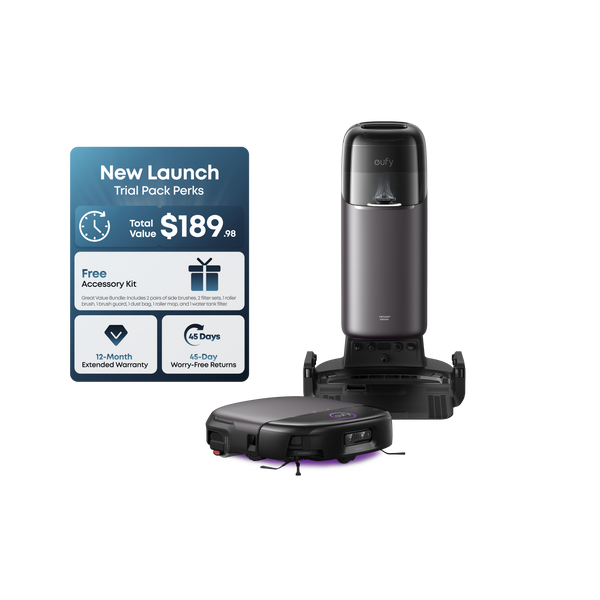
The iRobot Roomba Max 715 Vac and the Eufy Omni S2 Pro both score 3.4 in our AIBuyLab Score v1.0, and on paper they look like siblings: lidar-based mapping, bagged self-empty docks, multi-floor maps, runtimes within seven minutes of each other, and no subscription required for either. The real difference is one line on the spec sheet. The Roomba Max 715 Vac does not mop at all — it is a vacuum, full stop. The Eufy Omni S2 Pro carries a roller mop and a maker-rated 40,000 Pa suction figure. If your home is carpet end to end and mopping is a separate chore you handle yourself, the Roomba's vacuum-only focus is not a flaw. If your floors are mostly hard surfaces, the Eufy's mop is the whole argument. Everything else — avoidance tech, runtime, dock style — is a near tie that should not decide this for you.
Both models sit in the self-emptying robot vacuum category: a robot that maps your home with a laser-based navigation system, cleans on a schedule, and returns to a dock that pulls debris into a disposable bag so you are not emptying a dustbin after every run. Both store multi-floor maps, so a two-story home does not need two robots or constant re-mapping. Neither requires a subscription to unlock its core features, which is worth stating plainly because some brands gate mapping or obstacle features behind a paywall — these two do not.
Where they diverge is intent. The Roomba Max 715 Vac is a single-purpose machine: vacuum only, no mop hardware of any kind. The Eufy Omni S2 Pro is a two-in-one: vacuuming plus a roller mop for hard floors. That single design decision drives every section below.
A note on the scores before we go further: both robots carry an identical 3.4 in our Score v1.0. That score leans heavily on aggregated owner-rating data tracked in our catalog, and both of these models are thin on that data — so the number says more about how little verified owner feedback we hold for them than about how well either cleans. Do not read 3.4 as a verdict on quality. Judge this pair on the spec sheet, which is what the rest of this article does.
Spec comparison
Spec
Roomba Max 715 Vac
Eufy Omni S2 Pro
AIBuyLab Score v1.0
3.4
3.4
Navigation
Lidar
Lidar + 3D ToF
Obstacle avoidance
Camera-AI
Structured light
Mopping
None
Roller mop
Suction
Not listed in our catalog
40,000 Pa (maker figure)
Runtime
120 min
127 min
Self-empty
Bagged dock
Bagged dock
Multi-floor maps
Yes
Yes
Subscription required
No
No
The mop question decides this
Start here, because everything else is secondary. The Roomba Max 715 Vac has no mopping function — not a drag pad, not a vibrating plate, nothing. For a home that is wall-to-wall carpet, that is perfectly rational: a mop you never use is dead weight, extra maintenance, and one more tank to keep from smelling. If you already mop by hand or with a separate tool and you genuinely prefer it that way, the Roomba gives up nothing.
The Eufy Omni S2 Pro takes the opposite bet. Its roller mop continuously scrubs hard floors as it goes, which suits homes dominated by tile, hardwood, or laminate — the homes where dust shows daily and a vacuum-only pass leaves the floor looking unfinished. If hard floors are most of your square footage, buying a vacuum-only flagship means the chore you care most about still waits for you afterward. In that house, this comparison is over in one paragraph.
Mixed homes are the genuinely hard case. A roller mop handles the hard-floor zones; carpet zones simply get vacuumed. The Roomba, by contrast, asks you to own the mopping problem separately forever. Neither answer is wrong — but be honest about your floor mix before you weigh anything else.
Suction: one maker figure, one gap
Eufy rates the Omni S2 Pro at 40,000 Pa. Treat that as what it is: a manufacturer figure, measured under the maker's own conditions, and not directly comparable to any other brand's number. Our catalog does not list a suction figure for the Roomba Max 715 Vac, so there is no honest head-to-head to run here. What we can say is that suction ratings across the industry are not standardized, and a bigger Pa number on a box does not guarantee better pickup on your carpet. If suction is your deciding factor, neither spec sheet settles it — and any source claiming otherwise from these numbers alone is guessing.
Obstacle avoidance, in plain terms
Both robots try not to eat your charging cables, but they see the world differently. The Roomba Max 715 Vac uses camera-AI avoidance: a camera watches the floor ahead and onboard recognition classifies objects — cords, shoes, pet waste — and steers around the ones it recognizes. Its strength is recognition of specific object types; its weakness is that cameras need light, so a pitch-dark room is harder for it.
The Eufy uses structured light: it projects a pattern of light and reads how the pattern deforms to sense the shape and distance of objects in front of it. It does not need to know what an object is, only that something is there and how big it is — and it works in the dark. Its trade-off is that it reacts to shapes rather than categories, so it may give a wide berth to harmless items a camera system would identify and approach more closely. In practice: cluttered floors with predictable hazards favor either system; low-light cleaning runs favor structured light; homes where recognizing specific hazards matters favor the camera approach.
Runtime and the dock: a genuine tie
Runtime is 120 minutes for the Roomba and 127 for the Eufy — a seven-minute gap that will never matter in a real home, since both robots recharge and resume anyway. Both use bagged self-empty docks, which means the ongoing cost and chore for both is swapping a dock bag every so often rather than washing a bin. Both store multi-floor maps. Both run their full feature set with no subscription. If a comparison you read elsewhere manufactures a winner out of these categories, it is filling space.
Verdict
Buy the Roomba Max 715 Vac if your home is carpet-dominant, you never intend to robot-mop, and you prefer camera-based recognition of specific floor hazards. Its vacuum-only design is a deliberate focus, not a missing feature, in that house.
Buy the Eufy Omni S2 Pro if hard floors dominate your home and mopping is a weekly-or-daily need. The roller mop is a real capability gap that no other spec on this page can close, and its structured-light avoidance keeps working after lights-out.
Either way, you are getting lidar mapping, a bagged dock, multi-floor maps, and no subscription. The identical 3.4 scores reflect thin owner-rating data in our catalog for both models, not a tie in cleaning ability — the tie that actually matters here is your floor type.
Does the Roomba Max 715 Vac mop at all? No. It is a vacuum-only robot with no mopping hardware. If you want any form of robot mopping, it is the wrong pick regardless of its other specs.
What does the Eufy Omni S2 Pro's 40,000 Pa suction mean? It is Eufy's own manufacturer rating. Suction figures are not measured to a shared industry standard, so the number cannot be directly compared with other brands' ratings — and our catalog lists no suction figure for the Roomba, so no direct comparison is possible.
Why do both robots score only 3.4? Our Score v1.0 weights aggregated owner-rating data from our catalog, and both models have thin data there. The score reflects data availability, not a hands-on quality judgment — we did not test either unit.
Which avoidance system is better for pet homes? The Roomba's camera-AI is designed to recognize specific objects, which is the approach aimed at hazards like pet waste. The Eufy's structured light detects shapes and works in darkness, but does not classify what it sees. Pick based on whether recognition or low-light operation matters more to you.
Do either of them need a subscription? No. Both run their core features — mapping, scheduling, self-emptying — with no subscription required.
How often will I deal with the self-empty dock? Both use bagged docks, so maintenance is replacing a bag when it fills rather than emptying a bin after each run. Exact intervals depend on your home's debris load, pet hair, and cleaning frequency.
Last updated: November 27, 2026
Changelog
November 27, 2026 — Added retailer buying links (Our pick and Where to buy) for the products covered in this article.
Related in this category
Smart Cleaning · Robot Vacuums · Updated Nov 22, 2026
As of 2026-11-22, we track 34 robot vacuums from 7 brands, scored with Score v1.0 from owner ratings, spec strength and ownership cost. Dreame D30 Ultra leads the list at 8.4/10. Tracked prices run from $120 to $1,700; the full table below is sortable by score and price.

Discussion
No comments yet