Email me when iRobot Roomba Max 715 Vac drops to my target price. The confirmation includes a manage link — use it any time to list or remove your alerts at Your price alerts. Lowest price tracked so far: USD 399.99 — a target below that is below the historical low and less likely to be reached.
We may earn a commission when you buy through links on this page — at no extra cost to you. This comparison is a desk analysis of published specifications, tracked prices and catalog scores — not a hands-on test.
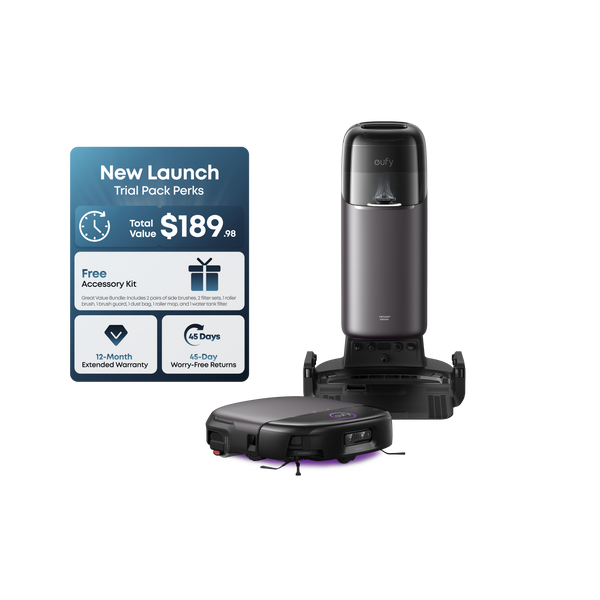
This is the strangest price relationship in our robot vacuum catalog. The iRobot Roomba Max 715 Vac costs USD 399.99; the Eufy Omni S2 Pro costs USD 1,699.99 — USD 1,300 more — and under Score v1.0 both land at exactly 3.4/10. They are also not the same kind of machine: the Roomba Max 715 is a vacuum-only model with no mopping system, while the Eufy is a flagship vacuum-mop combo with a roller mop and the highest published suction in the tracked category at 40,000 Pa. The verdict splits cleanly. If you want a vacuum-only robot with a bagged self-empty dock at a sane price, the Roomba is the buy and the brand premium question answers itself. If you want a flagship combo machine, the Eufy is a different product class — but its catalog score, dragged down by a 0.0 ownership-cost sub-score and a short 127-minute runtime, says the flagship money is better examined against other flagships before it is spent here.
The iRobot Roomba Max 715 Vac is iRobot's vacuum-only robot with LiDAR navigation, camera-AI obstacle avoidance and a bagged self-empty dock, priced at USD 399.99 in the snapshot checked on November 22, 2026. The Eufy Omni S2 Pro is eufy's flagship combo robot with LiDAR-3DToF navigation, structured-light obstacle avoidance and a roller mopping system, priced at USD 1,699.99 in the same snapshot.
The spec table
Spec (as published)
iRobot Roomba Max 715 Vac
Eufy Omni S2 Pro
Catalog price (checked Nov 22, 2026)
USD 399.99
USD 1,699.99
AI Buy Lab score (Score v1.0)
3.4/10
3.4/10
Spec strength sub-score
0.5
5.6
Ownership cost sub-score
7.9
0.0
Suction
Not published
40,000 Pa
Navigation
LiDAR
LiDAR-3DToF
Obstacle avoidance
Camera AI
Structured light
Mopping system
None
Roller
Self-empty dock
Bagged
Bagged
Runtime (maker-quoted)
120 min
127 min
Threshold climbing
Not published
36 mm
Weight
Not published
5.35 kg
App control
Yes
Yes
Multi-floor mapping
Yes
Yes
Subscription required
No
No
3-year total cost (catalog model)
USD 399.99
USD 1,699.99
Two different products wearing one category label
Start with the category trap. A buyer comparing these two by price alone assumes the Eufy does everything the Roomba does, better. In one respect that undersells the gap: the Roomba Max 715 does not mop at all — its published mopping system is "none" — while the Eufy mops with a self-washing-style roller. For homes with hard floors that need regular mopping, these are not substitutes. But the reverse trap matters more for the premium check: vacuum-only buyers are being asked, by the flagship market, to pay 4.25 times more for a machine whose extra hardware they may not need. Neither model has a verified public deal in our catalog as of November 26, 2026, so the USD 1,300 gap is the live one.
Suction and the spec-strength story
Eufy publishes 40,000 Pa of suction for the Omni S2 Pro — ranked #1 of 30 tracked robots in our catalog — and iRobot publishes no suction figure for the Roomba Max 715 in the listing we track, so that cell is honestly blank. The sub-scores reflect the imbalance: spec strength 5.6 for the Eufy against 0.5 for the Roomba, the widest spec gap in this comparison. Suction figures are maker-stated maxima rather than cross-tested measurements, but a missing figure versus a category-leading one is still information: iRobot is not competing on published suction here, and the Roomba's case rests on price, navigation and dock convenience instead. Both robots navigate by LiDAR (the Eufy adds 3DToF), both avoid obstacles with camera or structured-light systems, and both store multi-floor maps.
Runtime: the flagship's weak number
The number that undermines the Eufy's premium most is runtime. Its maker-quoted 127 minutes ranks #30 of 34 tracked robots in our catalog — near the bottom of the whole field — and barely exceeds the Roomba's 120 minutes, which itself ranks #31 of 34. In other words, USD 1,300 buys you seven extra published minutes. Large homes are where flagship runtime should shine, and on published data neither machine is a runtime leader; the Eufy's short figure is the main reason its strong spec sheet does not convert into a strong score. The Eufy does publish a 36 mm threshold-climbing figure and weighs 5.35 kg; iRobot publishes neither figure for the Roomba in our catalog, so those cells stay empty rather than estimated.
Scores: how both end up at 3.4
The identical 3.4/10 totals arrive by opposite routes, and the sub-scores tell the real story. The Roomba pairs a very low spec strength of 0.5 with a strong ownership-cost sub-score of 7.9 — the model rewards its USD 399.99 price and flat ownership cost. The Eufy pairs a solid 5.6 spec strength with an ownership-cost sub-score of 0.0, the floor of the scale, because at USD 1,699.99 it is priced at the very top of the category while its runtime ranks near the bottom. No aggregated owner rating is tracked for either model yet, so neither score benefits from review evidence. The full field, including flagships that score better at lower prices, is ranked in our best robot vacuums and browsable in the robot vacuums lab.
Which one should you buy?
Buy the Roomba Max 715 Vac if you want vacuum-only cleaning, a bagged self-empty dock, LiDAR navigation and app control at a mid-market price — and you handle mopping some other way. Buy the Eufy Omni S2 Pro only if you specifically want its combination of category-leading published suction and roller mopping in one flagship machine, and you accept that its published runtime and price pull its catalog score down to the same level as a robot costing USD 1,300 less. The premium check verdict: the Eufy's extra money buys a genuinely different, more capable hardware class — but on published evidence it does not buy a better-scored robot.
Why do both robots score 3.4/10 despite the huge price gap? Because the sub-scores cancel out. The Roomba scores low on spec strength (0.5) but high on ownership cost (7.9); the Eufy scores well on spec strength (5.6) but at the floor on ownership cost (0.0) due to its USD 1,699.99 price and short published runtime.
Does the Roomba Max 715 mop? No. Our catalog records its mopping system as "none" — it is a vacuum-only robot with a bagged self-empty dock. The Eufy Omni S2 Pro mops with a roller system, so the two are different product classes.
Which robot has more suction? The Eufy publishes 40,000 Pa, the highest figure among 30 tracked robots in our catalog. iRobot does not publish a suction figure for the Roomba Max 715 in the listing we track, so no numeric comparison is possible.
Which runs longer? Nearly a tie, and neither is strong: 127 published minutes for the Eufy against 120 for the Roomba. Both rank near the bottom of the 34 tracked robots for runtime, which is worth knowing if your home is large.
Do either of them require a subscription? No. The catalog records "subscription required: No" for both, and both include app control and multi-floor mapping. Ownership cost in our model stays at the purchase price for both over three years.
Last updated: November 26, 2026.
Changelog
November 27, 2026 — Added retailer buying links (Our pick and Where to buy) for the products covered in this article.
Related in this category
Smart Cleaning · Robot Vacuums · Updated Nov 22, 2026
As of 2026-11-22, we track 34 robot vacuums from 7 brands, scored with Score v1.0 from owner ratings, spec strength and ownership cost. Dreame D30 Ultra leads the list at 8.4/10. Tracked prices run from $120 to $1,700; the full table below is sortable by score and price.

Discussion
No comments yet